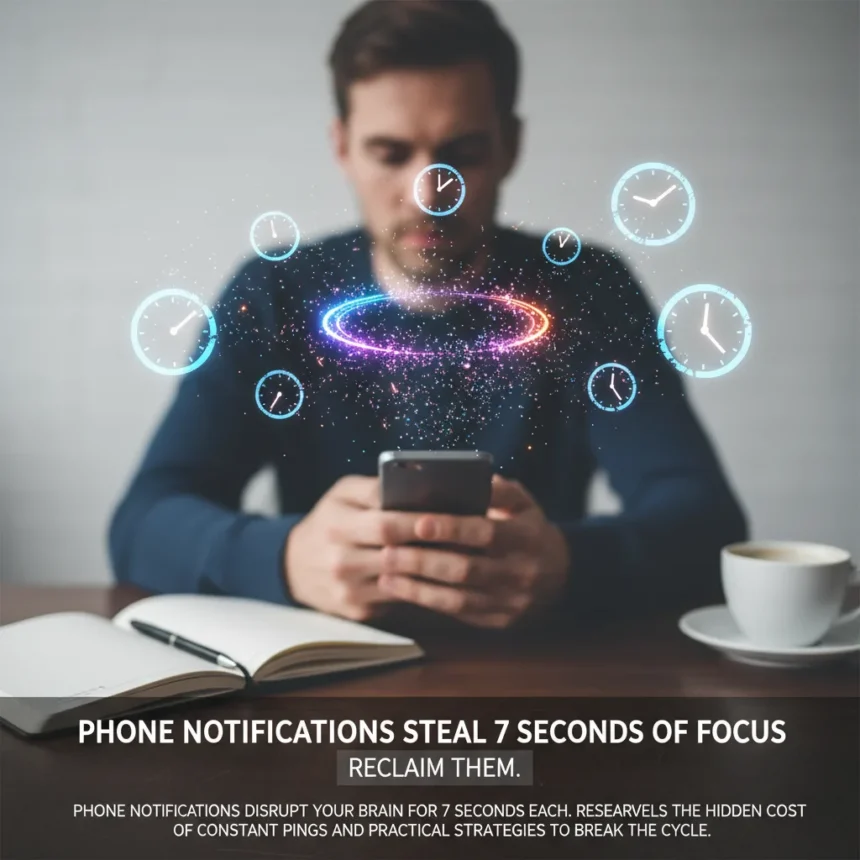
Phone notifications disrupt your cognitive processing for approximately seven seconds with every ping—a hidden tax on your attention that compounds throughout the day. That single notification does not simply interrupt you for the moment it arrives; it fragments your thinking for nearly a full second longer than the alert itself lasts. Multiply that across 150+ daily notifications, and you are losing hours of productive mental capacity without realizing it.
Key Takeaways
- A single notification disrupts cognitive processing for ~7 seconds, not just the moment it arrives
- Notification frequency predicts distraction better than total screen time
- Emotionally relevant alerts trigger measurable physiological arousal including pupil dilation
- Users receiving 150+ daily notifications experience cumulative cognitive costs
- Strategic notification management can restore focus without abandoning your phone
The Science of Phone Notifications Cognitive Cost
Research published in Computers in Human Behavior reveals that phone notifications cognitive cost extends far beyond the seconds you spend reading a message. When your phone pings, your brain does not simply glance and return to work. Instead, a single notification hijacks your attention for approximately seven seconds of disrupted processing, during which your ability to concentrate on your previous task plummets. This is not a matter of willpower or discipline—it is neurological.
The mechanism is visceral. Emotionally relevant notifications trigger measurable physiological arousal, including pupil dilation, which indicates heightened cognitive load. Your nervous system responds to that ping as a potential threat or opportunity, pulling your focus away from the task at hand. The interruption is not the notification itself; the interruption is your brain’s attempt to refocus after the distraction passes. That seven-second window represents the cost of context-switching—a cognitive tax that compounds every time your phone vibrates.
What makes this research particularly revealing is what it does not emphasize: total screen time is not the strongest predictor of distraction. Instead, notification frequency and phone-checking habits are the real culprits. You can spend an hour on your phone intentionally and recover focus quickly. But 150+ notifications scattered throughout your day create a constant state of fragmented attention, even if you never open most of them.


Why Notification Frequency Matters More Than You Think
The distinction between notification frequency and screen time is critical for understanding phone notifications cognitive cost. A person who checks their phone once per hour for 10 minutes experiences less cognitive disruption than someone who receives 15 notifications per hour but only glances at their screen for 30 seconds total. The interruptions themselves—not the duration—are what damage focus.
This reframes the entire conversation around digital wellness. You cannot simply reduce screen time and expect your attention to recover if you are still receiving constant notifications. A notification that you never open still costs you seven seconds of cognitive processing. The ping itself is the problem, not necessarily what you do with it afterward.


Consider the cumulative impact across a typical workday. If you receive 150 notifications daily, you are losing approximately 1,050 seconds—more than 17 minutes—of focused cognitive capacity. That is not counting the notifications you actively engage with, only the interruptions themselves. For knowledge workers, writers, programmers, and anyone whose job requires sustained concentration, that 17-minute loss is devastating to output quality and creative depth.
Reclaiming Your Attention From Phone Notifications
Breaking the cycle of phone notifications cognitive cost requires more than willpower. It demands intentional system design—treating your notifications like a scarce resource rather than an infinite stream. The goal is not to eliminate notifications entirely, but to eliminate the ones that do not genuinely require your immediate attention.
Start by auditing which apps are allowed to send notifications. Most users have never changed their notification settings from factory defaults, meaning dozens of apps are pinging them constantly with content that does not matter. Social media apps, news outlets, shopping platforms, and games are designed to send notifications that trigger engagement, not notifications that serve you. Disable notifications from any app that does not require your real-time attention for work or safety.
Next, disable visual and audio alerts for notifications that do not demand immediate response. Email from colleagues, Slack messages from your team, and messages from friends do not need to ping your screen. Instead, check these apps on your schedule, not on their schedule. This single change can reduce your notification count by 70-80% without missing anything important. Emergency contacts and critical alerts—actual phone calls, SMS from specific people, security warnings—can remain enabled.

Consider using Do Not Disturb or Focus Mode features to create distraction-free windows during your most cognitively demanding work. These tools allow you to silence notifications entirely during deep work sessions, then catch up on messages during designated checking times. This approach eliminates the seven-second cognitive cost entirely during the hours when your focus matters most.
Notification Management as a Productivity Tool
The paradox of modern phones is that they offer powerful tools for managing phone notifications cognitive cost, yet most users never access them. Your device likely has granular notification controls that let you silence specific apps, allow only priority contacts, or schedule quiet hours—features that directly address the research findings about notification frequency and attention.
Treating notification management as a productivity practice, not a personal failing, shifts your relationship with your phone entirely. You are not being antisocial by disabling notifications from a group chat; you are protecting your ability to do meaningful work. You are not being rude by checking email on your schedule rather than responding to every ping; you are being professional by maintaining focus on your current task.
The goal is to reach a state where your phone serves your attention rather than fragmenting it. This might mean receiving only 10-15 notifications per day instead of 150. Those remaining notifications are genuinely important, and you can respond to them without guilt. The seven-second cognitive cost becomes manageable when it happens a few times daily rather than dozens of times per hour.
Is the 7-second disruption from phone notifications really that significant?
Yes. While seven seconds sounds brief, the cumulative effect across 150+ daily notifications means you lose more than 17 minutes of focused cognitive capacity per day. Over a week, that is more than two hours of lost productivity. Over a month, that is more than eight hours. For creative work, writing, coding, or strategic thinking, that lost focus directly reduces output quality and innovation.
Can I still stay connected if I disable most notifications?
Absolutely. Disabling notifications does not mean ignoring messages. It means checking your apps on your schedule rather than responding to constant pings. You can check email every 30 minutes, Slack every hour, and social media once daily without missing anything important. The difference is that you are in control of when the interruption happens, not your apps.
What counts as an important notification worth keeping enabled?
Keep notifications enabled only for apps where real-time alerts serve a genuine need: calls from family, SMS from your bank, security alerts, or work messages from your immediate team if your job requires rapid response. Everything else—social media, news, shopping, entertainment—can wait until you choose to check it. This distinction alone can reduce your notification count by 80% while maintaining connectivity.
The research is clear: phone notifications cognitive cost is real and measurable, but it is not inevitable. By treating notifications as interruptions to be managed rather than alerts to be answered, you can reclaim hours of focused attention every week. Your phone is a tool—it should work for you, not against you.
Where to Buy
Apple iPhone 17 Pro | Apple iPhone 17 Pro Max | Samsung Galaxy S26 | Samsung Galaxy S26 Plus | Samsung Galaxy S26 Ultra
Edited by the All Things Geek team.
Source: TechRadar