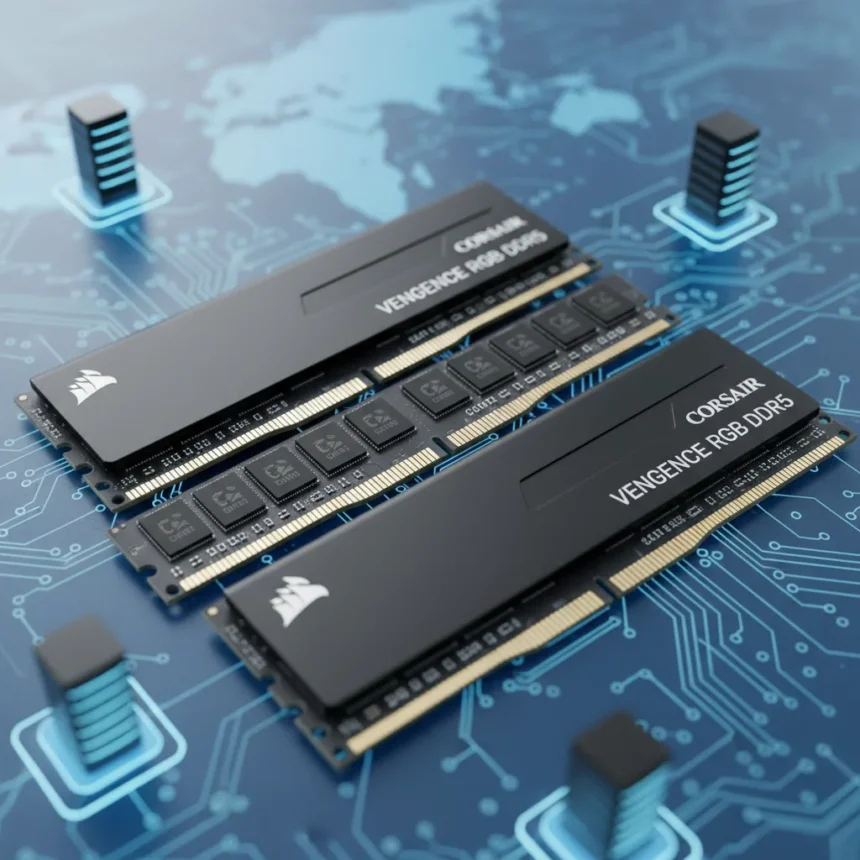
Chinese DDR5 chips are starting to appear inside mainstream consumer RAM modules, marking a potential turning point in the memory shortage that has gripped the PC market since AI demand exploded. A Corsair DDR5-6000 16GB memory stick was recently spotted using DRAM from ChangXin Technologies (CXMT), a Chinese memory manufacturer that has been working to close the gap with the three dominant DRAM makers. This sighting matters because it suggests Chinese memory is moving from niche industrial applications into the branded consumer products that everyday PC builders actually buy.
Key Takeaways
- CXMT DDR5 chips have been identified in a Corsair consumer memory module, marking mainstream adoption of Chinese DRAM.
- The spotted Corsair stick is a DDR5-6000 16GB module with CXMT DRAM, according to leaker @wxnod.
- CXMT can produce DDR5 at speeds up to 8000 MT/s with die capacities of 16Gb and 24Gb.
- AI-driven memory shortages have forced major PC makers to explore Chinese suppliers as alternative sources.
- Chinese firms are expected to double wafer output this year to meet domestic demand and offer cheaper alternatives.
Why Chinese DDR5 chips matter for the RAM shortage
The global memory market has been under severe strain because data centers and AI companies are hoarding commodity DRAM faster than factories can produce it. Corsair and other major brands have traditionally sourced from Samsung and SK Hynix, but those suppliers are now prioritizing high-margin AI and server contracts over consumer PC RAM. When those supply routes tighten, manufacturers look elsewhere. The appearance of Chinese DDR5 chips in a Corsair module signals that the supply crunch has become acute enough to justify integrating alternative sources into mainstream products.
CXMT has been developing DDR5 production capacity and is now offering speeds up to 8000 MT/s with DRAM dies in 16Gb and 24Gb capacities, positioning itself as a viable alternative to the established players. The fact that this memory is showing up in Corsair modules rather than under obscure no-name brands suggests Chinese DRAM has reached acceptable quality thresholds for consumer applications. A single Corsair sighting does not prove a flood of Chinese memory is imminent, but it does confirm that the market is willing to adopt it when supply pressure demands it.
The broader supply chain realignment underway
Chinese memory firms, including CXMT and YMTC, are increasing production capacity this year specifically to capture both domestic demand and export sales to overseas PC manufacturers seeking cheaper, similarly specced alternatives. The strategic implication is clear: as long as memory remains scarce and expensive, Western brands will continue integrating Chinese suppliers into their product lineups. This is not a temporary workaround—it reflects a permanent shift in how the PC memory market sources components.


The AI boom that triggered the current shortage is unlikely to reverse soon, which means memory will remain contested between consumer and enterprise buyers. Chinese manufacturers have the capital and government support to scale production faster than traditional suppliers can respond. If CXMT and other Chinese firms succeed in doubling their wafer output as expected, the combination of increased supply and brand acceptance could genuinely ease pricing pressure and availability for consumer PC builders within the next 12 to 18 months.
What this means for PC buyers right now
The immediate takeaway is that you may soon find Chinese-made DRAM inside products from trusted brands without any obvious labeling difference. Corsair modules will still carry the Corsair name and warranty, but the actual memory chips inside could be from CXMT rather than Samsung or SK Hynix. For most buyers, this is good news—it means more supply, potentially lower prices, and no actual performance penalty, since CXMT DDR5 operates at competitive speeds and capacities. The risk is minimal because established brands will not stake their reputation on substandard memory, and CXMT has already proven its DDR5 can meet consumer-grade performance standards.



The longer-term implication is that the RAM crisis may not last as long as pessimists predicted. If Chinese memory starts appearing regularly in Corsair, ADATA, Kingston, and other mainstream brands, the supply bottleneck will gradually ease. Prices may not collapse back to pre-shortage levels, but they should stabilize and decline as competition increases. For anyone waiting to build a PC or upgrade RAM, the next few months offer a window where supply is still tight but Chinese alternatives are starting to fill gaps. Buying sooner rather than later may still make sense, but the trajectory is finally pointing toward relief.
How does CXMT compare to Samsung and SK Hynix?
CXMT is a challenger trying to close the gap with the established three DRAM giants, not a replacement for them. The company has the capacity to produce DDR5 at respectable speeds and densities, but it is still catching up on process node maturity and manufacturing yield. CXMT’s advantage is cost and availability—it can undercut established suppliers on price and scale production faster because it faces fewer geopolitical export restrictions within China. For PC makers, CXMT is not a preferred choice, but it is an acceptable alternative when Samsung and SK Hynix cannot meet demand.
Will Chinese DDR5 chips become standard in consumer RAM?
Not standard, but increasingly common. The presence of CXMT in a Corsair module does not mean every Corsair stick will use Chinese DRAM. More likely, Corsair and competitors will mix sources based on availability and cost—using Samsung or SK Hynix when supply is available and switching to CXMT when it is not. Over time, as Chinese firms improve quality and scale production, their market share in consumer RAM will grow. Within two to three years, it would not be surprising to see Chinese DRAM representing 15 to 25 percent of consumer DDR5 sales, particularly in budget and mid-range modules.
Could this actually end the RAM shortage?
It could accelerate the end, but it will not immediately resolve it. The shortage exists because demand from AI and data centers is outpacing total global DRAM supply. Chinese firms adding capacity helps, but they are still ramping production from zero. The more meaningful relief will come when CXMT and YMTC reach full capacity production and when the AI boom eventually moderates. If Chinese manufacturers succeed in doubling wafer output as planned, combined with continued investment from Samsung and SK Hynix, total market supply should begin catching up to demand by late 2025 or 2026. That timeline assumes no new supply shocks and sustained Chinese manufacturing expansion.



The real story here is not that one Corsair module solves the shortage—it is that the market is already adapting to scarcity by embracing alternatives. Chinese DDR5 chips in Corsair modules prove the supply crisis is severe enough to force major brands to reconsider their sourcing strategies. That adaptation, multiplied across dozens of brands and thousands of products, is what will eventually ease the RAM crisis. The shortage will not end because Chinese DRAM suddenly floods the market, but because persistent supply pressure finally forces the entire industry to diversify away from the traditional three suppliers. CXMT’s appearance in Corsair is the visible sign that diversification is already underway.
Edited by the All Things Geek team.
Source: TechRadar