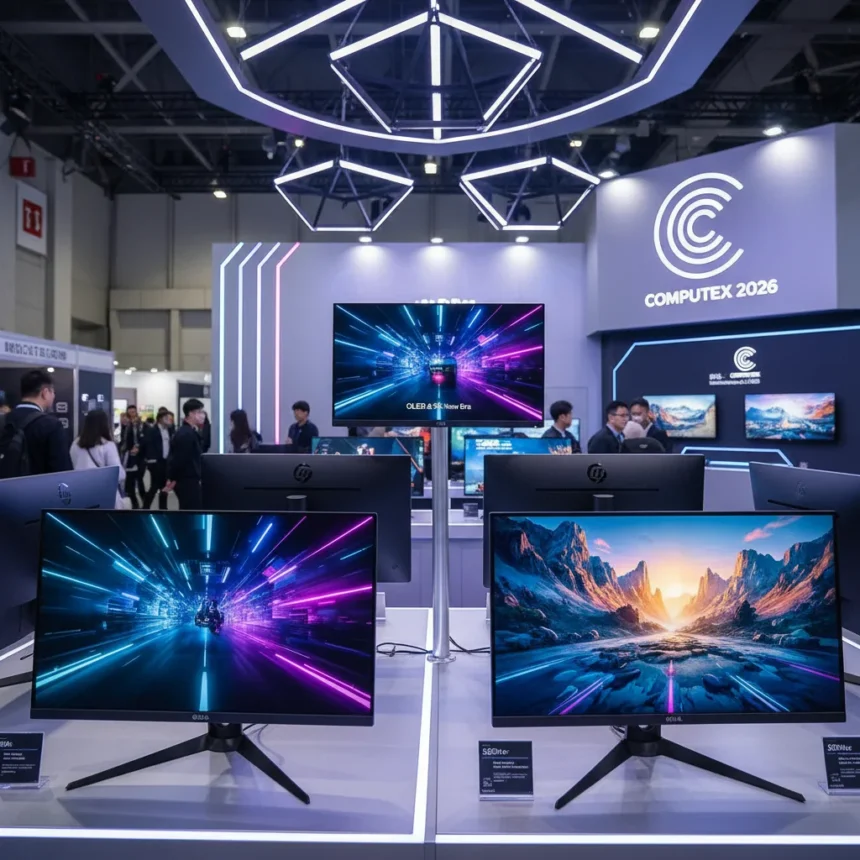
Computex 2026 monitors represent a fundamental shift in how manufacturers approach display technology, moving beyond incremental refresh-rate bumps toward genuinely transformative panel architectures. The event’s standout displays emphasize multi-mode OLED and Mini LED backlighting, pushing 5K resolution into mainstream conversation while competitive gaming monitors are hitting near-700Hz refresh rates at 1080p. This is not just evolution—it is a reset of what gamers and professionals should expect from their screens.
Key Takeaways
- OLED and Mini LED dominate Computex 2026’s monitor showcase, replacing traditional LCD dominance
- 5K resolution is moving from niche to mainstream, especially in premium gaming and creative displays
- Competitive gaming monitors now exceed 540Hz, with some reaching near-700Hz at 1080p
- 4K gaming monitors are pushing beyond 240Hz, redefining high-refresh gaming at higher resolutions
- Asus’s tandem OLED technology delivers 15% higher brightness and 60% longer lifespan than conventional OLED
Why Computex 2026 monitors matter right now
Computex 2026 monitors are reshaping the market at a critical moment. For years, gaming displays have traded resolution for refresh rate, forcing players to choose between visual fidelity and responsiveness. This year’s announcements suggest that compromise is ending. The emphasis on OLED and Mini LED means manufacturers are finally solving the brightness and lifespan concerns that held these technologies back. That matters because professional creators, esports competitors, and casual gamers have spent the last decade settling for displays that excelled in one dimension but stumbled in another.
The shift toward 5K is equally significant. Computex 2026 monitors pushing 5K into mainstream availability signals that 4K, which dominated for nearly a decade, is now considered baseline for premium displays. This mirrors the jump from 1080p to 1440p to 4K—each transition felt radical until the next one arrived. For content creators, photographers, and anyone working with high-resolution assets, 5K monitors eliminate the need for multi-display setups or expensive specialized panels.
Computex 2026 monitors and the OLED revolution
OLED technology at Computex 2026 monitors is no longer experimental. The Asus ROG Strix OLED XG259QWPG Ace exemplifies how far the technology has progressed. This 24.5-inch 1080p OLED display hits 540Hz refresh rate with 0.02ms response time, G-Sync support, 10-bit color depth, and 99.5% DCI-P3 color coverage. More importantly, it uses Asus’s tandem OLED panel architecture, delivering 15% higher brightness and 60% longer lifespan compared to conventional OLED screens. That addresses the two biggest complaints about OLED gaming monitors: they were too dim for bright rooms and burned out too quickly.


The tandem OLED approach is the kind of engineering breakthrough that justifies Computex’s reputation as a tech inflection point. By stacking two OLED layers, manufacturers achieve brightness levels that rival Mini LED while retaining OLED’s superior contrast and response times. For competitive esports players, the 0.02ms response time and 540Hz refresh rate eliminate any perceptual lag—the monitor is no longer the bottleneck in the player-to-screen feedback loop. For casual gamers, the color accuracy and contrast make single-player games feel more immersive than anything LCD can deliver.
4K gaming and 5K displays reshape performance expectations
Computex 2026 monitors demonstrate that 4K gaming is no longer confined to 144Hz or 165Hz. High-end 4K panels are now moving beyond 240Hz, a threshold that seemed impossible just two years ago. This matters because 1440p 240Hz displays became the esports standard, but many gamers wanted 4K visuals without sacrificing responsiveness. Computex 2026 monitors finally bridge that gap.



The 5K push is equally transformative. While 4K (3840 × 2160) has dominated for years, 5K (5120 × 2880) offers 33% more pixels without the scaling headaches of ultrawide displays. For video editors, graphic designers, and photographers, this extra screen real estate is game-changing. Computex 2026 monitors bringing 5K into mainstream availability means these displays will eventually become affordable enough for professional and enthusiast markets, not just high-end studios.
Competitive gaming monitors reach extreme refresh rates
The competitive gaming segment at Computex 2026 monitors is pushing into territory that seemed absurd just years ago. Some displays are approaching 700Hz at 1080p, with the Asus ROG Strix OLED XG259QWPG Ace hitting 540Hz as a more practical sweet spot. At this point, the question is not whether monitors can deliver extreme refresh rates—they can. The question is whether human reflexes can meaningfully benefit from 540Hz versus 360Hz versus 240Hz.
What matters more is response time and input lag. The Asus monitor’s 0.02ms response time is where the real advantage lives. Below 1ms, the difference becomes imperceptible to most players, but professional esports athletes operate at a different level. For them, shaving milliseconds off the feedback loop can mean the difference between a winning flick shot and a missed opportunity. Computex 2026 monitors reflect this obsession with eliminating every possible source of lag.
Mini LED and the middle ground
While OLED dominates the conversation at Computex 2026, Mini LED technology deserves equal attention. Mini LED backlighting offers a middle ground between traditional LCD and OLED: better contrast and local dimming than standard LCD, but with the brightness and longevity advantages of LED. For gamers and professionals who want premium image quality without the premium OLED price tag, Mini LED Computex 2026 monitors represent the practical choice. The technology is mature enough that manufacturers can deliver thousands of dimming zones, approaching OLED’s per-pixel control.



How Computex 2026 monitors compare to previous generations
To understand the leap Computex 2026 monitors represent, consider the Acer Nitro PG271K from Computex 2025. That 27-inch 4K display delivered 72Hz at 4K and 144Hz at 1080p—a respectable gaming monitor for its time. Now, in 2026, the expectation is that 4K panels should exceed 240Hz. That is not a marginal improvement; it is a fundamental rethinking of what is possible. The shift from LCD to OLED and Mini LED, combined with higher refresh rates and 5K resolution, means Computex 2025 monitors are already feeling dated.
What this means for your next display purchase
If you are shopping for a monitor in the coming months, Computex 2026 monitors set the benchmark for what to expect. OLED gaming displays are no longer a luxury—they are becoming the standard. If a manufacturer is still pushing LCD gaming monitors as premium products, they are falling behind. The same applies to refresh rates: 144Hz is now entry-level for gaming, 240Hz is mainstream, and 360Hz+ is where serious competitors play. For 4K gaming, expect 144Hz as a baseline and 240Hz as the new sweet spot. For 5K, watch for announcements about pricing and availability in the coming quarters.
Are Computex 2026 monitors worth waiting for?
If you are shopping now, it depends on your use case. Competitive esports players should wait for OLED 1080p displays like the Asus ROG Strix OLED XG259QWPG Ace to reach the market. The combination of 540Hz, 0.02ms response time, and superior color accuracy is a generational leap. For 4K gamers, waiting for Computex 2026 monitors to ship makes sense if your current display is older than two years. For creative professionals, 5K availability is the key milestone to watch.
Will Mini LED monitors compete with OLED at Computex 2026?
Yes. Mini LED offers better value than OLED for many buyers, with superior brightness, longer lifespan, and lower cost. Computex 2026 monitors using Mini LED backlighting will appeal to gamers who want premium image quality without the OLED price premium. The choice between OLED and Mini LED will depend on whether you prioritize contrast and response time (OLED) or brightness and affordability (Mini LED).
Computex 2026 monitors represent the moment when display technology finally caught up with GPU performance. For years, graphics cards have been powerful enough to drive high refresh rates and high resolutions simultaneously, but monitors could not keep pace. Now they can. The next question is not whether these technologies work—it is how quickly they become affordable.
Edited by the All Things Geek team.
Source: TechRadar