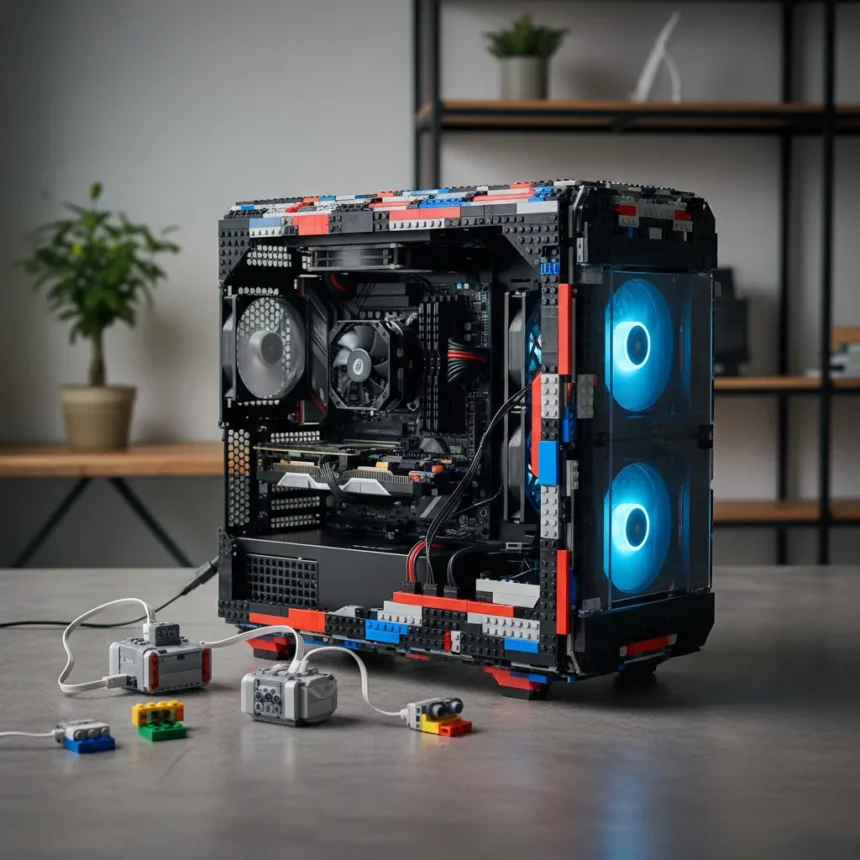
A custom Lego PC has emerged as the internet’s latest obsession, proving that home-built ingenuity beats corporate product launches. TechRadar highlighted the breathtaking gaming PC housed in an entirely custom Lego chassis, positioning it as far cooler than Lego’s newly launched Smart Bricks system.
Key Takeaways
- A Reddit user built a full gaming PC inside a custom Lego chassis, showcasing DIY creativity.
- The custom Lego PC contrasts sharply with Lego Smart Bricks, which are motion-sensing building elements.
- Lego Smart Bricks require Smart Tags and Minifigures to function, limiting standalone appeal.
- The home-built Lego PC demonstrates that unconventional PC chassis designs can rival commercial products.
- DIY Lego computing projects highlight growing interest in custom PC aesthetics and form factors.
What Makes This Custom Lego PC Stand Out
The custom Lego PC represents a radical departure from traditional gaming chassis design. Instead of aluminum towers or tempered glass cases, the builder opted for Lego bricks to create an entirely functional computer housing. This approach transforms a standard gaming rig into a conversation piece that merges childhood nostalgia with latest hardware. The build demonstrates that Lego’s modular brick system can accommodate real PC components while maintaining structural integrity and visual appeal.
What elevates this project beyond mere novelty is the engineering required to house active components—power supplies, graphics cards, cooling systems—within a Lego chassis. The builder achieved something that commercial Lego products have not: a fully functional, adult-oriented computing device that doubles as interactive art. The result has captured attention precisely because it feels impossible until you see it completed.
Custom Lego PC vs. Lego Smart Bricks: The Real Comparison
Lego Smart Bricks are fundamentally different devices designed for younger audiences and casual builders. A Smart Brick is a 2×4 Lego brick embedded with a silicon chip, motion sensor, gyroscope, pressure-sensing microphone, speakers, LEDs, and light sensor. However, these bricks require additional components to function: Smart Tags (RFID tiles that trigger preprogrammed behaviors like sounds or light effects) and Smart Minifigures to unlock interactive features. A single Smart Brick provides roughly 40 minutes of playtime when shaken, making it dependent on external accessories and limited battery life.


The custom Lego PC, by contrast, is a standalone computing device capable of running games, applications, and any software a traditional PC executes. Where Smart Bricks offer interactive play through motion sensors and sound effects, the custom Lego PC delivers genuine processing power. One is a toy designed for guided, sensor-driven interaction; the other is a full computer wrapped in Lego aesthetics. The comparison itself reveals why the home-built project has garnered more attention—it solves an actual computing problem while Smart Bricks address recreational play.
Why DIY Lego Builds Matter in PC Culture
The custom Lego PC taps into a growing trend of PC enthusiasts prioritizing aesthetics and personal expression alongside raw performance. Custom PC building has evolved from a niche hobby into mainstream culture, with builders investing heavily in RGB lighting, tempered glass panels, and exotic cooling solutions. A Lego chassis represents the next frontier: combining childhood brand loyalty with adult-level engineering.



This project also challenges the assumption that premium PC cases require premium materials. Lego bricks offer modularity, repairability, and infinite customization—qualities that traditional aluminum or plastic cases cannot match. If a panel cracks, you swap individual bricks. If you want to reconfigure airflow or cable management, the modular design allows rapid iteration. For builders who value flexibility and uniqueness, a custom Lego PC offers advantages that off-the-shelf chassis simply cannot provide.
The broader implication is that Lego’s brand perception is shifting. Rather than positioning Lego exclusively as children’s entertainment, projects like this custom PC demonstrate the material’s potential for adult hobbyists and creators. Lego Smart Bricks attempt to modernize the brand through electronics; the custom Lego PC achieves the same goal through engineering ingenuity.
What About Lego Smart Bricks Going Forward?
Lego Smart Bricks represent the company’s push into connected play, adding digital interactivity to physical building. The All-in-One sets bundle Smart Bricks with Smart Tags, Smart Minifigures, and chargers to create dynamic, responsive builds. However, the system has faced criticism for its complexity, cost structure, and limited appeal beyond young children. Smart Bricks shine in guided, narrative-driven play—a duck that quacks when touched, a helicopter that spins when activated—but they do not offer the open-ended computing potential of a custom Lego PC.
The contrast highlights a fundamental difference in philosophy. Lego Smart Bricks are designed to be plug-and-play interactive toys with predetermined behaviors. A custom Lego PC is a canvas for unlimited computing applications. One is entertainment; the other is infrastructure. For adult hobbyists and creators, the custom Lego PC’s flexibility and real-world utility far outweigh Smart Bricks’ novelty factor.



Can You Build Your Own Custom Lego PC?
While the specific Reddit build has not been replicated at scale, the concept is theoretically reproducible for anyone with PC building knowledge and access to Lego bricks. The primary challenge is thermal management—Lego is plastic, not metal, so cooling airflow and heat dissipation require careful planning. Builders would need to design intake and exhaust vents, possibly incorporating custom fans or liquid cooling solutions. Cable management inside a Lego chassis also demands precision to avoid shorts or component damage.
The project requires hybrid engineering: standard PC components mounted inside a Lego frame using custom adapters, standoffs, and brackets. For experienced builders, this is achievable; for beginners, the learning curve is steep. The custom Lego PC remains impressive precisely because it is not a mass-market product—it is one person’s solution to a problem nobody else thought to solve.
Is a custom Lego PC practical for daily use?
Practicality depends on execution. If the builder properly managed thermals, cable routing, and component mounting, a custom Lego PC can function as a daily driver. However, Lego’s plastic construction means less durability than traditional metal chassis, potentially affecting longevity under sustained heat and vibration. Repairability would be excellent—swapping components is easier in a modular Lego frame—but long-term reliability remains unproven for this specific build.
How does a custom Lego PC compare to a standard gaming PC case?
A standard gaming case offers superior thermal performance, durability, and cable management out of the box. A custom Lego PC trades these advantages for uniqueness, modularity, and visual impact. Functionally, both house identical components; aesthetically and philosophically, they serve different audiences. One is optimized for performance; the other prioritizes creative expression.
The custom Lego PC represents a broader shift in PC culture toward valuing personality and ingenuity alongside specifications. In a market saturated with black aluminum towers and RGB-laden tempered glass cases, a fully functional gaming rig built from Lego bricks stands out precisely because it seems impossible. That combination of technical achievement and creative audacity is why this project has captured attention in ways that Lego Smart Bricks, despite their technological sophistication, simply cannot match. For PC enthusiasts seeking to push boundaries, the custom Lego PC proves that the best innovations often come from asking unconventional questions.
Edited by the All Things Geek team.
Source: TechRadar