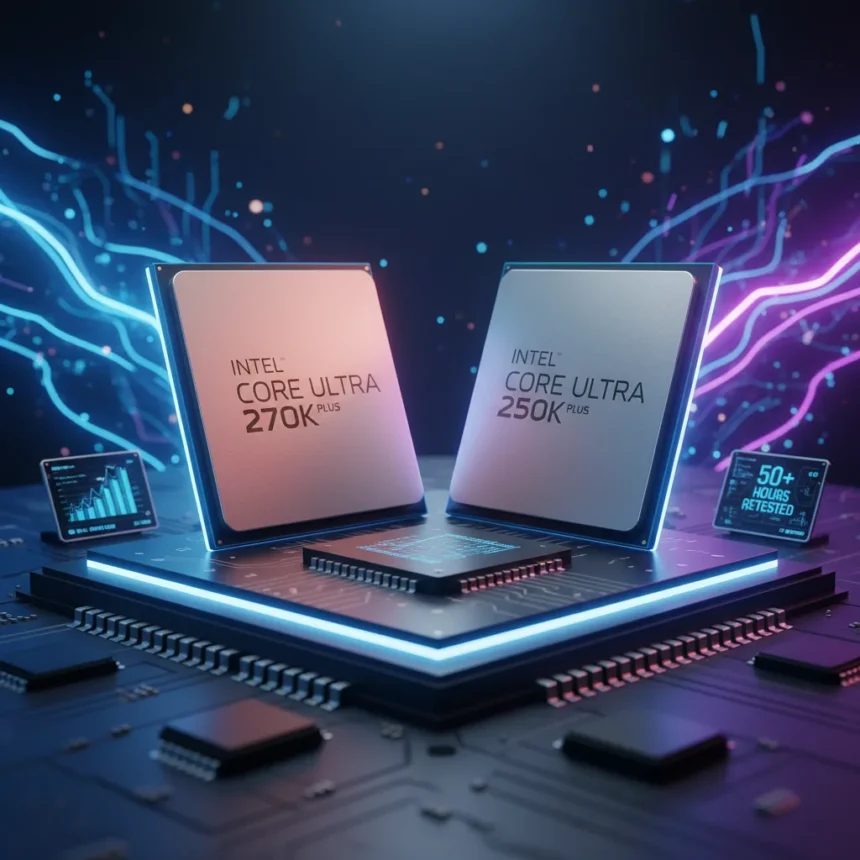
The Intel Core Ultra 270K Plus is a refreshed Arrow Lake processor from Intel, priced at $200 less than the Core Ultra 7 265K, and it has landed on Tom’s Hardware’s Best CPU for Gaming in 2026 list after results so strong they triggered over 50 hours of retesting before publication. That’s not a marketing line — it’s a genuine editorial admission that the numbers were difficult to believe on first pass.
Key Takeaways
- The Intel Core Ultra 270K Plus costs $100 less than the Core Ultra 7 265K while adding four E-cores and a 900 MHz higher die-to-die clock speed.
- The Core Ultra 5 250K Plus delivers 95% of the 270K Plus’s gaming performance at $200, compared to $300 for the 270K Plus.
- Both CPUs earned spots on Tom’s Hardware’s Best CPU for Gaming in 2026 list.
- K-series chips like these are fully unlocked for overclocking, unlike non-K Intel processors.
- The Arrow Lake platform is approaching end of lifecycle, making now a pivotal moment to buy in — or walk away.
Why Intel Core Ultra 270K Plus Results Were Hard to Believe
Tom’s Hardware spent more than 50 hours retesting the Core Ultra 270K Plus and Core Ultra 5 250K Plus because the initial gaming and productivity numbers came back unexpectedly strong. That kind of editorial caution is rare — and telling. The team also noted that idle power drops below base clocks, and that other reviews did not show significantly higher power draw, which helped validate the results.
The retesting was conducted partly with Nvidia RTX 5090 hardware, though some benchmarks still use historical RTX 4090 data pending full updates. That’s a caveat worth knowing if you’re comparing these results to other publications running different test rigs. The underlying performance story, however, held up across the extended testing window.
How the 270K Plus Stacks Up Against Its Own Siblings
The Intel Core Ultra 270K Plus undercuts the Core Ultra 7 265K by $100 while packing four additional E-cores and a 900 MHz higher die-to-die clock speed. That’s a meaningful architectural upgrade for less money — the kind of value shift that doesn’t happen often within a single product family mid-cycle. Meanwhile, the Core Ultra 7 265K itself already punches above its weight: it delivers 98% of the Core Ultra 9 285K’s gaming performance at $200 less.


What does that chain of comparisons tell you? Intel’s own lineup is cannibalizing itself in the best possible way for buyers. The flagship tax has rarely looked this unjustifiable within a single generation.
Core Ultra 5 250K Plus: The Smarter Buy for Most Gamers
The Core Ultra 5 250K Plus is priced at $200 and delivers 95% of the Core Ultra 7 270K Plus’s gaming performance. For the overwhelming majority of gaming workloads, that 5% gap is invisible in practice. Paying $100 more for a marginal frame-rate difference that won’t show up in real sessions is hard to justify — and Tom’s Hardware’s own buying guides reflect that, listing the 250K Plus as a top pick for the $200 price bracket.



Both chips are K-series, meaning they’re fully unlocked for overclocking. That matters because it gives buyers headroom to push performance further without paying for a higher-tier chip — a meaningful advantage over locked non-K processors that offer no such flexibility.
The Intel Stability Problem Hasn’t Gone Away
Before you commit to an Intel platform, one uncomfortable fact deserves airtime. An Unreal Engine supervisor publicly reported a 50% failure rate with Intel chips in professional workloads, and their studio switched to AMD Ryzen 9 9950X as a result. That’s not a benchmark — it’s a production environment verdict, and it carries weight for anyone doing serious creative or development work alongside gaming.
For pure gaming, the 270K Plus and 250K Plus look compelling. For mixed workloads that include Unreal Engine or similarly demanding software, the AMD Ryzen 9 9950X has earned a credibility advantage that Intel hasn’t fully answered yet.
Is Now the Right Time to Buy an Arrow Lake CPU?
The Arrow Lake platform is heading toward end of lifecycle. That’s both a warning and an opportunity. Prices on these chips are competitive precisely because Intel is moving on — but buyers should know that platform longevity is limited. If you want multiple upgrade cycles on the same motherboard, Arrow Lake is not the long-term bet.



If you need a CPU now and want strong gaming performance at a fair price, the Core Ultra 5 250K Plus at $200 is the most rational choice in Intel’s current lineup. The Core Ultra 7 270K Plus makes sense if productivity workloads matter as much as gaming — the extra E-cores and higher die-to-die clock speed earn their keep in threaded tasks.
Is the Intel Core Ultra 270K Plus worth buying in 2026?
Yes, for gaming and productivity combined, the Intel Core Ultra 270K Plus is one of the strongest value propositions Intel has offered in recent memory. It costs less than the Core Ultra 7 265K, outpaces it in core count, and landed on Tom’s Hardware’s Best CPU for Gaming list for 2026. The caveat is platform longevity — Arrow Lake is nearing end of life, so future upgrade paths on the same socket are limited.
What is the difference between the 270K Plus and 250K Plus?
The Core Ultra 7 270K Plus costs $300 and the Core Ultra 5 250K Plus costs $200, with the 250K Plus delivering 95% of the 270K Plus’s gaming performance. For most gamers, the 250K Plus is the smarter buy. The 270K Plus pulls ahead in productivity workloads where its additional E-cores and higher die-to-die clock speed make a more tangible difference.
How do these Intel chips compare to AMD options?
For gaming, the 270K Plus and 250K Plus are competitive. For professional and creative workloads — particularly Unreal Engine — AMD’s Ryzen 9 9950X has earned a stronger reputation for stability, with at least one major studio reporting a 50% Intel failure rate before switching to AMD. Intel’s value argument is real; its reliability reputation in demanding professional environments still needs work.
The 270K Plus and 250K Plus are the most compelling Arrow Lake chips Intel has shipped — and the 50-plus hours of retesting they demanded before anyone would publish the results says more about how surprising that is than any spec sheet could. At these prices, with these performance levels, they’re worth serious consideration. Just go in with eyes open about where the platform is headed and what AMD is doing in the professional space.
Edited by the All Things Geek team.
Source: Tom's Hardware