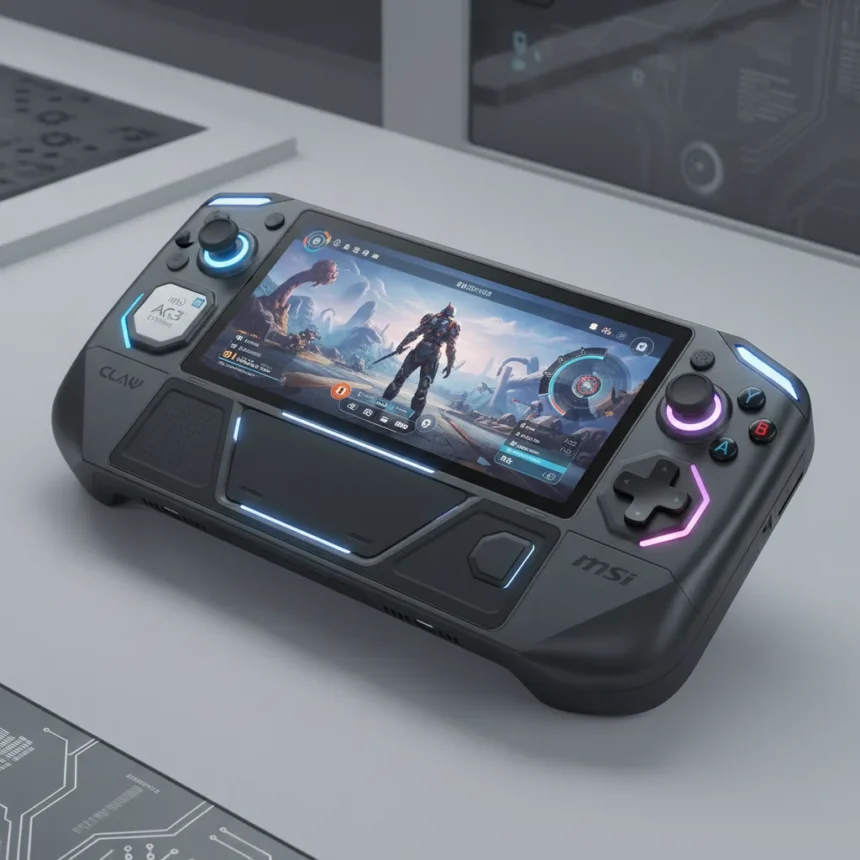
The Intel Arc G3 Extreme handheld gaming market just got its first major contender. MSI unveiled the Claw 8 EX AI+ at Computex 2026 in Taipei on June 1, positioning it as a complete rethink of what premium portable Windows gaming should be. The device pairs Intel’s new Arc G3 Extreme processor with an 8-inch 120Hz display, Hall-effect controls, and ergonomic grips designed to address everything that frustrated players about the original Claw. With availability starting June 23, 2026, and a target price around $1,500, this is MSI’s answer to skeptics who dismissed the first generation as underbaked.
Key Takeaways
- Intel Arc G3 Extreme handheld debuts in MSI Claw 8 EX AI+ at Computex 2026 with 8-inch 120Hz display
- Redesigned ergonomic grips, Hall-effect triggers, and linear motor haptics address comfort and control issues
- Arc G3 Extreme supports XeSS 3 and Multi-Frame Generation for higher frame rates and power efficiency
- Available June 23, 2026, targeting around $1,500 price point
- Competes against Acer Predator Atlas 8 and other premium handheld gaming PCs
Intel Arc G3 Extreme Handheld Arrives With Real Upgrades
The Intel Arc G3 Extreme handheld platform is Intel’s first graphics architecture explicitly designed for portable gaming, not a repurposed laptop chip squeezed into a smaller form factor. The Arc G3 Extreme variant includes 12 Xe3 cores and focuses on graphics improvement, power efficiency, and high-frame-rate gaming with smoother responsiveness. This matters because the original Claw relied on a processor that felt compromised—decent performance but poor thermals and battery life that made long gaming sessions painful. The Claw 8 EX AI+ changes that equation by building around a platform that understands what handheld players actually need: consistent frame rates, low latency, and batteries that last beyond two hours.
MSI’s engineering team clearly learned from the first Claw’s missteps. The new device features improved airflow, a comfier ergonomic design, Hall-effect triggers and sticks that resist stick drift, a responsive D-pad, and a new linear motor for haptic feedback. These are not flashy specs—they are the fundamentals that separate a handheld worth buying from one that collects dust. The 8-inch LCD touchscreen with 1,920 x 1,200 resolution and 120Hz refresh rate gives you real screen real estate without the bulk that made early handhelds feel cramped. For a device targeting $1,500, these are reasonable expectations, not luxuries.
How Intel Arc G3 Extreme Stacks Against the Handheld Competition
The handheld gaming PC market has matured. Buyers no longer tolerate novelty—they expect AAA performance, fast resume behavior, good thermals, and a console-like experience. The Asus ROG Ally X and Lenovo Legion Go S set a high bar for performance and comfort, and the Acer Predator Atlas 8 is also built around Intel’s Arc G3 family, making it a direct rival. What separates the Claw 8 EX AI+ is that MSI is not pretending to be something it is not. It is a Windows handheld, not a Nintendo Switch competitor. That means it runs full games, supports XeSS 3 upscaling, and enables Multi-Frame Generation—technologies that Nvidia’s DLSS and AMD’s FSR have made familiar to PC gamers. If you want latest graphics upscaling and frame generation on a handheld, Intel is finally offering a credible alternative.


The real question is whether Arc G3 Extreme delivers on efficiency. Handheld players care more about battery life than raw frame rates. A device that hits 60 fps for four hours is more useful than one that hits 120 fps for 90 minutes. The brief hands-on impressions suggest MSI has prioritized thermals and airflow, which is a good sign, but full reviews will need to test this claim under sustained gaming loads.
Price and Availability: Premium Positioning in a Crowded Market
MSI is targeting around $1,500 for the Claw 8 EX AI+, placing it at the premium end of the handheld spectrum. The device becomes available June 23, 2026, giving MSI a head start before other Arc G3 Extreme handhelds flood the market. At that price, it is not a casual purchase—it is a statement that you are serious about portable AAA gaming and willing to pay for a device built around a processor designed specifically for that use case. For players currently juggling a ROG Ally X or Legion Go, the question is whether the Arc G3 Extreme’s efficiency gains and new ergonomics justify the upgrade cost. For newcomers, it is a much more compelling entry point than the original Claw ever was.



What Makes This Launch Newsworthy Right Now
The timing matters. Computex 2026 is where Intel is finally making its pitch for handheld gaming—not as an afterthought, but as a core market. The Arc G3 Extreme platform represents a genuine pivot from the company, and the Claw 8 EX AI+ is the first device to showcase it at scale. This is not a refresh or a minor spec bump. It is MSI betting that the handheld market is ready for a premium Windows device that does not cut corners on comfort, thermals, or display quality. Whether that bet pays off depends on whether Arc G3 Extreme actually delivers the efficiency gains Intel is promising and whether $1,500 feels reasonable to players who have already invested in competing hardware.
Is the Intel Arc G3 Extreme handheld worth the premium price?
That depends on your priorities. If you value battery life, low thermals, and a large screen for a portable device, the Claw 8 EX AI+ is worth considering. If you already own a recent handheld and play less demanding titles, the upgrade cost is hard to justify without seeing real-world performance data. Wait for full reviews testing sustained gaming, battery endurance, and actual frame rates in demanding AAA titles.
When will other Intel Arc G3 Extreme handhelds launch?
The Acer Predator Atlas 8 is also coming with Arc G3 hardware, but no official launch date has been announced yet. Other manufacturers will likely follow as the Arc G3 platform matures. The Claw 8 EX AI+ arriving June 23, 2026, gives MSI an early window to establish itself as the premium option.
How does the 8-inch display compare to smaller handheld screens?
The 8-inch 120Hz IPS panel is noticeably larger than the 7-inch screens on most competitors, giving you more visual real estate without significantly increasing device thickness. The 1,920 x 1,200 resolution keeps text sharp and games looking crisp at that size. For players who spend hours gaming on a handheld, the larger screen reduces eye strain and makes smaller UI elements more readable.



The Claw 8 EX AI+ signals that MSI learned from its mistakes and Intel is serious about handheld gaming. Whether it actually delivers on that promise depends on real-world testing. But on paper, this is the most thoughtfully designed premium Windows handheld we have seen, and the Arc G3 Extreme platform finally gives Intel a credible story to tell in a market it has largely ignored.
Edited by the All Things Geek team.
Source: Tom's Hardware