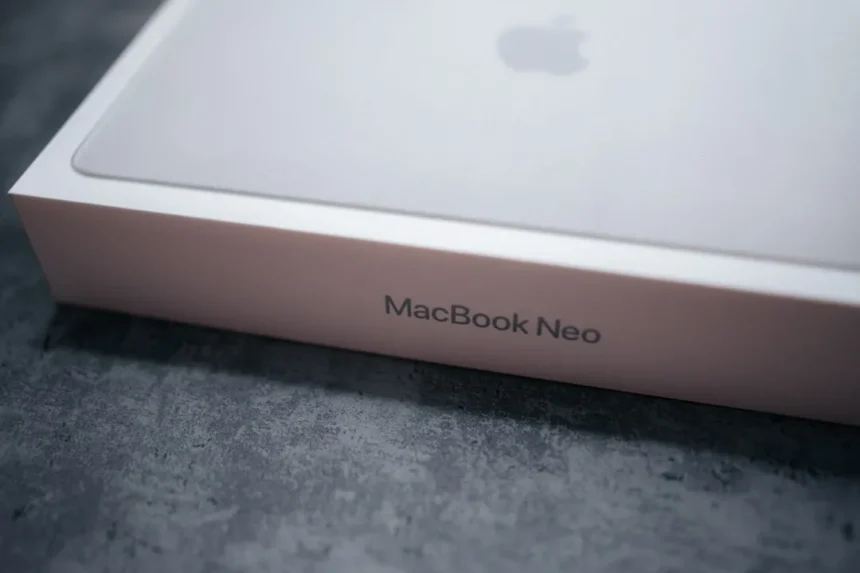
MacBook Neo is Apple’s new entry-level laptop, starting at $599 with 256GB storage and an A18 Pro chip, challenging Microsoft’s pricing strategy in the 13-inch ultrabook market. For years, the Surface Laptop 13-inch has owned the premium-budget segment—expensive enough to feel serious, cheap enough to justify the purchase. MacBook Neo just broke that equation.
Key Takeaways
- MacBook Neo starts at $599 with A18 Pro chip and 256GB storage, undercutting Surface Laptop 13
- Features 13-inch Liquid Retina display and up to 16 hours of battery life
- Available in four color options, offering aesthetic choice at budget price point
- A18 Pro architecture delivers performance traditionally reserved for much pricier machines
- Direct comparison exposes Surface Laptop 13 as overpriced for the specs and battery life offered
MacBook Neo: The $599 baseline that changes everything
The MacBook Neo arrives with specifications that would have cost $900 just two years ago. A18 Pro processing, 256GB SSD storage, and a 13-inch Liquid Retina display form a foundation that handles everyday computing—email, browsing, document editing, video calls—without compromise. The battery life claim of up to 16 hours matters: that is a full workday plus buffer, which means fewer chargers in your bag and fewer moments scrambling for a power outlet in coffee shops or during travel.
Apple’s color options—four choices at the entry price—signal a design philosophy that even budget products deserve aesthetic consideration. This matters more than spec sheets suggest. A laptop you like looking at gets used more, carried more confidently, and feels less like a compromise purchase. Microsoft’s Surface Laptop 13 exists in a narrower visual palette, which is fine, but it is also a reminder that Apple treats budget as a price point, not a design concession.
Why Surface Laptop 13 suddenly looks expensive
Microsoft’s Surface Laptop 13 has long occupied an awkward middle ground: too pricey for students and casual users, yet lacking the raw performance of higher-tier machines. MacBook Neo collapses that middle. At $599, MacBook Neo undercuts Surface Laptop 13 by a significant margin while matching or exceeding its everyday performance profile. The A18 Pro chip is not a mobile processor squeezed into a laptop—it is a desktop-class architecture designed from the ground up for sustained workloads, thermal efficiency, and battery longevity.


Surface Laptop 13 relies on Intel or Qualcomm processors that, while capable, operate in a different thermal and power envelope. They generate more heat, consume more power, and demand more aggressive cooling. That translates to heavier machines, shorter battery life, and louder fan noise under load. MacBook Neo’s fanless design (enabled by the A18 Pro’s efficiency) means silent operation—a feature Surface Laptop 13 cannot match at any price point.
The ecosystem question: where MacBook Neo wins and where it doesn’t
MacBook Neo runs macOS, which locks you into Apple’s ecosystem. That is a real consideration for Windows-dependent users or those with legacy software requirements. Surface Laptop 13 offers Windows, which means broader software compatibility and seamless integration with corporate environments. If your workflow demands specific Windows applications, Adobe Creative Suite on Windows, or enterprise software, Surface Laptop 13 remains the safer choice—but you are paying a premium for that compatibility.



For everyone else—students, content creators, remote workers, developers—MacBook Neo’s ecosystem advantage is substantial. iCloud integration, AirDrop file sharing, Handoff between devices, and native optimization for creative software like Final Cut Pro and Logic Pro come standard. These are not gimmicks; they are workflow multipliers that justify the platform choice and make the lower entry price even more compelling.
Battery life and portability: MacBook Neo’s decisive edge
Up to 16 hours of battery life on MacBook Neo is not marketing hyperbole—it is a genuine architectural advantage. Surface Laptop 13 typically delivers 10-12 hours in real-world use, which is respectable but not exceptional. That four-hour difference compounds over a week of travel, a semester of classes, or a month of remote work. Fewer charging sessions mean fewer cables, fewer adapters, and less anxiety about finding power.
Combined with the fanless design, MacBook Neo becomes the quieter, cooler, longer-lasting option. If you spend eight hours a day on video calls, that silent operation is not a luxury—it is a necessity. Your colleagues on the call will notice the difference, and you will notice the thermal comfort in your lap during extended work sessions.
Is MacBook Neo worth buying over Surface Laptop 13?
If you use macOS or are open to switching, MacBook Neo is the obvious choice at $599. You get better battery life, faster performance, quieter operation, and a more modern design at a lower price. Surface Laptop 13 only makes sense if Windows is a hard requirement or if you have specific software dependencies that rule out macOS.



Can MacBook Neo run professional software like Photoshop or Premiere Pro?
Yes. Adobe’s Creative Suite runs natively on macOS and is fully optimized for Apple silicon. Performance is strong for editing tasks, though heavy rendering will benefit from the higher-end MacBook Air M5 models. For hobbyist and professional-level creative work, MacBook Neo is capable.
How does MacBook Neo compare to MacBook Air M5 in real-world use?
MacBook Air M5 starts at $1,099, making it $500 more expensive. The performance difference is modest for everyday tasks—both handle email, browsing, and document editing identically. MacBook Air M5 excels if you do sustained video editing, 3D rendering, or heavy multitasking with dozens of browser tabs. For most users, MacBook Neo’s A18 Pro is sufficient and saves $500.
MacBook Neo has fundamentally shifted the value equation in the 13-inch laptop market. Microsoft’s Surface Laptop 13 was already a good machine, but it was also expensive for what it offered. Now it is expensive and outgunned. Unless Windows is non-negotiable, there is no compelling reason to choose Surface Laptop 13 over MacBook Neo. Apple has done what it does best: entered an established market with a lower price, better technology, and a design that makes competitors look outdated. For budget-conscious laptop buyers, that changes everything.
Edited by the All Things Geek team.
Source: Windows Central