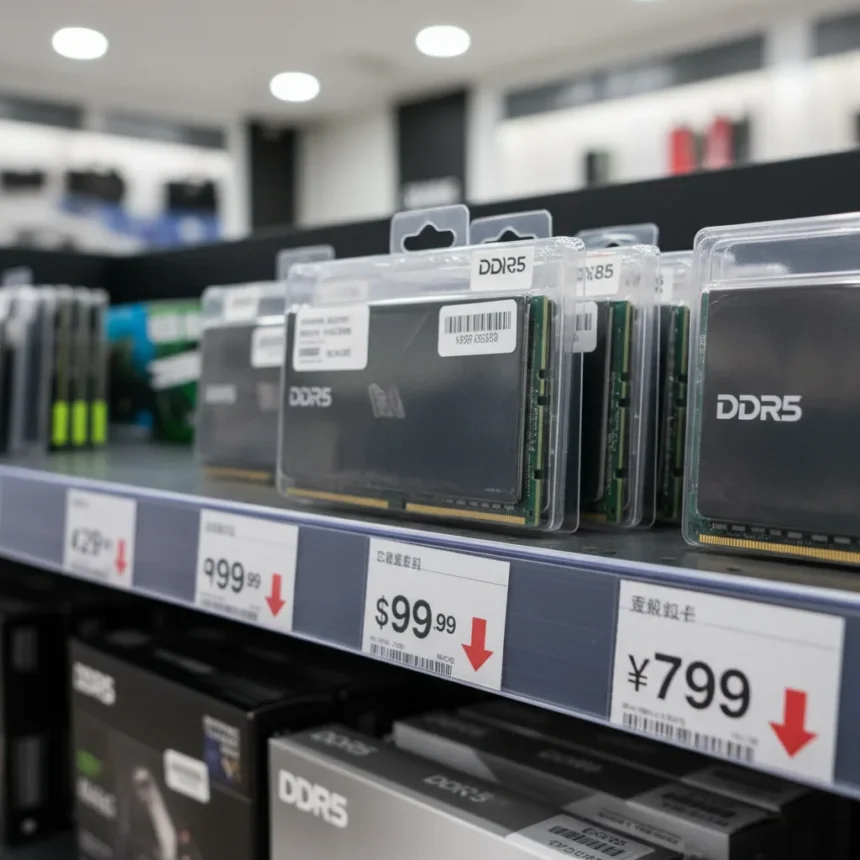
DDR5 retail prices pullback is finally happening. After eight straight months of relentless increases, memory prices in Germany dropped 7.2% month-on-month in March 2026, marking the first meaningful decline in the ongoing RAM crisis. Corsair’s VENGEANCE 32GB DDR5 kit fell to $379.99 in U.S. retail, shedding over 20% from its recent $490 peak. In China, mainstream 16GB DDR5-5600/6000 modules crashed from a January-February peak of RMB 1,300 down to RMB 1,000—a 25-30% cumulative decline. These drops matter because they suggest the market correction everyone has been waiting for might actually be arriving.
Key Takeaways
- DDR5 retail prices pullback 7.2% month-on-month in Germany (March 2026), first decline after eight months of gains.
- Corsair VENGEANCE 32GB DDR5 fell over 20% to $379.99; TeamGroup 16GB DDR5-6000 dropped to $239 lowest-ever.
- Chinese 16GB DDR5-5600/6000 modules fell 25-30% from January-February peaks to around RMB 1,000.
- Q1 2026 DDR5 contract prices still up 105-110% year-over-year despite retail softening, signaling supply constraints persist.
- Retail pullback contrasts with stable contract pricing; industry players warn of ongoing shortages despite price relief.
Why DDR5 Retail Prices Pullback Matters Right Now
The DDR5 retail prices pullback arrives as a relief after what felt like endless increases. Yes, German retail prices remain 408% higher than July 2025 levels. Yes, contract prices for DDR4 and DDR5 jumped 105-110% year-over-year in Q1 2026. But the fact that retail is finally moving downward signals something has shifted in the supply-demand equation. Buyers who have been holding off on upgrades now have a window to act without completely emptying their wallets. For builders and system integrators watching margins compress, even a 20% discount on premium kits represents real savings on high-volume orders.
What makes this pullback noteworthy is its contrast with what is happening at the contract level. While retailers slash prices, the wholesale market remains stubbornly high and stable. This disconnect reveals the real pressure: retailers are clearing inventory at lower margins while chipmakers and distributors maintain pricing power upstream. It is a classic market correction pattern—retail capitulates first, contracts follow later. But the lag matters. If retailers are willing to sell at lower prices, it means they see inventory risk or demand softening. That is the signal the crisis might be turning.
The Global Picture: Retail Relief, Contract Stability
The DDR5 retail prices pullback is not isolated to one region. U.S. retailers are offering the lowest prices on record across multiple SKUs. TeamGroup’s T-Force Vulcan DDR5-6000 C38 16GB hit $239, with historical lows at $197. Corsair’s Vengeance RGB DDR5-6000 32GB landed at $369, down from a lowest-ever recorded price of $87. These are not fire-sale anomalies—they reflect genuine inventory pressure and margin compression. China’s e-commerce platforms show similar patterns, with 16GB DDR5-5600/6000 modules at RMB 1,000 versus the RMB 1,300 seen just two months earlier. Germany’s 7.2% month-on-month decline, while modest, broke an eight-month streak of increases.


Yet contract prices tell a different story. DDR5 contract pricing remains elevated, underpinned by demand from AI and data center buyers who cannot wait for retail discounts. HBM production complexity and NVIDIA and hyperscaler demand are tightening conventional DRAM supply, keeping DDR5 margins high—Micron is projected to achieve 81% margins in 3QFY26. This creates a bifurcated market: retail buyers get relief, but OEMs and integrators still face high wholesale costs. The gap between retail and contract pricing will likely narrow as inventory clears and contract cycles reset, but for now, it is the clearest evidence that the crisis is fragmenting rather than ending uniformly.
DDR4 Did Not Escape—It Got Worse
If you thought DDR4 was a safe harbor while DDR5 burned, think again. DDR4 32GB kits (2x16GB) climbed from $60-90 in October 2025 to $150-180 by January 2026—a 100-200% increase that makes DDR5’s gains look almost reasonable. Spot prices for DDR4 1Gx8 3200MT/s rose 1.98% week-over-week to US$30.90 in late January 2026. DDR3 has seen modest spot price gains due to its low-price advantage and renewed buyer interest, but it is a niche play for legacy systems, not a genuine alternative for modern builds. The takeaway: there is no escape route. Both DDR4 and DDR5 are caught in the same supply crunch driven by AI demand and manufacturing complexity. The DDR5 retail prices pullback offers relief, but it does not solve the underlying shortage.



What the DDR5 Retail Prices Pullback Tells Us About What Comes Next
TrendForce hints that 16GB DDR5 module prices could normalize by end-2026, but that is a cautious forecast buried in a report that also emphasizes stable contract trends despite retail softening. Translation: do not expect a crash. Expect a slow, uneven descent as inventory clears, contract cycles reset, and supply gradually stabilizes. Mobile DRAM (LPDDR4X/LPDDR5X) is forecast to rise another 88-93% in Q1 2026 after Q4 gains of 43-53%, so the crisis is not uniform across memory types. PC memory rose 38-43% in Q4 2025, with Q1 2026 revised to 105-110% increases—the pullback in retail is not yet reflected in wholesale pricing.
The real question is whether the DDR5 retail prices pullback accelerates or stalls. If retailers continue to clear inventory, prices could fall faster. If demand from AI and data center buyers keeps contract prices high, retail will eventually stabilize at a new floor well above pre-crisis levels. Either way, the crisis is not ending—it is evolving. Buyers who have been waiting should act soon, because the window between retail relief and contract price reset is narrow. Once contract prices fall, retailers will have less pressure to discount, and the momentum will slow.
Is the DDR5 retail prices pullback the start of a real market correction?
It is the start, not the finish. Retail prices are falling, but contract prices remain stable and elevated. The pullback reflects inventory pressure and margin compression at retail, not a sudden surge in supply or collapse in demand. Expect prices to decline further over the next two quarters, but do not expect a return to 2024 levels anytime soon.
Why are DDR4 prices also spiking if DDR5 is the focus?
DDR4 is caught in the same AI-driven demand surge that is pushing DDR5 prices. Chipmakers are prioritizing high-margin memory types for data centers, leaving consumer DDR4 supply tight. The DDR5 retail prices pullback does not mean DDR4 is getting cheaper—it is just experiencing a different trajectory.



When will DDR5 prices return to normal?
TrendForce suggests 16GB modules could normalize by end-2026, but that is speculative. The DDR5 retail prices pullback is real, but contract prices remain high. Full normalization depends on when AI demand moderates and chipmakers can redirect capacity to consumer memory. That could take another six months or longer.
The DDR5 retail prices pullback is real, measurable, and significant. It is not the end of the crisis, but it is the first concrete sign that the market is correcting. Builders and buyers who have been priced out should start shopping now, because this window will not stay open forever. Retailers are clearing inventory at the lowest prices in months, and once contract prices fall, that urgency will disappear.
Edited by the All Things Geek team.
Source: TechRadar