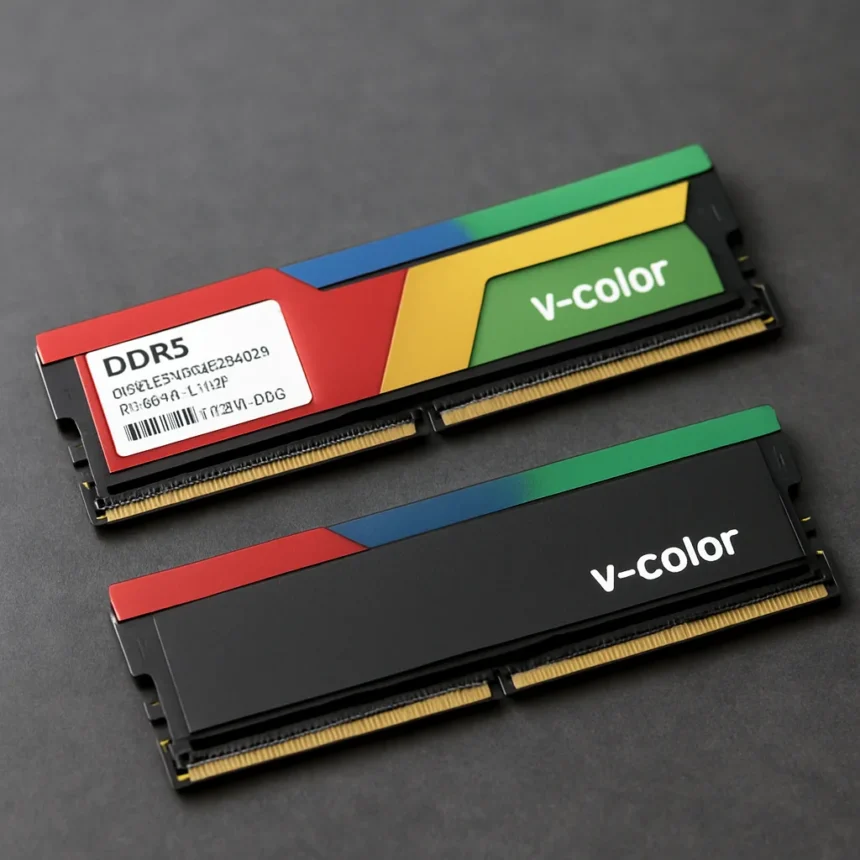
Fake DDR5 RAM is now a commercially available product, and it is being sold by V-Color under the banner of a “value pack.” The company has launched 1+1 DDR5 memory kits from its Manta Sky and Manta XFinity series, starting at DDR5-6400 speeds, that pair one genuine DRAM module with one completely non-functional filler stick designed to look identical to the real thing. The filler even includes RGB lighting that synchronises with the working module. No extra performance. No additional memory capacity. Just the visual impression of a two-stick setup.
What Is V-Color’s Fake DDR5 RAM Kit and How Does It Work?
V-Color sells these kits as DDR5 RGB Filler Kits on its own website, with filler modules available under the Manta XPrism RGB and Manta XSky RGB product lines, both carrying Intel XMP branding. The 1+1 configuration gives you one real DDR5 stick and one dummy module that occupies a second memory slot without contributing a single byte of capacity or a single megahertz of bandwidth. A 2+2 configuration is also available, meaning two real sticks paired with two decorative fillers.
The filler modules are priced from $66.88 on V-Color’s site. No specific bundle pricing for the 1+1 kits has been announced at the time of writing. That price point for what is essentially a plastic and RGB shell is either audacious or a sign of how distorted the current memory market has become — possibly both.
Why Is This Fake DDR5 RAM Targeted at AMD Users?
The product is specifically positioned for AMD and Ryzen-based gaming PCs. The logic, such as it is, hinges on aesthetics rather than architecture. AMD systems with a single memory stick run in single-channel mode, which genuinely does limit memory bandwidth compared to a dual-channel configuration with two real sticks. The filler module does nothing to change that. It does not enable dual-channel operation. It does not improve latency, bandwidth, or any measurable performance metric. What it does is make the inside of your case look like a dual-channel setup, which is a distinction that matters only to someone peering through a tempered glass side panel.


V-Color frames this as solving a problem created by worsening DDR5 memory shortages. The implication is that buyers who cannot source a second real DDR5 stick can at least maintain visual symmetry in their builds. That framing deserves scrutiny. A memory shortage that makes real sticks hard to find does not obviously create demand for fake ones — it creates demand for real ones at fair prices. Calling a dummy module a solution to a supply problem is a creative piece of marketing, not a technical fix.
How Does Fake DDR5 RAM Compare to Just Buying Real Memory?
The comparison here is straightforward and unflattering for V-Color’s product. A second genuine DDR5 stick at DDR5-6400 speeds would unlock actual dual-channel performance, meaningfully increasing memory bandwidth for CPU-bound tasks and gaming workloads on AMD platforms. The filler module provides none of that. It occupies the same physical slot, draws power for its RGB LEDs, and delivers nothing beyond symmetry. For builders who genuinely cannot find matching DDR5 modules due to supply constraints, the honest alternative is to wait, not to spend money on decorative plastic. The filler kit is a product that exists because the market is broken enough that someone calculated it would sell.



Should you buy a DDR5 filler kit for your AMD build?
No. A DDR5 filler kit adds zero memory capacity and zero performance to your system. It is a purely cosmetic product that occupies a memory slot and synchronises RGB lighting with your real module. If aesthetics inside your case matter enough to spend $66.88 or more, that is a personal choice — but go in with clear expectations about what you are and are not getting.
Does a dummy RAM stick affect system stability or compatibility?
Based on V-Color’s product design, the filler module is passive — it does not interact with the memory controller or the CPU. It should not affect system stability. However, because it physically occupies a DIMM slot, it is worth confirming that your specific motherboard does not require populated slots to follow a particular configuration for optimal signal integrity. When in doubt, consult your motherboard manual before installing any non-functional module.
What is causing the current DDR5 memory shortage?
The research brief does not detail the specific causes of the current DDR5 shortage, and speculating on supply chain dynamics without verified data would not serve you well. What is clear is that V-Color’s decision to commercialise a dummy module is a direct response to that shortage — and the fact that such a product exists at all is a reasonable indicator of how constrained the DDR5 market has become for consumers building AMD systems.
V-Color’s fake DDR5 RAM kits are a fascinating and slightly depressing artefact of a supply chain under pressure. They solve no real problem, offer no real performance, and exist primarily to let builders maintain the appearance of a fully populated memory configuration. If the DDR5 shortage is severe enough that dummy modules are now a commercial product category, the right response is patience and a watchlist for real stock — not $66.88 spent on RGB-lit plastic that your CPU will never acknowledge.



Edited by the All Things Geek team.
Source: Tom's Hardware