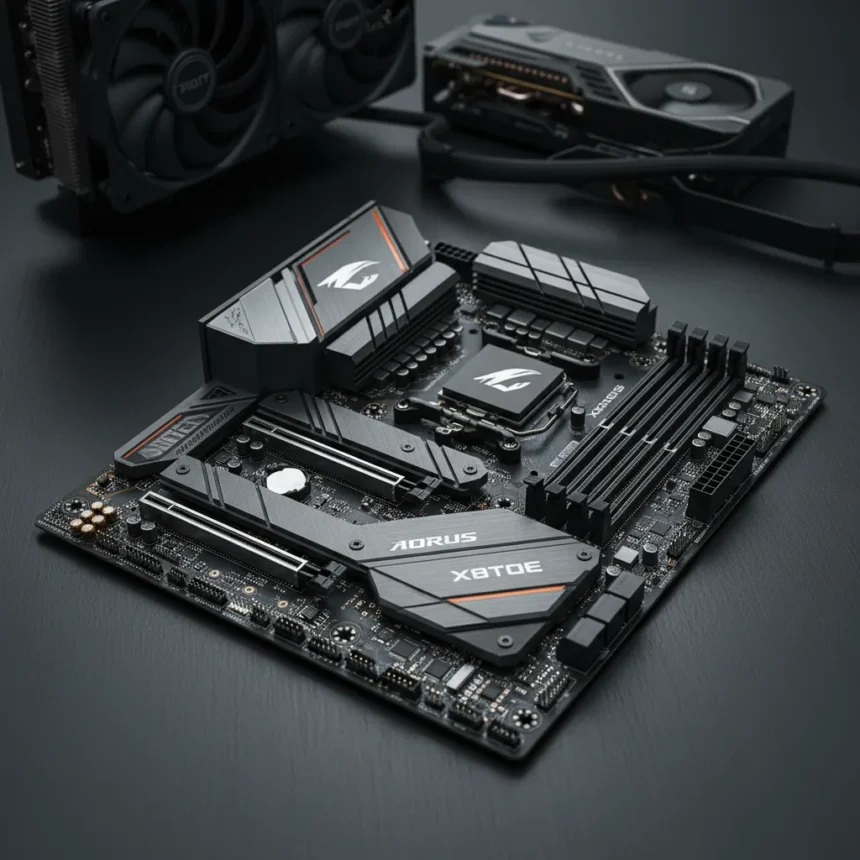
The Gigabyte X870E Aorus Xtreme AI Top is a premium E-ATX motherboard for AMD’s AM5 socket, built on the X870E chipset and loaded with features that appeal to high-end builders. But here’s the problem: Gigabyte’s own X3D refresh makes this original flagship nearly impossible to recommend in 2025.
Key Takeaways
- E-ATX flagship for AM5 socket with Wi-Fi 7, DDR5 support up to 9000 MHz, and strong VRM design.
- X870E Aorus Xtreme X3D AI Top outperforms the original in benchmarks and adds X3D Turbo Mode 2 for content creation.
- Original AI Top faces tough competition from its own X3D variant and other X870E models at similar price points.
- Five M.2 sockets and 8-channel audio (120 dB SNR) exceed most competitor offerings.
- Refurbished deals may justify purchase over the newer X3D version.
Gigabyte X870E Aorus Xtreme AI Top Specs and Design
The Gigabyte X870E Aorus Xtreme AI Top packs enterprise-grade connectivity and performance features into a sleek E-ATX form factor. It supports DDR5 memory up to 9000 MHz, Wi-Fi 7 (802.11be), Bluetooth 5.3, and HDMI 2.1, making it future-proof for demanding workloads. The board features five M.2 NVMe sockets—more than the four-slot standard on many competitors like the X870E Aorus Master—and delivers eight channels of audio via a Realtek ALC1220 chipset with 120 dB signal-to-noise ratio. This audio specification exceeds the 7.1-channel output on some rival boards, a detail that matters for creators and audiophiles.
The PCIe layout offers three full-length slots: the first runs at x16 (full bandwidth if only the top slot is populated), the second at x8, and the third at x4 (which disables a fourth x4 slot if used). Two additional x4 and x2 slots round out the expansion options. This configuration balances flexibility with electrical stability, though it requires careful planning if you’re stacking multiple GPUs or NVMe adapters.
Performance: Solid, But the X3D Variant Pulls Ahead
The Gigabyte X870E Aorus Xtreme AI Top delivers respectable performance for a flagship board, but the X3D refresh introduces measurable gains that make the original harder to justify. The X3D variant achieves an AIDA64 write speed of 88,128 MB/s in Extreme Gaming mode—a 14% improvement over standard configurations—while posting a 3DMark Time Spy score of 33,195 points, up 6% from the standard mode. In Cyberpunk 2077, the X3D version averages 284 fps at high settings versus 194 fps on the standard configuration, a 12% boost.


These gains stem from the X3D AI Top’s superior 24+2+2 phase VRM design with advanced cooling, which maintains VRM temperatures at 45°C even under heavy loads and delivers 394W of power during stress testing. The original AI Top, while respectable, cannot match these thermal and power delivery improvements. For content creators, the X3D variant adds X3D Turbo Mode 2, a feature designed to accelerate rendering and encoding tasks—a capability absent from the original.
Why the Original AI Top Struggles Against Competitors
Gigabyte’s own lineup presents the real challenge. The X870E Aorus Xtreme X3D AI Top operates on the same AM5 socket, E-ATX form factor, and Wi-Fi 7 standard as the original, but with better performance, enhanced VRM architecture, and exclusive software features. Meanwhile, other X870E boards like the Aorus Elite X3D and Aorus Pro X3D offer comparable connectivity and feature sets at potentially lower price points, though the original AI Top’s five M.2 sockets and 8-channel audio remain advantages.



The MSI GODLIKE presents an alternative flagship with a 24+2+1 VRM design—one phase fewer than the X3D AI Top’s 24+2+2 configuration—but comparable performance in most real-world scenarios. Without a significant price advantage or exclusive features, the original Gigabyte X870E Aorus Xtreme AI Top becomes a middle ground that satisfies neither budget-conscious builders nor performance-obsessed enthusiasts.
Should You Buy the Gigabyte X870E Aorus Xtreme AI Top?
Unless you find a refurbished unit at a substantial discount, the answer is no. The newer X3D variant delivers better performance, superior VRM cooling, and content creation features that justify the platform investment. If you’re building a high-end AM5 system today, spend the extra budget for the X3D refresh. The original AI Top’s premium pricing combined with the existence of a superior alternative makes it a poor value proposition in the current market. Refurbished deals might change this calculus, but retail pricing leaves this board caught between enthusiast aspirations and practical compromises.
Does the X870E Aorus Xtreme AI Top support overclocking?
Yes, the board’s robust VRM design and cooling infrastructure support overclocking, though the X3D variant’s superior thermal management delivers better sustained performance under extreme conditions. The original AI Top handles moderate overclocking well but lacks the advanced cooling and power delivery of its X3D counterpart.
How many M.2 slots does the Gigabyte X870E Aorus Xtreme AI Top have?
The board features five M.2 NVMe sockets, exceeding the four-slot standard on competitors like the X870E Aorus Master. This abundance of M.2 connectivity benefits storage-heavy workloads such as video editing and data archiving.



What is the difference between the AI Top and X3D AI Top variants?
The X3D variant features a superior 24+2+2 VRM phase design versus the original’s architecture, delivers measurable performance gains (up to 14% in memory write speed and 6% in 3DMark), includes X3D Turbo Mode 2 for content creation acceleration, and maintains better VRM thermals. Both share the same socket, form factor, and Wi-Fi 7 support, but the X3D is the clear performer.
The Gigabyte X870E Aorus Xtreme AI Top is a capable flagship that gets overshadowed by its own refresh. In a market where the X3D variant exists, choosing the original requires either a significant price discount or specific use-case requirements that the standard configuration uniquely addresses—a rare scenario for most builders today.
Where to Buy
Edited by the All Things Geek team.
Source: Tom's Hardware