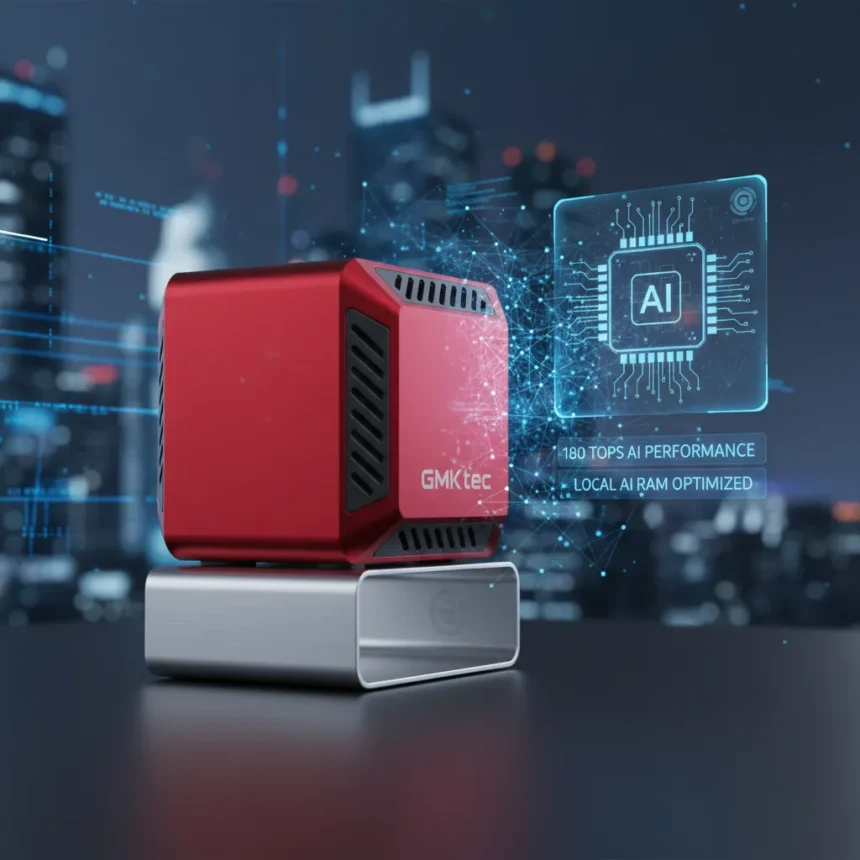
The GMKtec EVO-T2 mini PC is a compact desktop system powered by Intel’s Core Ultra X9 388H processor, delivering up to 180 TOPS of local AI performance via its integrated Arc B390 graphics processor. Unveiled at CES 2026 in January, this device marks the first consumer mini PC to harness Intel’s latest Panther Lake architecture, built on the company’s 18A (1.8 nm) manufacturing process. The machine directly targets creators, developers, and AI enthusiasts who need desktop-class performance without sacrificing desk space.
Key Takeaways
- 180 TOPS AI performance from integrated Arc B390 GPU — double the raw compute of AMD’s Radeon 890M
- Intel Core Ultra X9 388H with 16 cores (4 performance, 4 low-power, 8 efficiency) reaching 5.1 GHz boost
- Up to 128 GB LPDDR5X RAM with dual M.2 slots supporting up to 16 TB storage via PCIe 5.0 and 4.0
- Pseudo-memory feature uses SSD-assisted memory extension to handle large AI models beyond physical RAM limits
- Connectivity includes USB4 (40 Gbps, 100W power delivery), OCuLink, 10GbE Ethernet, and dual USB Type-A ports
Performance That Justifies the Hype
The GMKtec EVO-T2 mini PC’s 180 TOPS AI capability sets it apart in the compact desktop space. This figure represents raw compute throughput for local inference — running large language models, image generators, and AI analysis tools entirely on your machine without cloud connectivity. The Arc B390 iGPU delivers twice the raw performance of AMD’s Radeon 890M, found in competing systems like the GMKtec Evo-X2. For context, Geekbench 6 scores show the system hitting approximately 3,000 in single-core and 17,600 in multi-core performance, matching the AMD Ryzen AI Max+ 395 and beating Intel’s own Core Ultra 9 285H from the prior generation.
The 16-core CPU architecture balances efficiency with raw speed. Four performance cores handle demanding single-threaded tasks, four low-power cores manage background processes, and eight efficiency cores provide sustained multi-threaded throughput. This heterogeneous design reflects Intel’s mobile-first strategy, adapted here for desktop form factor. Boost clocks reach 5.1 GHz, enabling brief spikes of performance when needed without constant thermal strain.
The SSD-Assisted Memory significant shift
The pseudo-memory feature addresses a genuine pain point: running large AI models on consumer hardware. A 70-billion-parameter language model demands roughly 140 GB of VRAM in full precision — far beyond even the EVO-T2’s maximum 128 GB RAM configuration. GMKtec’s solution leverages the system’s fast NVMe SSD as virtual memory, allowing the processor to shuffle model layers between RAM and storage dynamically. This trades latency for capability. Inference becomes slower than running the full model in RAM, but it becomes possible at all.


The approach hinges on the EVO-T2’s storage architecture: dual M.2 slots with PCIe 5.0 and PCIe 4.0 support enable up to 16 TB total capacity. Phison SSDs are mentioned as the storage partner, though the exact models are not specified. The vapor chamber cooling system sustains performance during sustained AI workloads, preventing thermal throttling that would otherwise cripple the pseudo-memory workflow.
Connectivity and Real-World Usability
A mini PC lives or dies by its I/O. The EVO-T2 includes USB4 with 40 Gbps bandwidth and 100W power delivery, enabling external GPU enclosures or high-speed storage arrays. OCuLink support adds another high-speed external interface for specialized peripherals. The dual Ethernet setup — 2.5G and 10G — is unusual for a consumer desktop, targeting users who need gigabit-class network throughput for model downloads, distributed training, or video streaming. Multiple USB Type-A ports ensure backward compatibility with legacy peripherals.



This connectivity matrix reveals GMKtec’s positioning: the EVO-T2 is not a gaming machine first. It is a workstation. Gamers would prioritize discrete GPU support; this system bakes graphics into the CPU. That said, the Arc B390 can handle 1080p AAA games at modest settings, making it viable for casual gaming alongside professional AI work.
Pricing and Availability Reality Check
GMKtec has announced two configurations at launch. The Core Ultra X7 358H variant — a step down from the flagship X9 388H — carries a 14,999 Yuan price tag (approximately $2,175 USD) in China for 64 GB RAM and 1 TB storage. Early buyers in China received a 5,000 Yuan discount on the first 100 units. The higher-spec X9 388H model pricing remains unannounced for international markets.
International pre-orders opened on the GMKtec website starting March 30, 2026, but no global pricing has been published. This creates uncertainty for Western buyers. A $2,175 entry point is steep for a mini PC, though comparable to high-end laptops and well below professional workstations. The X9 388H variant will likely command a premium, potentially pushing past $2,500 USD in international markets — though this is speculation pending official announcements.
How does the GMKtec EVO-T2 mini PC compare to other compact systems?
The EVO-T2 outperforms its predecessor, the GMKtec Evo-T1 (Core Ultra 9 285H), in both CPU and GPU metrics. It matches the AMD Ryzen AI Max+ 395 in Geekbench scores, though the Arc B390 iGPU edges out the Radeon 890M in raw AI TOPS. Unlike traditional mini PCs, the EVO-T2 prioritizes AI workload capability over gaming performance, making it fundamentally different from gaming-focused competitors.



What is the pseudo-memory feature, and does it actually work?
Pseudo-memory uses your SSD as overflow storage for AI models, allowing the system to handle models larger than physical RAM. Performance drops compared to full in-RAM inference, but it enables running previously impossible models on consumer hardware. Real-world speed depends on SSD latency and the specific model architecture.
Is the GMKtec EVO-T2 mini PC worth buying at launch?
For AI developers and creators needing local model inference without cloud costs, the EVO-T2 delivers genuine capability at a premium price. For casual users or gamers, the cost and AI-centric design make it a poor fit. Wait for international pricing and independent thermal/performance testing before committing — early adopter pricing in China suggests global variants will be expensive.
Edited by the All Things Geek team.
Source: TechRadar