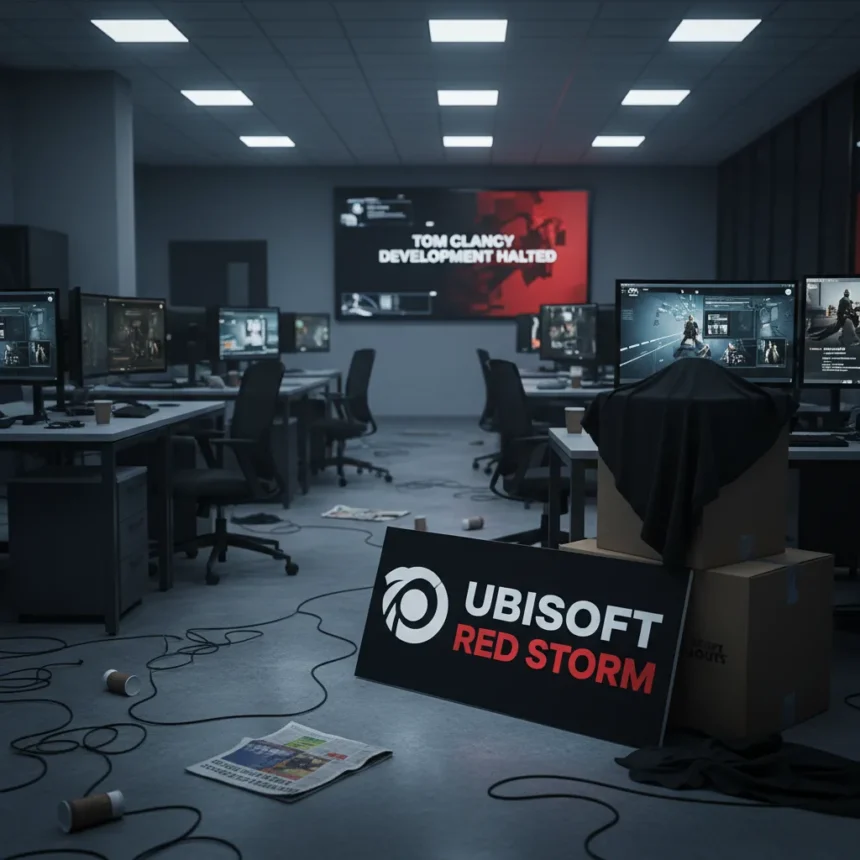
Ubisoft Red Storm layoffs have become the studio’s defining story in 2026, with the North Carolina-based developer cutting roles and abandoning new Tom Clancy projects as part of a broader corporate restructuring. Red Storm Entertainment, now operating as Ubisoft Red Storm, is no longer developing new titles—a dramatic shift for a studio that spent decades building the Ghost Recon and The Division franchises.
Key Takeaways
- Ubisoft Red Storm eliminated 19 roles in January 2026, following prior August 2024 cuts of 45 jobs across Cary and San Francisco teams.
- The studio is ending all new game development after canceling The Division Heartland and other projects.
- Red Storm’s recent work included Star Trek: Bridge Crew and Assassin’s Creed Nexus VR before the shutdown.
- Ubisoft is targeting €200 million in cost savings by March 2028 as part of a larger restructuring affecting multiple studios globally.
- The layoffs reflect a pattern: Red Storm has faced repeated cuts since August 2024 as Ubisoft realigns its portfolio.
How Red Storm Became Collateral Damage in Ubisoft’s Cost Crisis
Red Storm Entertainment, based in Cary, North Carolina, built its reputation on Tom Clancy adaptations—Ghost Recon and The Division Heartland were flagship projects that defined the studio’s output. But the studio’s repeated exposure to layoffs reveals a studio caught between legacy IP management and Ubisoft’s desperate need to cut costs. In August 2024, Ubisoft cut 45 jobs across the Cary location and San Francisco teams to align organizations with future business objectives. Less than 18 months later, the January 2026 layoffs eliminated another 19 roles specifically at Red Storm, with Ubisoft stating the cuts reflected the needs on the studio’s projects.
The pattern is telling. Red Storm has been hit twice in rapid succession, suggesting the studio’s project pipeline collapsed faster than leadership anticipated. The Division Heartland cancellation—a spin-off that was supposed to extend the franchise—signals that Ubisoft’s Tom Clancy strategy has fundamentally shifted. Rather than invest in new entries, the publisher is consolidating development elsewhere. Massive Entertainment, which developed The Division and is handling Star Wars Outlaws, now controls the franchise’s future. Red Storm’s role as a Tom Clancy studio has effectively ended.
What Red Storm Was Building Before the Shutdown
Before the development freeze, Red Storm had diversified into VR and licensed properties. The studio led development on Assassin’s Creed Nexus VR and Star Trek: Bridge Crew, attempting to prove its relevance beyond Tom Clancy shooters. These projects represented a pivot—acknowledgment that the studio needed to adapt beyond its core expertise. Yet VR remains a niche market, and licensed games carry higher risk if IP holders change direction or demand shifts. When Ubisoft needed to cut costs, Red Storm’s experimental portfolio became an easy target.


The studio’s recent output shows ambition hampered by budget constraints. Star Trek: Bridge Crew, a VR-exclusive title, has a dedicated but limited audience. Assassin’s Creed Nexus VR similarly targets a specialized segment. Neither project generated the revenue justification needed to protect the studio from layoffs during a cost crisis. Red Storm’s inability to maintain a blockbuster franchise—or develop one independently—sealed its fate.
The Broader Context: Ubisoft’s Systemic Collapse
Red Storm’s shutdown is one domino in a larger collapse. Ubisoft is pursuing €200 million in cost savings by March 2028, part of a restructuring that has already eliminated over 3,000 jobs since 2022. In January 2026 alone, Ubisoft announced layoffs at Massive Entertainment and Ubisoft Stockholm (55 roles), Toronto (40 roles), and closures including the unionized Halifax studio. Six games have been canceled, including the Prince of Persia remake, while four unannounced new IPs remain in development. The math is grim: Ubisoft is cutting aggressively while betting on unknown projects.



Red Storm’s fate reflects a publisher in freefall. Studios that once anchored Ubisoft’s portfolio—like Red Storm with Tom Clancy—are being dismantled because they cannot justify their existence in a leaner financial model. The studio’s inability to launch a successful new IP, combined with the declining performance of its licensed properties, made it expendable. Ubisoft’s leadership chose to consolidate Tom Clancy development under Massive Entertainment, which has proven its ability to ship major titles, and let Red Storm’s 30-year legacy fade.
Why Red Storm’s Closure Matters Beyond Ubisoft
Red Storm’s shutdown signals a broader industry shift: legacy studios with strong franchises are no longer safe. The studio had Ghost Recon, a series with decades of player investment. Yet that pedigree did not protect it from closure. For developers, the message is stark—even established studios can be eliminated if quarterly targets demand it. For players, it means fewer voices developing Tom Clancy games and less competition in the tactical shooter space, where Massive Entertainment now holds near-monopoly control over the franchise.
The human cost is also significant. Ubisoft’s statement on the 19 January layoffs acknowledged severance packages, extended health-care benefits, and career transition assistance. But these cushions are cold comfort in an industry where job mobility is limited and remote work has not solved geographic clustering around major studio hubs. Red Storm employees in Cary face a tight regional market for AAA game development.
What Happens to Red Storm Now?
Ubisoft has not announced whether Red Storm will be completely shut down or repurposed as a support studio. The announcement that development of new titles is ending completely suggests the studio may transition to maintenance work—keeping existing games running, handling live-service updates, or supporting other Ubisoft projects remotely. This model has become common in the industry as publishers try to retain institutional knowledge while cutting headcount. But it is a far cry from the studio’s former role as a creative driver of major franchises.


The Tom Clancy portfolio will consolidate under Massive Entertainment, which is already managing The Division 2 and has demonstrated capability shipping large-scale multiplayer experiences. Ghost Recon’s future remains unclear—no new entries are announced, and the franchise has not launched a major title since Ghost Recon Breakpoint in 2019. Ubisoft may be quietly retiring the series, or waiting for market conditions to improve before investing in a reboot.
Did Ubisoft have other options?
Theoretically, yes—but not within Ubisoft’s current financial constraints. The publisher could have maintained Red Storm as a dedicated Tom Clancy studio, continued investing in VR titles, or spun the studio off as an independent entity. Each option required capital Ubisoft does not have while pursuing €200 million in savings. Consolidation under Massive Entertainment is cheaper than running two studios. Shuttering development is cheaper than investing in new projects. Ubisoft chose the path of least financial resistance, not the path that preserves creative diversity or player choice.
Is Red Storm closing permanently?
Ubisoft has not announced a permanent closure, only that development of new titles is ending. The studio may continue operating in a reduced capacity, supporting live games or assisting other Ubisoft teams. However, the practical reality is that a studio without development authority is a studio in decline. Unless Ubisoft reverses course and assigns Red Storm a major new project, the studio’s days are numbered—either through gradual attrition or formal shutdown within the next 12-24 months.
What does this mean for Tom Clancy games going forward?
Tom Clancy development is now centralized under Massive Entertainment, which is managing The Division franchise and other Ubisoft projects. This consolidation reduces development overhead but also reduces creative competition. Players will see fewer voices interpreting the Tom Clancy universe. Ghost Recon’s future is uncertain, with no announced new entries. Ubisoft may be stepping back from the franchise entirely, or waiting for a market window to greenlight a major reboot. Either way, the franchise is in limbo—a casualty of Ubisoft’s cost crisis.
Red Storm’s closure represents the end of an era for Ubisoft. The studio that defined tactical shooters and live-service military games is now a footnote in the publisher’s history. For the industry, it is a reminder that legacy, franchise pedigree, and decades of institutional knowledge offer no protection when financial pressure demands cuts. Ubisoft chose efficiency over creativity, and Red Storm paid the price.
Edited by the All Things Geek team.
Source: Windows Central