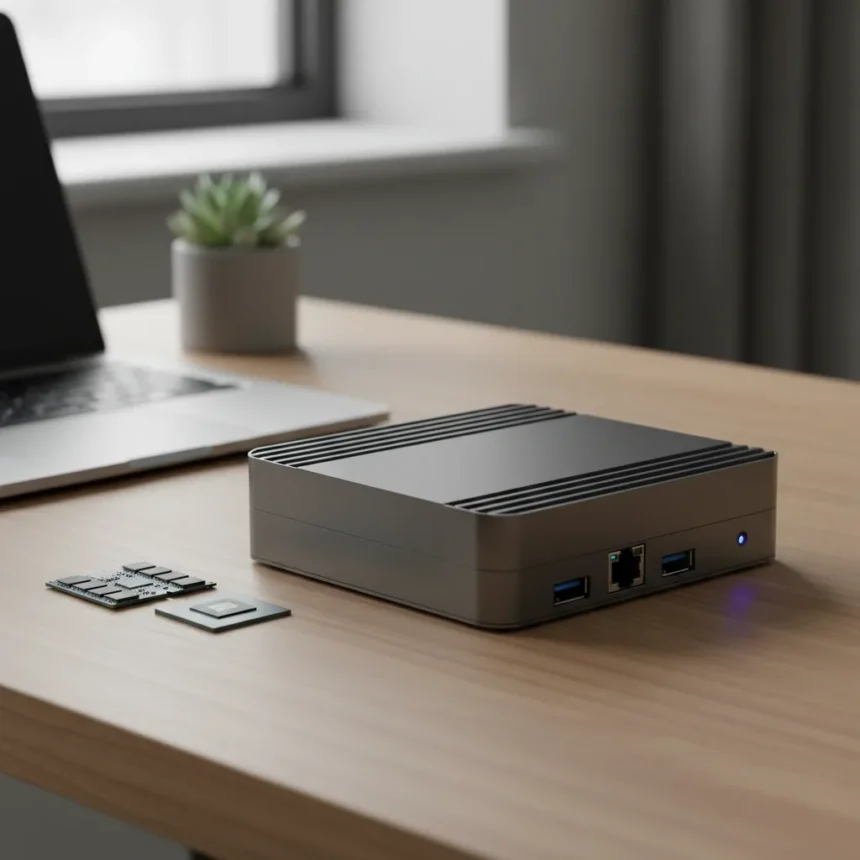
The IceWhale ZimaBoard 2 mini NAS is a fanless single-board computer designed for home servers, private VPN hosting, media streaming, and software routing. As the successor to the original ZimaBoard, it improves the processor and memory while maintaining the passively cooled design that made the first generation attractive to users seeking quiet, low-power alternatives to traditional NAS boxes.
Key Takeaways
- ZimaBoard 2 upgrades processor and memory over the original ZimaBoard model.
- Fanless, passively cooled design ensures silent operation for home server use cases.
- Original ZimaBoard funded on Kickstarter in under 10 minutes, signaling strong market demand.
- Supports personal NAS, private VPN, 4K media server, and software router configurations.
- Competes with cloud storage alternatives by offering private, on-premises control.
What Makes the ZimaBoard 2 Different From the Original
The original ZimaBoard captured attention by reaching its Kickstarter funding goal in less than 10 minutes, a signal that the market was hungry for compact, affordable single-board NAS devices. That model featured a 6W Intel Apollo Lake processor, two SATA 6.0 Gb/s ports for SSDs, one PCIe 2.0 x4 interface, two USB 3.0 Type-A ports, and two Gigabit Ethernet ports. The ZimaBoard 2 builds on this foundation with upgraded internals. While the exact specifications of the new processor and memory remain unconfirmed, IceWhale has positioned the improvements as meaningful increments rather than a complete redesign. The fanless architecture persists, which is the defining feature that separates this device from noisier competitors.
The original ZimaBoard’s success hinged on its simplicity and low cost. At around $69 for early backers, it offered a genuine entry point into self-hosted infrastructure without the expense or complexity of traditional NAS enclosures. The ZimaBoard 2 maintains that philosophy while addressing the one criticism that emerges from any single-board server: performance constraints. By upgrading the processor and memory, IceWhale is signaling that users can expect better throughput for simultaneous connections, faster media transcoding, and smoother operation under load. However, without independent benchmarks, claims about performance improvements remain theoretical.
Fanless Design Remains the Core Advantage
Passive cooling is not a marketing gimmick for the ZimaBoard 2—it is the entire reason to consider this device over alternatives. A completely silent server running in a bedroom, living room, or office closet is a genuine quality-of-life improvement that spreadsheets and spec sheets cannot capture. The original ZimaBoard’s 6W power envelope made this possible; the ZimaBoard 2, with improved components, will draw more power but should remain well within the fanless range if IceWhale has engineered properly. This is a bet the company is making, and it is one worth watching.


Competing single-board computers and compact NAS devices often rely on small fans to manage thermals, creating a constant, barely perceptible hum that becomes maddening over months of use. The ZimaBoard 2 avoids this entirely. For users building a private media server or VPN endpoint that runs 24/7, eliminating fan noise is not a luxury—it is essential.
Positioning Against Cloud Services and Larger NAS Boxes
IceWhale positions the ZimaBoard 2 as an alternative to cloud storage services. The original ZimaBoard marketing emphasized that a single device could store the equivalent of over 33 million standard-resolution photos—enough to replace cloud subscriptions for most households. The ZimaBoard 2, with improved hardware, should handle this use case even more capably. Unlike cloud services, which require monthly or annual fees and surrender privacy to third parties, a self-hosted NAS gives users complete control. The trade-off is that the user becomes responsible for backups, security patching, and hardware maintenance.



IceWhale also produces the ZimaCube, a larger, more feature-rich NAS that raised $1.2 million on Kickstarter against a $10,000 goal. The ZimaCube offers 6+1 drive bays, 2.5GbE ports, and more powerful processors (Intel N100 or 12th Gen Core i5 depending on configuration). The ZimaBoard 2, by contrast, is a single-board device with limited storage expansion. It is not a replacement for the ZimaCube; rather, it occupies a different market segment—users who want to self-host services on a budget and accept the storage and performance limitations of a single-board design.
Use Cases Where ZimaBoard 2 Shines
The IceWhale ZimaBoard 2 mini NAS excels in specific scenarios. A user running a personal VPN endpoint for privacy while traveling abroad benefits from the low power draw and silent operation. A small office needing a local backup target for workstations can deploy the ZimaBoard 2 without adding noise or heat to the environment. A homelab enthusiast building a software router or firewall appliance gains a platform that consumes minimal electricity and requires no active cooling. A media server for a small household, streaming 1080p content to two or three devices simultaneously, falls within the performance envelope of upgraded single-board hardware.
Where the ZimaBoard 2 struggles is in scenarios requiring high throughput, large storage capacity, or redundancy. A family with terabytes of photos and videos, or a small business needing RAID protection, should look at the ZimaCube or traditional NAS enclosures. The ZimaBoard 2 is a specialist device, not a generalist replacement.
Frequently Asked Questions
What is the ZimaBoard 2 compatible with?
The original ZimaBoard supported Linux, Windows, OpenWrt, pfSense, Android, and LibreELEC. The ZimaBoard 2 is expected to maintain broad OS compatibility, though IceWhale has not published a definitive list. Users should verify compatibility with their intended operating system before purchasing.



How much storage can the IceWhale ZimaBoard 2 mini NAS handle?
As a single-board device with two SATA ports (based on the original design), the ZimaBoard 2 can accommodate two storage drives. With modern 4TB or 8TB SSDs, total capacity reaches 16TB, sufficient for most home users but modest compared to larger NAS enclosures.
Is the ZimaBoard 2 suitable for 4K media streaming?
The original ZimaBoard was marketed as capable of functioning as a 4K media server. The ZimaBoard 2, with improved processor and memory, should handle 4K transcoding and streaming more reliably, though simultaneous streams may remain limited depending on the upgraded hardware specifications.
The IceWhale ZimaBoard 2 mini NAS represents an incremental but meaningful evolution of a successful product. For users seeking a silent, low-power platform to self-host services and reclaim privacy from cloud providers, the ZimaBoard 2 is worth watching. The improvements over the original address real pain points—performance and capacity—without abandoning the fanless design that made the first generation distinctive. However, potential buyers should wait for detailed specifications and independent reviews before committing. A device marketed on quiet operation and improved performance needs proof that both claims hold up in real-world use.
Where to Buy
$359.90 at Amazon | $399.90 at Amazon | $399.90 at Amazon | $399.90 in the US | £322.99 in the UK
Edited by the All Things Geek team.
Source: TechRadar