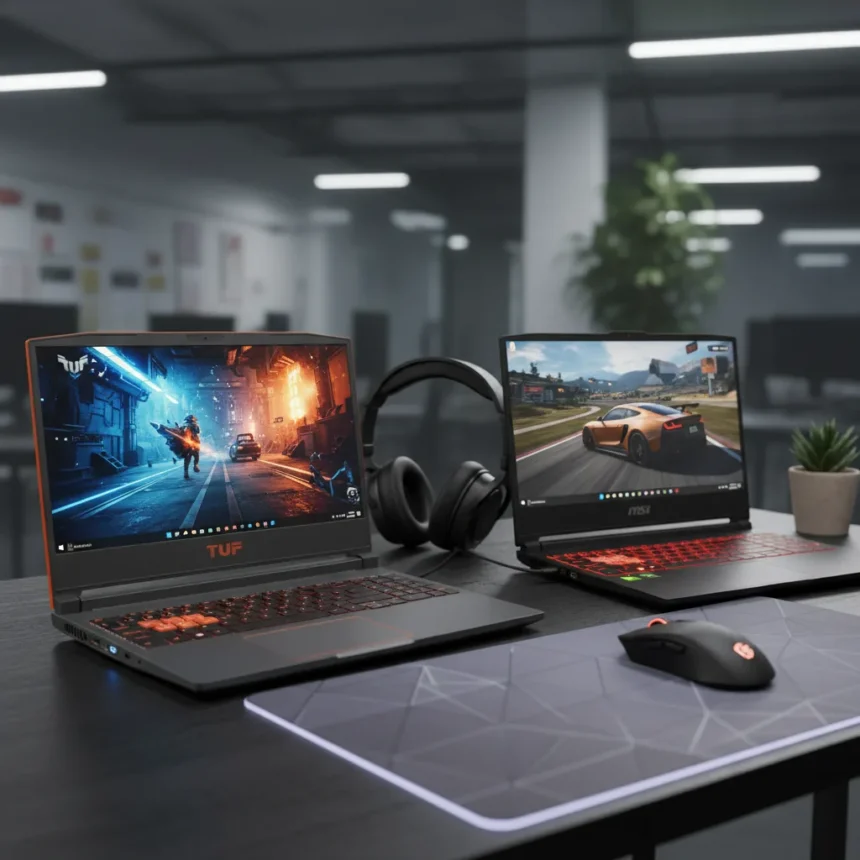
Budget gaming laptops are a contradiction in modern computing—powerful enough to run demanding games, yet priced low enough that buyers don’t need to take out a second mortgage. Finding one that delivers on both fronts is harder than it sounds. Current-generation GPUs in affordable machines remain rare, but a handful of models prove that sub-$1,000 gaming laptops can still offer genuine performance.
Key Takeaways
- Budget gaming laptops under $1,000 with current-generation GPUs are increasingly uncommon in 2026.
- The ASUS TUF Gaming F16 combines Intel Core 5 processing with RTX 4050 graphics for around $892.
- MSI Thin 15.6 delivers RTX 4060 performance at $699, making it one of the cheapest gaming options available.
- Lenovo Legion 5i Gen 10 offers a third alternative for budget-conscious gamers seeking current-gen hardware.
- Scarcity of affordable gaming laptops means comparing specs and real-world performance is essential before buying.
What defines budget gaming laptops?
Budget gaming laptops are machines designed to run modern games at playable frame rates without exceeding the $1,000 price ceiling. Unlike ultrabooks or productivity machines, gaming laptops prioritize GPU performance and thermal management, even at lower price points. The challenge in 2026 is that manufacturers rarely pair current-generation graphics cards with entry-level pricing—most affordable options either use older GPUs or push toward the upper end of the budget range.
The scarcity of sub-$1,000 gaming laptops with current-gen hardware reflects a market squeeze. Chipmakers and OEMs have consolidated their offerings, leaving fewer truly affordable gaming options than existed just two years ago. This means buyers shopping for budget gaming laptops face a narrower field, but the models that do exist represent stronger value propositions than ever.
ASUS TUF Gaming F16: Intel and RTX 4050 at $892
The ASUS TUF Gaming F16 sits at the sweet spot for budget gamers willing to spend under $900. It pairs Intel’s Core 5 processor with an NVIDIA RTX 4050 GPU, delivering enough horsepower for 1080p gaming at high settings in most modern titles. At $892, it undercuts competitors while maintaining a robust build quality that TUF branding implies.


The RTX 4050 is not a powerhouse—it won’t crush 4K gaming or max out every setting in AAA releases—but it handles esports titles comfortably and delivers playable performance in demanding games at medium-to-high settings. The Core 5 processor keeps pace without becoming a bottleneck, though it represents Intel’s more modest tier rather than flagship performance. For players transitioning from console gaming or returning to PC after years away, the ASUS TUF Gaming F16 offers a practical entry point without compromising on durability or thermal design.
MSI Thin 15.6: RTX 4060 for under $700
At $699, the MSI Thin 15.6 with RTX 4060 is arguably the most aggressive budget gaming laptop on the market. It sacrifices some of the build quality and thermal sophistication of pricier models, but the GPU—NVIDIA’s RTX 4060—delivers solid 1080p gaming performance. This is the machine for buyers who prioritize raw affordability and are willing to accept thinner margins on cooling and chassis durability.



The RTX 4060 occupies the same performance tier as the RTX 4050 in the ASUS, with marginal real-world differences in frame rates. Where the MSI saves money is in the overall package: thinner chassis, less elaborate cooling systems, and fewer premium materials. For casual gamers, students, or anyone playing indie games and older AAA titles, the MSI Thin 15.6 represents remarkable value. The trade-off is that sustained gaming sessions may push thermals higher than in more expensive competitors.
Lenovo Legion 5i Gen 10: The third option
Lenovo’s Legion 5i Gen 10 rounds out the budget gaming laptop landscape, offering another current-generation alternative for buyers seeking options beyond ASUS and MSI. Details on exact pricing and GPU configuration are limited in available reviews, but the Legion line has historically occupied the middle ground between aggressive budget pricing and premium gaming performance. For buyers who prioritize brand loyalty or prefer Lenovo’s software ecosystem, the Legion 5i Gen 10 deserves consideration alongside the ASUS and MSI models.
Why budget gaming laptops matter in 2026
The gaming laptop market has bifurcated. Premium machines at $2,000 and above command latest specs and premium designs. Entry-level non-gaming laptops cost $400–$600. Budget gaming laptops—true gaming machines under $1,000—have become a narrow market segment, which paradoxically makes them more valuable. They fill the gap for millions of gamers who want current-generation performance without flagship pricing. The scarcity also means that when you find a solid budget gaming laptop, it tends to offer stronger value than similarly priced machines from a year or two ago.
Should you buy a budget gaming laptop?
Yes, if you game at 1080p and prioritize affordability over maximum frame rates or ultra-high settings. Budget gaming laptops excel at esports titles, indie games, and older AAA releases. They struggle with 1440p gaming and ray-traced settings in demanding new releases, but they remain capable machines for the price. Compared to building a gaming PC at the same price point, a budget gaming laptop offers portability and integrated display—a genuine trade-off worth considering if you game away from home.



What’s the difference between a budget gaming laptop and a regular ultrabook?
A gaming laptop prioritizes discrete GPU performance and thermal design for sustained gaming loads. An ultrabook optimizes for battery life, thinness, and productivity tasks. Budget gaming laptops sacrifice some battery life and thinness to deliver gaming performance; ultrabooks sacrifice gaming performance to optimize portability. Budget gaming laptops are heavier, run hotter, and drain batteries faster—but they can actually play modern games.
Are current-generation GPUs necessary in budget gaming laptops?
Not strictly, but they matter. Older GPUs like the RTX 3050 can still game adequately, but current-generation cards like the RTX 4050 and RTX 4060 offer better performance-per-watt and stronger driver support for new games. If a budget gaming laptop uses a previous-generation GPU, expect to pay a lower price or receive other upgrades (better CPU, more RAM) to justify the trade-off.
Budget gaming laptops in 2026 occupy a precarious market position. Manufacturers have largely abandoned the sub-$1,000 gaming segment in favor of higher margins at $1,200 and above, which makes the ASUS TUF Gaming F16, MSI Thin 15.6, and Lenovo Legion 5i Gen 10 genuinely noteworthy finds. If you game at 1080p and refuse to overspend, these machines prove that budget gaming laptops are still worth buying—you just have to shop carefully.
Where to Buy
View at Amazon | View at Amazon | View at Amazon
Edited by the All Things Geek team.
Source: Tom's Hardware