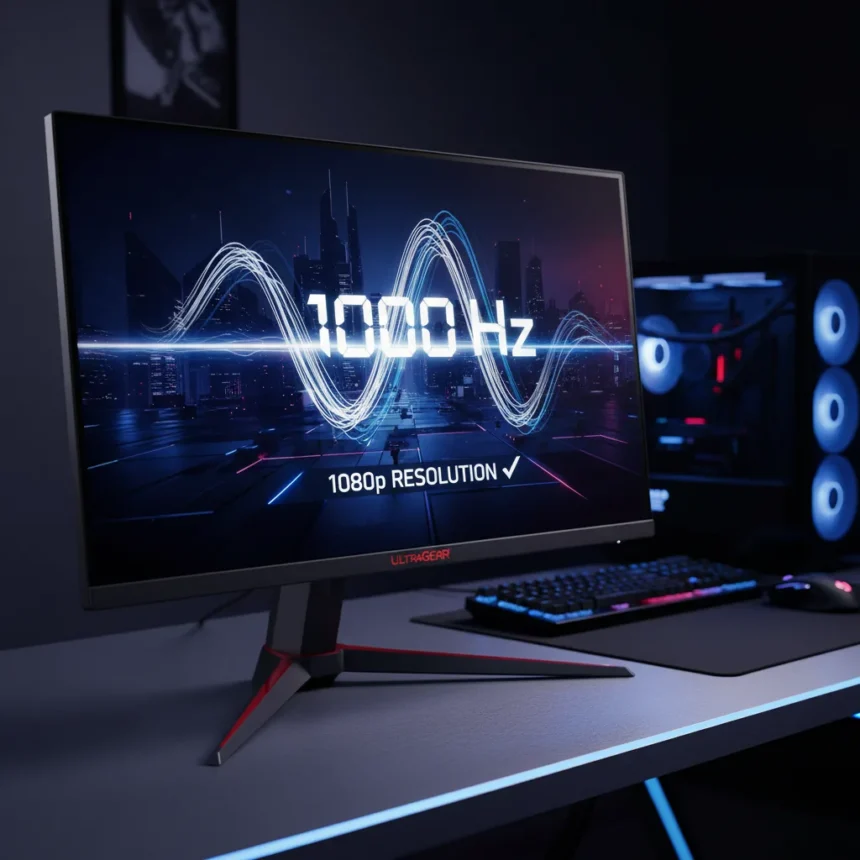
The native 1000 Hz refresh rate is coming to gaming monitors, and LG claims it will be the first to deliver it at full 1080p resolution without compromise. The LG UltraGear 25G590B represents a fundamental shift in how manufacturers approach extreme-refresh gaming displays, ditching the old dual-mode approach that forced players to choose between frame rate and visual real estate.
Key Takeaways
- LG UltraGear 25G590B claims world’s first native 1000 Hz at 1080p, launching second half of 2026
- Unlike previous dual-mode displays, this monitor maintains full 1080p resolution at 1000 Hz
- Targets competitive esports players who prioritize response time and frame rate consistency
- No resolution sacrifice required to reach the 1000 Hz threshold
Why Native 1000 Hz at Full Resolution Matters
Previous gaming monitors that reached extreme refresh rates above 360 Hz typically required dropping resolution to achieve them. Players faced a binary choice: run at lower resolution for maximum frame rate, or accept a refresh rate ceiling to maintain 1080p. The LG UltraGear 25G590B breaks that mold by delivering a native 1000 Hz refresh rate at 1080p, meaning the panel itself operates at that speed without any resolution compromise or mode-switching penalty. For competitive esports players in games like Counter-Strike and Valorant, where millisecond differences determine outcomes, this eliminates a critical performance bottleneck.
The distinction between native and dual-mode is crucial. Dual-mode displays achieve extreme refresh rates through firmware tricks that lower resolution internally, creating a performance illusion rather than true capability. A native 1000 Hz panel at 1080p means the hardware itself supports that combination natively, with no hidden trade-offs or software workarounds.
LG UltraGear 25G590B vs. Previous High-Refresh Gaming Displays
Existing high-refresh gaming monitors have forced players into uncomfortable compromises. Displays capable of 500 Hz or higher typically required 720p or lower resolution, making on-screen text and UI elements blurry and harder to read during intense competitive matches. The UltraGear 25G590B’s approach of maintaining 1080p at 1000 Hz directly addresses this weakness, allowing players to enjoy both extreme responsiveness and acceptable visual clarity in a single mode.


This is not merely an incremental upgrade. The engineering required to maintain full HD resolution while pushing 1000 Hz natively represents a significant leap in panel technology. Previous manufacturers sidestepped this challenge by accepting the resolution penalty, treating it as an acceptable trade-off for enthusiasts. LG’s willingness to eliminate that compromise suggests the company believes the esports market is willing to pay for true native support rather than workarounds.
When Will It Launch and What Should You Expect
The LG UltraGear 25G590B is scheduled to arrive in the second half of 2026. That timeline gives LG several months to refine the technology and prepare manufacturing, though it also means competitive gamers looking for an immediate upgrade will need to stick with current options. The delay is understandable—achieving stable 1000 Hz operation at 1080p without artifacts or reliability issues requires extensive validation.



Pricing and full technical specifications remain unannounced, so expectations should be tempered. A display pushing this far into unexplored territory will likely command premium pricing, positioning it as a flagship product for esports professionals and wealthy enthusiasts rather than mainstream gamers. Availability details for different regions have not been disclosed, though LG typically launches premium gaming monitors in major markets simultaneously.
Is Native 1000 Hz Actually Necessary for Gaming
Most casual and even serious gamers will never perceive the difference between 360 Hz and 1000 Hz. Human perception of frame rate improvements plateaus somewhere around 240-360 Hz for typical gameplay. The jump to 1000 Hz is purely for competitive esports professionals playing fast-twitch games at the absolute highest level, where every millisecond of input lag reduction compounds into measurable skill advantages.
This is a specialist product, not a mass-market upgrade. For streamers, content creators, and single-player gamers, the UltraGear 25G590B offers no meaningful advantage over a solid 240 Hz or 360 Hz display. Its value proposition is razor-focused: maximum competitive advantage in esports titles where frame rate consistency and response time are the only metrics that matter.
FAQ
What makes the UltraGear 25G590B different from dual-mode 1000 Hz displays
The UltraGear 25G590B achieves 1000 Hz natively at 1080p without requiring resolution reduction or mode switching. Previous displays that reached 1000 Hz did so by dropping to 720p or lower, forcing players to sacrifice visual clarity. LG’s approach eliminates this compromise entirely.



When does the LG UltraGear 25G590B launch
The monitor is scheduled to launch in the second half of 2026. Exact availability dates and regional rollout plans have not been announced yet.
Who should buy the UltraGear 25G590B
This monitor is designed for competitive esports players in fast-twitch games who demand maximum frame rate consistency and minimal input lag. Casual gamers and content creators will see minimal practical benefit compared to existing 240-360 Hz displays.
The LG UltraGear 25G590B represents a philosophical shift in how manufacturers approach extreme-refresh gaming. By refusing to compromise resolution, LG is betting that the esports market values true native performance over convenient workarounds. Whether that bet pays off depends on pricing and market demand—but for competitive players who have waited years for this combination, the wait is almost over.
Edited by the All Things Geek team.
Source: Tom's Hardware