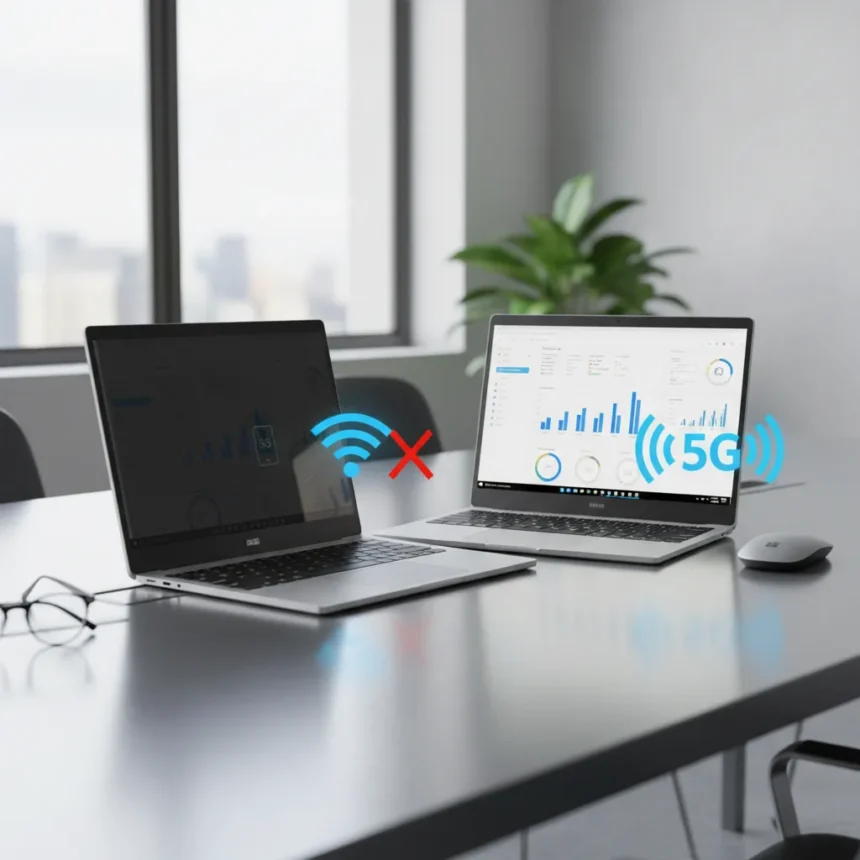
The Surface Laptop 8 for Business represents Microsoft’s latest exercise in feature fragmentation. The device includes a built-in privacy screen that works far better than film protectors, but only if you are willing to sacrifice 5G connectivity. This is not a new problem for Surface buyers—it is Microsoft’s recurring strategy of spreading must-have features across different configurations, forcing users to pick their battles.
Key Takeaways
- Surface Laptop 8 for Business includes an integrated privacy screen superior to adhesive film protectors.
- The privacy-screen model removes 5G connectivity as a tradeoff.
- Microsoft continues its pattern of segmenting premium features across separate Surface variants.
- Buyers must choose between privacy and mobile connectivity rather than getting both.
- The built-in privacy screen represents a genuine hardware innovation, not just a software feature.
The Privacy Screen Advantage That Comes at a Cost
The Surface Laptop 8 for Business introduces a meaningful innovation: a hardware-integrated privacy screen. Unlike the flimsy adhesive film protectors that peel off after weeks of use, this is a permanent part of the display architecture. The privacy screen works far better than film protectors, delivering genuine screen privacy without the degradation in clarity and color accuracy that external protectors impose. For business users handling sensitive documents, video calls, or financial data in shared spaces, this is a real feature worth having.
The problem is the price of admission. Selecting the model with the privacy screen means losing 5G connectivity. This is not a minor spec downgrade—it is a fundamental architectural decision that Microsoft has baked into the product line. Users who need both features cannot have them. They must choose: do I prioritize privacy when working in coffee shops and airports, or do I prioritize mobile connectivity when I cannot access Wi-Fi?
Microsoft’s Ongoing Strategy of Feature Splitting
This is not the first time Microsoft has forced Surface buyers into uncomfortable compromises. The company has a documented pattern of spreading high-value features across different models rather than building a single, complete flagship device. Some configurations get premium processors; others get the best displays. Some include specific ports; others omit them. Some get advanced connectivity; others sacrifice it for other features.


The rationale is familiar: segmentation allows Microsoft to justify different price points and target different buyer segments. A privacy-conscious business user might accept losing 5G. A mobile-first professional might skip the privacy screen entirely. By splitting features, Microsoft creates multiple entry points and prevents any single model from cannibalizing sales across the lineup.
But this approach also creates frustration. It signals that Microsoft could build a truly premium Surface Laptop that includes both privacy and 5G—but chooses not to. The company would rather force buyers to compromise than offer a single device that addresses all use cases at a higher price point. This is a product strategy choice, not a technical limitation.



Privacy Screen vs. Film Protectors: A Real Difference
The built-in privacy screen’s superiority over adhesive film protectors is not marketing hype. Film protectors work by dimming the display and limiting viewing angles, but they degrade image quality noticeably. Colors become muted, brightness drops, and the screen feels less responsive. Users also deal with dust accumulation, peeling edges, and the need for periodic replacement. A hardware-integrated privacy screen eliminates these problems entirely—it is part of the display panel itself, not a layer sitting on top of it.
For business users who frequently work in public spaces or conduct sensitive video calls, this is a genuine advantage. The privacy screen is always there, always effective, and never degrades the display quality. Comparing this to the compromises required with film protectors shows why Microsoft included it in the Surface Laptop 8 for Business. The question is why Microsoft did not find a way to keep 5G as well.
Who This Tradeoff Actually Affects
The privacy-versus-5G decision matters most to mobile professionals who work across multiple locations. A user who stays primarily at a desk with reliable Wi-Fi might not miss 5G. Someone who primarily works from home certainly will not. But a consultant, sales professional, or executive who moves between client sites, airports, and temporary offices needs both privacy and connectivity. For them, this forced choice is a genuine problem.
The Surface Laptop 8 for Business is aimed at exactly these professionals. They are the ones most likely to appreciate a built-in privacy screen and most likely to depend on mobile connectivity. Microsoft’s decision to make them choose between these features suggests the company prioritized cost management and supply-chain simplification over user experience.



What About the 5G-Only Configuration?
The other side of this equation is equally frustrating. Buyers who want 5G connectivity get a Surface Laptop 8 for Business without the privacy screen. They are left to either accept the security and privacy risks of working without one, or add a film protector—the very thing the privacy-screen model eliminates. This is not a choice between two equally appealing options; it is a choice between two compromises.
Microsoft could have engineered a way to include both features. The company has the resources, the expertise, and the market position to do so. Instead, it chose the path of least resistance: segment the market, justify different configurations, and let buyers navigate the tradeoffs themselves.
Is the privacy screen worth losing 5G?
For most business users, the answer depends on your work environment. If you handle sensitive information and frequently work in public or shared spaces, the privacy screen is likely worth the tradeoff. If you rely heavily on mobile connectivity and rarely work with sensitive data, keeping 5G is the better choice. The frustrating part is that you should not have to make this choice at all.
Can you add a privacy screen to the 5G model?
No. The privacy screen is a hardware feature integrated into the display panel. It cannot be added to the 5G model after purchase. Your only option is to use an adhesive film protector, which comes with the drawbacks of reduced image quality and durability issues that the built-in screen avoids.
Why does Microsoft keep splitting features across Surface models?
Feature segmentation allows Microsoft to create multiple price points and target different buyer segments without a single model cannibalizing sales across the lineup. It also simplifies supply-chain decisions and allows the company to justify higher prices for fully-featured configurations. The downside is that it forces buyers to compromise on features they actually need.
Microsoft’s refusal to build a single, truly ultimate Surface Laptop is a choice, not an inevitability. The company could bundle privacy screens and 5G into one premium configuration and charge accordingly. Instead, it continues the pattern of spreading premium features across separate models, betting that market segmentation is more profitable than customer satisfaction. For business users who want both privacy and connectivity, the Surface Laptop 8 for Business remains a frustrating reminder that Microsoft’s product strategy prioritizes business logic over user needs.
Edited by the All Things Geek team.
Source: Windows Central