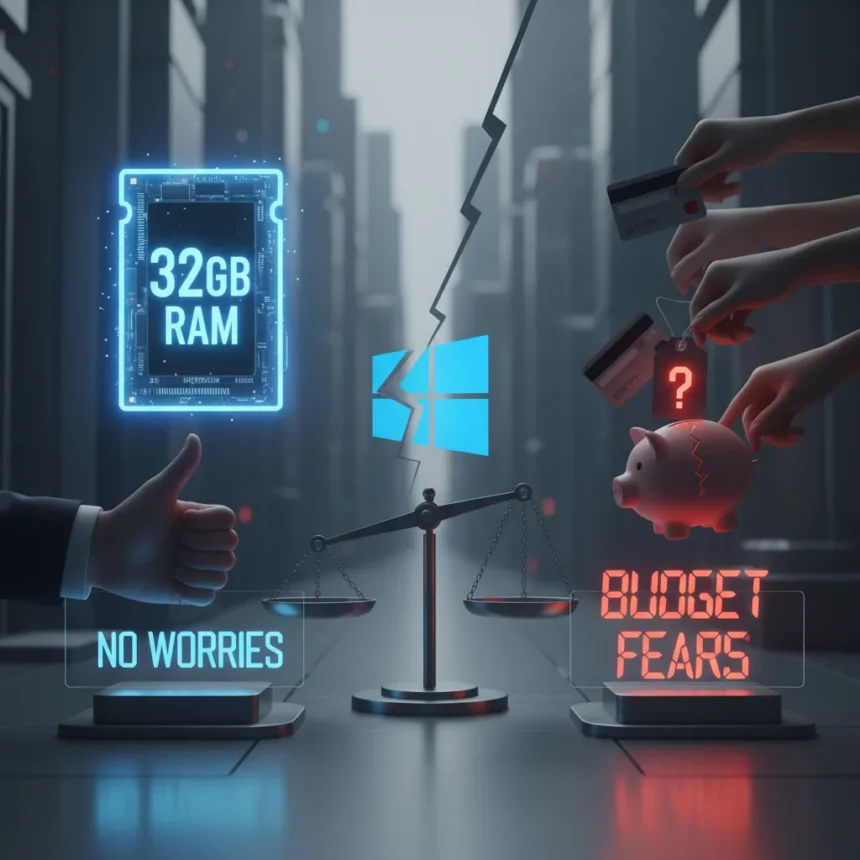
Windows 11 gaming RAM requirements just got murkier. Microsoft published guidance in April 2026 stating that 32GB of RAM is the “no worries” upgrade level for gaming on Windows 11, a recommendation that immediately triggered concern among budget-conscious builders and existing PC owners.
Key Takeaways
- Microsoft called 32GB RAM the “no worries” upgrade for Windows 11 gaming, though 16GB remains the practical baseline
- 32GB helps with multitasking—running Discord, browsers, and streaming tools alongside games without stutters
- Steam Hardware Survey shows 40.97% of gamers use 16GB, while 36.62% have upgraded to 32GB
- The specific “no worries” phrasing was removed after user backlash over budget implications
- Newer game titles are demanding more memory, pushing the industry toward higher baseline recommendations
What Microsoft Actually Said About Windows 11 Gaming RAM
Microsoft’s blog post on best features of Windows 11 gaming PCs positioned 32GB as the comfortable tier for worry-free gaming. The company stated: “16GB RAM is the baseline; 32GB is the ‘no worries’ upgrade”. The framing matters. By labeling 32GB as “no worries,” Microsoft implied that 16GB—still the practical starting point—carries some level of concern, at least for certain use cases.
The company clarified its intent in follow-up messaging: “For most players, 16GB RAM is a practical starting point. Moving to 32GB RAM helps if you run Discord, browsers, or streaming tools alongside your games. That extra memory also gives newer titles more breathing room as memory demands continue to rise”. This distinction between “practical” and “no worries” became the flashpoint for criticism. Users interpreted the guidance as Microsoft subtly pushing them toward a pricier upgrade that many felt was unnecessary.
Why 32GB Makes Sense for Multitasking, Not Raw Gaming
The real value of 32GB lies in what you’re doing beyond the game window. Running Discord, a web browser with multiple tabs, OBS for streaming, and a game simultaneously creates memory pressure that 16GB struggles to manage smoothly. With 32GB, that juggling act becomes effortless—background apps don’t cause frame rate dips, and you avoid the stuttering that happens when the system runs out of RAM and starts using slower storage as overflow.


For pure gaming—launching a title and nothing else—16GB remains sufficient for current and near-future releases. The gap between 16GB and 32GB isn’t raw gaming performance; it’s the breathing room that lets your system handle OS overhead, driver updates, and auxiliary apps without compromising frame rates. Newer games are indeed pushing memory demands higher, but that’s a gradual shift, not an immediate cliff.
The Budget Backlash: Why Users Fear Getting Priced Out
Microsoft’s phrasing backfired because it landed at a moment when PC gaming is already expensive. A 16GB-to-32GB upgrade isn’t trivial—it typically adds $50–$100 to a system build depending on RAM speed and brand. For gamers already stretching budgets to afford a decent GPU and CPU, that extra cost stings.



The timing of the recommendation also matters. Microsoft’s guidance came as game studios began shipping titles with higher memory footprints, creating a perception that the company was capitalizing on rising technical demands to nudge users toward premium configurations. The specific phrasing was removed after the backlash, but the damage to user sentiment was done. Many felt Microsoft was redefining the baseline upward to justify higher-priced gaming PCs in its own ecosystem.
What Steam Hardware Data Actually Shows
Real-world adoption tells a different story than Microsoft’s marketing. According to the Steam Hardware Survey, 40.97% of gamers still game with 16GB of RAM, while 36.62% have moved to 32GB. That’s nearly an even split, with a significant population still gaming comfortably on 16GB. Only 8.15% of surveyed gamers have 8GB or less, suggesting that 16GB has indeed become the de facto minimum.
This data undermines the “no worries” framing. If more than 40% of the gaming population is still using 16GB without widespread complaints, Microsoft’s implication that 32GB is necessary for peace of mind rings hollow. The survey reflects a gradual, market-driven shift toward higher RAM, not a sudden technical mandate.
32GB vs. 16GB: The Real Difference in Gaming
Here’s the practical truth: 32GB does not make your games run faster. It does not increase frame rates in most titles. What it does is eliminate stutters caused by memory pressure when you’re multitasking, and it provides headroom for games released 2–3 years from now that might demand more than 16GB. If you’re a single-game, closed-system gamer, 16GB is fine. If you’re streaming, running Discord, browsing, and gaming simultaneously, 32GB is genuinely useful.



The distinction matters because Microsoft conflated two separate concerns: raw gaming performance and system comfort. By calling 32GB the “no worries” tier, the company suggested that 16GB is somehow inadequate, when the real issue is use case, not gaming capability. Some users argue that 64GB is the true worry-free capacity, but that’s overkill for gaming alone and speaks to the absurdity of the escalation.
Should You Upgrade to 32GB for Windows 11 Gaming?
If your current system has 16GB and you’re gaming without major stuttering or background app interference, upgrading to 32GB is optional. If you’re building new and multitasking is part of your workflow—streaming, content creation, heavy web browsing—32GB is a sensible investment that will feel noticeably smoother. If you’re on a strict budget, 16GB remains a legitimate choice that will handle gaming and light multitasking without issue.
The real takeaway is that Microsoft’s “no worries” phrasing was marketing language, not a technical mandate. It reflected the company’s preferred configuration for its best-case gaming PC scenario, not a universal requirement. The backlash forced Microsoft to soften the messaging, but the underlying shift in memory demands is real—just slower and more gradual than the initial framing suggested.
Is 16GB still enough for Windows 11 gaming in 2026?
Yes, 16GB remains the practical baseline for Windows 11 gaming. It handles current and near-future titles without issue, though multitasking with streaming or content creation will feel smoother with 32GB. The choice depends on your specific workflow, not on a marketing recommendation.
Why did Microsoft remove the “no worries” phrasing?
User backlash over budget implications and the perception that Microsoft was pushing unnecessary upgrades forced the company to revise the guidance. The phrasing suggested 16GB was inadequate, which contradicted the real-world data showing millions of gamers gaming comfortably on 16GB.
How much does upgrading from 16GB to 32GB RAM cost?
A 16GB-to-32GB upgrade typically adds $50–$100 to a system build, depending on RAM speed, brand, and regional pricing. For budget-conscious builders, that’s a meaningful cost that factors into the decision to upgrade.
Microsoft’s Windows 11 gaming RAM guidance exposed a broader tension in the PC industry: the gap between what’s technically optimal and what’s actually necessary. The company’s “no worries” framing was aspirational, not practical. 32GB is genuinely useful for multitasking, but 16GB remains a perfectly valid choice for gamers focused on gaming alone. The real worry isn’t your RAM—it’s your budget, and Microsoft’s marketing didn’t help ease that concern.
Edited by the All Things Geek team.
Source: TechRadar