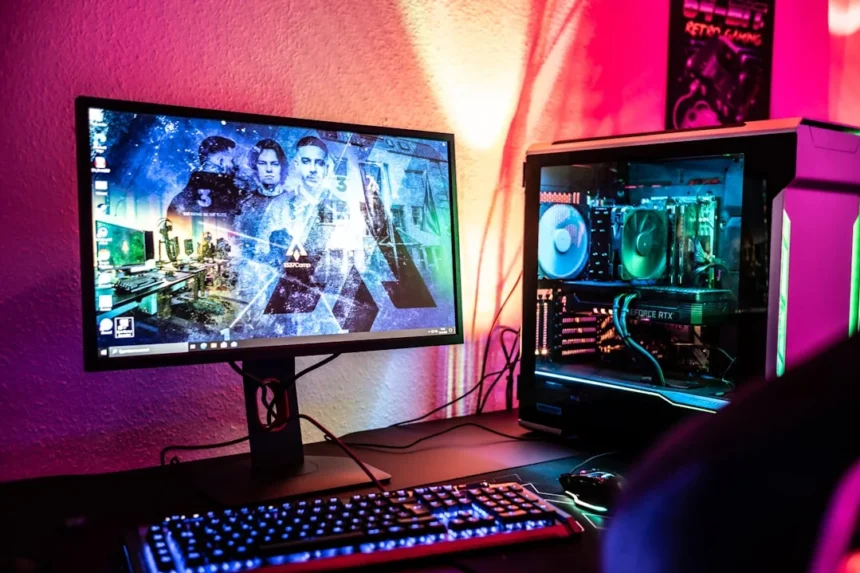
A room-sized gaming PC has emerged from the modding community, pushing the boundaries of what “custom build” actually means. This is not a case modification or a particularly large tower—it is literally the size of a room, complete with giant fans, industrial air conditioning, and inexplicably, a fully functional sauna.
Key Takeaways
- An unnamed modder constructed a gaming PC occupying an entire room with scaled-up components.
- The build includes industrial-grade cooling infrastructure rivaling commercial HVAC systems.
- A functional sauna is integrated into the setup for unclear reasons.
- The Corsair Obsidian 1000D, the world’s largest commercial PC case, is still dwarfed by this custom creation.
- The project highlights extreme solutions to gaming room heat problems.
The Room-Sized Gaming PC Explained
A room-sized gaming PC is a custom-built computer system that occupies an entire room rather than fitting into a traditional case or tower. This unnamed modder’s creation scales PC components—or builds custom alternatives—to room dimensions, with cooling infrastructure designed to manage the thermal load of a system that would make any standard gaming setup look miniature.
The sheer scale alone defies convention. Where typical gaming rigs fit under a desk or on a shelf, this build requires its own dedicated space. The modder did not simply buy large components; they engineered an entire thermal management ecosystem complete with oversized fans and air conditioning units that would be more at home in a commercial server room than a gamer’s bedroom.
Cooling Infrastructure That Rivals Industrial Systems
Keeping a room-sized gaming PC operational requires cooling solutions far beyond what a standard gaming setup demands. The build features giant fans and dedicated air conditioning systems working in concert to manage heat output. This is not a water-cooled loop with a few radiators—this is industrial-grade thermal engineering.


For context, the Corsair Obsidian 1000D, currently the world’s largest commercial PC case, supports dual 480mm radiators plus a 420mm top radiator for custom water cooling, alongside space for up to five GPUs. Yet even this extreme case is confined to a desk. The room-sized build exceeds the Obsidian entirely by occupying an entire room with cooling capacity that makes the Corsair’s radiator array look modest. The thermal demands of a system this large require active cooling infrastructure that operates continuously.
Why Is There a Sauna?
The decision to integrate a functional sauna into a room-sized gaming PC build defies logical explanation, which is precisely why it exists. The sauna serves no cooling purpose—if anything, it adds heat to the equation. Yet it remains part of the final design, a testament to the modder’s commitment to absurdity and their apparent sense of humor about the entire project.



This detail highlights a broader trend in extreme PC modding: when builders push the boundaries of what is technically possible, they often abandon pure utility in favor of spectacle. The sauna transforms the build from a mere engineering exercise into a statement—a full-room installation art piece that happens to also run games.
Room-Sized Gaming PC vs. Standard High-End Builds
Standard gaming PCs prioritize compact ventilation and efficient power delivery within constrained physical spaces. A budget gaming PC build focuses on balancing performance and thermals using a single case, a few intake and exhaust fans, and a power supply matched to component load. These setups assume desk placement and shared living space.
The room-sized gaming PC inverts every constraint. It has unlimited physical space, dedicated cooling infrastructure, and no concern for fitting into existing furniture or room layouts. Where a standard build might use a 240mm or 280mm radiator for water cooling, this custom creation employs giant fans and full air conditioning units. The comparison is not about performance—it is about philosophy. One approach solves thermal challenges within limits; the other eliminates limits entirely.
What This Build Says About Gaming Heat
The existence of a room-sized gaming PC with dedicated air conditioning reflects a real problem: gaming rooms genuinely do become uncomfortably hot during summer months, especially when running high-end hardware continuously. High-performance GPUs and CPUs generate substantial heat, and without proper cooling, gaming sessions become uncomfortable or impossible.



Most gamers address this with portable air conditioning units or improved room ventilation. The modder behind this build chose to solve it by making cooling the centerpiece of the entire design. While the sauna addition is clearly tongue-in-cheek, the underlying engineering reflects genuine thermal challenges that extreme gaming setups face.
Is a room-sized gaming PC actually practical?
No. A room-sized gaming PC is a novelty project, not a practical solution for gaming. It requires dedicated physical space, constant power input, ongoing maintenance of cooling systems, and air conditioning units that would cost more to operate than most people spend on gaming hardware annually. It exists because someone could build it, not because anyone should.
How does the Corsair Obsidian 1000D compare?
The Corsair Obsidian 1000D is the world’s largest commercial PC case, supporting dual complete systems, up to five GPUs, and extensive radiator mounting options. It is still desk-sized. The room-sized gaming PC dwarfs it by occupying an entire room instead of a single case, making direct comparison almost meaningless—they operate at entirely different scales and serve different purposes.
Why would someone build a room-sized gaming PC with a sauna?
Because the modding community thrives on pushing boundaries and creating spectacle. The sauna serves no functional purpose and actively works against cooling efficiency, which is precisely the point. It transforms an already extreme engineering project into a statement about absurdity and creative freedom in PC modding. The “why” is the fun.
The room-sized gaming PC is a reminder that PC modding exists on a spectrum from practical optimization to pure creative expression. Most builds fall somewhere in the middle, balancing performance gains with real-world constraints. This one abandons constraints entirely and asks: what if we just made everything bigger? The answer, apparently, includes a sauna.
Edited by the All Things Geek team.
Source: TechRadar