





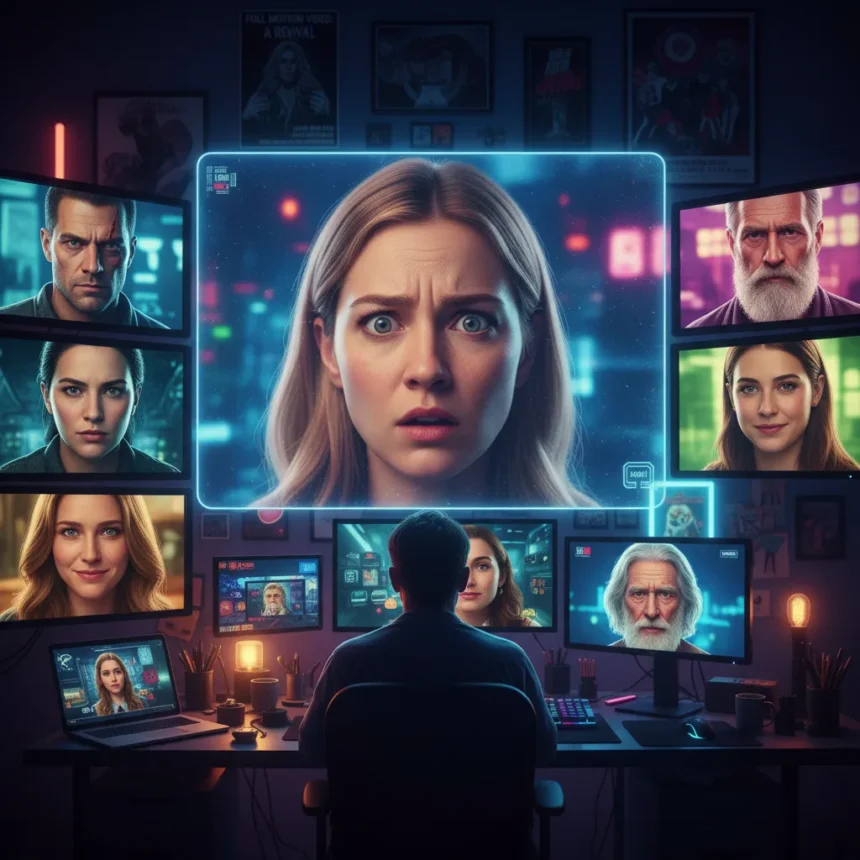
FMV gaming indie developers are proving that the most impressive faces in modern video games might not be rendered in real-time at all. Full Motion Video, a technique where pre-recorded live-action footage integrates directly into gameplay, dominated the 1990s before fading into obscurity. Now, nearly three decades later, indie creators are dusting off this forgotten approach and discovering that audiences—particularly Gen Z—find the results startlingly convincing.
Key Takeaways
- FMV gaming indie projects use live-action video footage integrated into gameplay, a technique popular in 1990s titles like Night Trap and Phantasmagoria.
- MoonStreet: The Playable Movie blends FMV with pixel art and 3D elements to create a noir aesthetic with realistic human faces.
- Modern audiences mistake FMV faces for AI-generated or motion-captured CGI, unaware they are watching actual recorded actors.
- Indie developers leverage affordable smartphone cameras and editing software to create FMV content, bypassing the high costs of 3D facial animation.
- Recent FMV indie titles like Her Story and Telling Lies demonstrate sustained creative interest in the format beyond nostalgia.
Why FMV Gaming Indie Is Returning Now
FMV gaming indie represents a paradox: a technique considered technologically obsolete is now thrilling players who assumed modern games could only achieve realism through polygon-pushing and ray tracing. The shift is driven partly by accessibility. Where 1990s FMV required expensive film equipment and post-production facilities, today’s indie developers can shoot realistic footage on smartphones and edit it with free or low-cost software. This democratization has made FMV viable for solo creators and small teams who could never afford AAA-grade 3D facial animation pipelines.
The technique gained prominence in the early 1990s through titles like Night Trap on Sega CD in 1992, The 7th Guest in 1993, and Phantasmagoria in 1995. These games embedded video sequences directly into interactive experiences, creating an uncanny blend of cinema and gameplay. Players were fascinated and, often, deeply unsettled. That discomfort faded as 3D graphics improved, and FMV became a punchline—a relic of an era when game developers mistook Hollywood production values for compelling interactive design.
MoonStreet: The Playable Movie Leading the Revival
The indie game MoonStreet: The Playable Movie exemplifies how FMV gaming indie is evolving. Described as a pixel-styled 3D retro-noir title, MoonStreet integrates live-action footage of real actors into a deliberately low-resolution aesthetic. The contrast is jarring and intentional: hyper-realistic human faces emerge from pixelated environments, creating a visual tension that feels both nostalgic and unsettling. Social media reactions reveal genuine confusion. Players post screenshots asking whether the faces are AI-generated, motion-captured, or somehow rendered in real-time. The answer—they are simply actors recorded on camera—surprises people who expected such realism to require latest technology.


This confusion is the heart of FMV gaming indie’s appeal. In an era saturated with photogrammetry, neural rendering, and procedural animation, audiences have forgotten that actual video footage of human beings is the ultimate expression of realism. No algorithm can compete with a camera pointed at an actor’s face. FMV gaming indie exploits this blind spot, using a 30-year-old technique to achieve something that feels avant-garde.
FMV Gaming Indie Versus Modern 3D Animation
The comparison between FMV gaming indie and contemporary 3D facial animation reveals why the retro approach holds unexpected advantages. Modern AAA games invest heavily in real-time 3D face models, using motion capture suits and complex shader networks to approximate human likeness. These systems are computationally expensive, require specialized equipment, and still often fall into the uncanny valley—close enough to human appearance to trigger discomfort rather than recognition.



FMV gaming indie sidesteps this problem entirely. A recorded actor is already human; no approximation is necessary. The trade-off is flexibility. A 3D character model can turn its head in any direction, express any emotion on demand, and respond dynamically to player choices. FMV footage is locked in place, predetermined. But modern FMV indie developers are solving this limitation through creative framing and editing, layering video sequences strategically to create the illusion of interaction. Her Story, released in 2015, pioneered this approach by using fragmented video clips of an actress to construct a mystery narrative. Telling Lies, released in 2019 and designed by Sam Barlow, expanded the technique further, embedding video conversations into a desktop interface.
The Broader FMV Gaming Indie Trend
MoonStreet is not an isolated experiment. A wave of recent indie titles have embraced FMV gaming indie as a legitimate creative choice rather than a nostalgic gimmick. The Infectious Madness of Doctor Dekker, released in 2017, combined FMV with psychological horror. These projects suggest that FMV gaming indie is becoming a recognized aesthetic and design philosophy, not merely a throwback.
Part of this resurgence reflects a generational shift. Gen Z players discovering 90s FMV games online encounter them as lost media, untethered from the technological context that made them seem primitive. To modern eyes, Night Trap or The 7th Guest feel experimental and surreal rather than dated. This reframing has given indie developers permission to treat FMV not as a limitation to overcome but as a style to embrace. The pixelated environments in MoonStreet deliberately echo early 3D games, creating visual coherence with the FMV faces rather than fighting them.
Why FMV Gaming Indie Matters for Game Development
The resurgence of FMV gaming indie challenges assumptions about what constitutes technical achievement in games. For decades, the industry has measured progress through polygon counts, shader complexity, and rendering speed. FMV gaming indie inverts this hierarchy. It suggests that realism and innovation are not synonymous, and that sometimes the oldest solution to a problem is the best one.


For indie developers specifically, FMV gaming offers a path to visual sophistication without requiring years of 3D art training or expensive software licenses. A filmmaker with a camera and editing skills can now create a game with faces as realistic as anything in AAA titles. This democratization could reshape indie game development, enabling new voices and perspectives to enter the medium.
Is FMV gaming indie just nostalgia?
FMV gaming indie is partly nostalgic, but it is also pragmatic. Yes, the technique evokes 1990s aesthetics, and that appeal matters to players. But the core reason indie developers are choosing FMV is practical: it delivers visual results that would otherwise require resources they do not have. Nostalgia is the wrapper; accessibility is the engine.
How does FMV gaming indie differ from motion capture?
FMV gaming indie uses pre-recorded video footage of actors, while motion capture records movement data that is then applied to 3D character models. FMV is simpler and cheaper—you only need a camera and editing software. Motion capture requires specialized suits, markers, and tracking equipment, making it inaccessible to most indie teams.
Can FMV gaming indie adapt to player choices?
Traditional FMV is linear, but modern FMV gaming indie projects like Her Story and Telling Lies use branching video sequences and fragmented editing to create the illusion of interactivity. Players navigate databases, make selections, and uncover different video clips based on their choices, maintaining agency within a pre-recorded framework.
The resurgence of FMV gaming indie proves that video game innovation does not always mean technological advancement. Sometimes it means looking backward, dusting off forgotten tools, and discovering that they solve contemporary problems in unexpected ways. As indie developers continue experimenting with this retro technique, expect more players to do a double-take at those impossibly realistic faces—and more will realize that the most futuristic thing a game can do is simply record an actor and let them be human.
Edited by the All Things Geek team.
Source: Creativebloq




