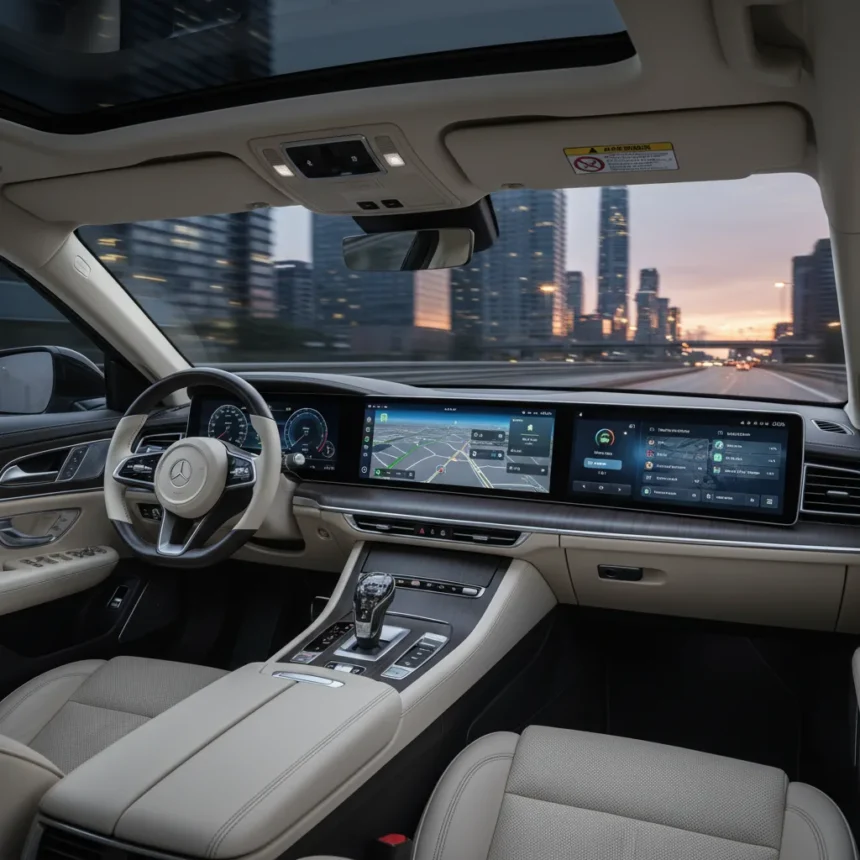
Apple CarPlay Ultra is the next-generation version of Apple CarPlay, designed to extend across multiple screens in vehicles including dashboard displays, instrument clusters, and passenger screens. Tested in the Aston Martin DB12 S—a luxury grand tourer with a 12.3-inch digital instrument cluster, 10.25-inch central touchscreen, and optional passenger display—the software reveals a glimpse of where in-car integration could go. The problem: only the richest drivers will ever see it.
Key Takeaways
- Apple CarPlay Ultra spans multiple vehicle screens simultaneously, unifying navigation, climate, and entertainment controls.
- Customizable widgets and live activities appear on instrument clusters and dashboards for real-time information.
- Feature requires iPhone 15 Pro or newer running iOS 26 or later.
- Currently available only in premium vehicles like Aston Martin DB12 S (starting at £190,000) and select Porsche models.
- No aftermarket support or mainstream vehicle compatibility planned, limiting adoption to ultra-luxury segment.
What Makes Apple CarPlay Ultra Actually Work
Apple CarPlay Ultra transforms the driving experience by treating the entire vehicle dashboard as one unified iOS extension. Rather than confining navigation and controls to a single central screen, the software orchestrates information across every display. Maps overlays appear on the instrument cluster while widgets show real-time data on passenger screens and climate controls integrate directly into CarPlay menus. This architectural depth separates Apple CarPlay Ultra from its predecessors, which operated within single-screen silos.
The three standout capabilities deserve specific attention. First, full integration across all vehicle screens creates a genuinely seamless interface—no switching between native car software and CarPlay, no visual fragmentation. Second, customizable widgets and live activities transform the instrument cluster from a static readout into a dynamic information hub. Third, direct control of car functions like radio, climate, and seat adjustments from CarPlay menus eliminates the friction of toggling between systems. In the Aston Martin DB12 S, this cohesion feels genuinely premium. Widgets on the speedometer, Maps overlaying the rev counter—it’s seamless until you hit the price wall.
The Cost Barrier That Kills Apple CarPlay Ultra’s Promise
Apple CarPlay Ultra’s greatest weakness is not technical—it’s commercial. The feature exists only in vehicles starting at £150,000 or higher, with the Aston Martin DB12 S priced at £190,000 in UK markets. Porsche has added it to select 2025 Cayenne models, and Hyundai Genesis and Audi e-tron GT will follow in 2026. That’s the entire rollout. No aftermarket upgrades. No retrofit kits. No support for mainstream vehicles. Apple CarPlay Ultra is not coming to your Honda Civic or Tesla Model 3, and there are no plans to change that.


This exclusivity fundamentally undermines the technology’s impact. Android Auto, despite lacking multi-screen depth and instrument cluster integration, reaches millions of vehicles globally through aftermarket head units and mainstream manufacturer adoption. Tesla’s native UI, while proprietary and closed to CarPlay entirely, offers superior native navigation with EV-specific features like battery preconditioning across its entire fleet. Apple CarPlay Ultra, by contrast, remains a curiosity for the ultra-wealthy—impressive in isolation, irrelevant at scale. The software is free with compatible hardware, but the hardware itself costs more than most people’s homes.
Apple CarPlay Ultra vs. The Competition
Comparing Apple CarPlay Ultra to existing alternatives reveals why its limited availability matters. Android Auto has recently added YouTube audio-only playback to its feature set, but it still cannot match multi-screen orchestration or instrument cluster integration. Pioneer aftermarket add-ons can deliver Dolby Atmos audio enhancement for CarPlay, yet they remain confined to single-screen audio enhancements rather than full dashboard takeover. GM’s Ultifi platform represents a different philosophy entirely—focusing on in-house software rather than Apple’s ecosystem—but it reaches far more vehicles. Tesla’s rumored CarPlay support would likely run in windowed mode without full optimization, preserving the company’s control over its native interface.



The competitive landscape reveals that Apple CarPlay Ultra is not losing a technical war. It is losing an accessibility war. The software does what it promises: seamless multi-screen integration, real-time widgets, unified control. The problem is that promise reaches only luxury buyers willing to spend £150,000 or more on a vehicle. Android Auto’s limitations matter less when it reaches fifty times more cars. Ultifi’s proprietary approach matters less when it ships in millions of vehicles yearly. Apple CarPlay Ultra is technically superior but commercially irrelevant.
What You Actually Need to Use Apple CarPlay Ultra
Running Apple CarPlay Ultra requires an iPhone 15 Pro or newer paired with iOS 26 or later—both free to existing iPhone owners. The software requirement is straightforward: no surprises, no subscription fees. The hardware requirement is the sticking point. Your vehicle must be a 2024 or newer Aston Martin DB12, a select 2025 Porsche Cayenne, or one of the upcoming Hyundai Genesis or Audi e-tron GT models. If your car predates these models or falls outside this ultra-premium segment, Apple CarPlay Ultra simply does not exist for you. There is no path to adoption. No future update will unlock it. No aftermarket solution will bring it to your vehicle.
Will Apple CarPlay Ultra Ever Reach Mainstream Vehicles?
The short answer: not anytime soon. Apple’s rollout strategy prioritizes ultra-luxury manufacturers willing to redesign their entire dashboard architecture around multi-screen integration. That design work is expensive, which is why only brands targeting six-figure vehicles are participating. Mainstream manufacturers like Toyota, Honda, and Ford have no financial incentive to undertake that investment when existing CarPlay systems already satisfy customer demand. Tesla’s refusal to support CarPlay at all—even in rumored future implementations—suggests that premium automakers increasingly prefer proprietary software control. Apple CarPlay Ultra remains locked in the ultra-premium segment because that is where the money is and where manufacturers can justify the engineering investment.
Is Apple CarPlay Ultra worth the upgrade if you own a compatible vehicle?
For Aston Martin DB12 S and compatible Porsche owners, Apple CarPlay Ultra is a genuine differentiator that justifies the premium hardware it ships on. The multi-screen integration, customizable widgets, and unified control genuinely improve the driving experience. However, the feature should not influence your vehicle purchase decision unless you were already considering a £150,000+ luxury car. Buying an Aston Martin specifically for CarPlay Ultra would be economically absurd. If you are already shopping in that segment, the software is a welcome bonus, not the primary draw.



When will Apple CarPlay Ultra come to other vehicles?
Hyundai Genesis and Audi e-tron GT will gain Apple CarPlay Ultra support in 2026, expanding the feature beyond Aston Martin and Porsche. No mainstream brands—Toyota, Honda, Ford, Volkswagen, or others—have announced plans to support it. The feature is unlikely to reach vehicles under £100,000 in the foreseeable future. If you own a non-luxury vehicle, expect to wait years, if ever, for this technology to trickle down.
Apple CarPlay Ultra is technically impressive and genuinely useful for drivers fortunate enough to access it. The multi-screen integration, customizable widgets, and unified control represent a meaningful leap forward in in-car software design. Yet the feature’s commercial failure is already baked in: locked behind six-figure price tags, unavailable for aftermarket installation, and unsupported on the vehicles most people actually drive. Apple built something brilliant and then made it inaccessible to everyone who needs it. That is not a product strategy—it is a luxury novelty.
Where to Buy
JVC KW-M785DBW | Pioneer SPH-10BT | Kenwood DMX-5020DABS
Edited by the All Things Geek team.
Source: T3