





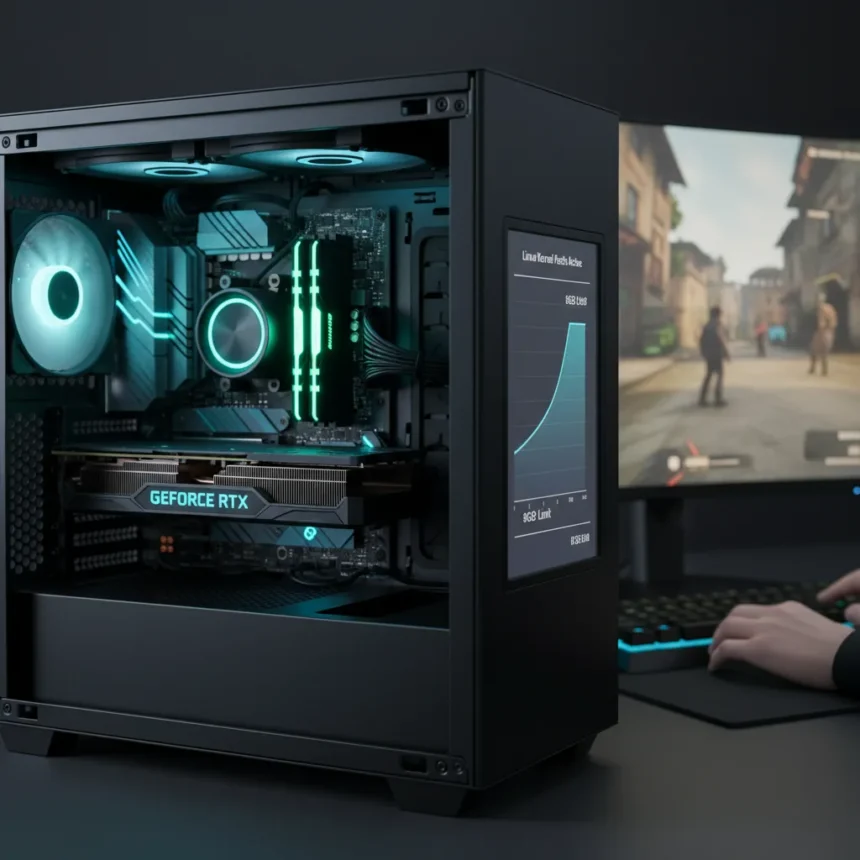
Linux VRAM management has long frustrated budget PC gamers, but a breakthrough from Valve engineer Natalie Vock is changing that. Vock, a developer on Valve’s Linux graphics driver team working primarily on the RADV Vulkan driver, has submitted kernel patches that rewrite how Linux handles memory when GPUs run out of VRAM. The fix targets a critical bottleneck: when 8GB graphics cards overflow, data spills into Graphics Translation Table (GTT) memory—essentially system RAM—causing severe stuttering because system memory runs at a fraction of GPU VRAM speed.
Key Takeaways
- Valve engineer Natalie Vock introduced Linux kernel patches optimizing VRAM allocation for gaming workloads
- 8GB GPUs experience stuttering when VRAM overflows into slower system RAM, affecting demanding titles like Cyberpunk 2077
- Patches prioritize foreground games over background applications, relegating non-critical tasks to system memory
- Fixes include DRM device memory cgroup controller support and changes to TTM memory management code
- CachyOS users on KDE Plasma can test patches now; broader kernel adoption pending
Why Linux VRAM management matters for budget gamers
The problem is straightforward but devastating to frame rates. When a demanding game like Cyberpunk 2077 fills a 8GB GPU’s VRAM, the Linux kernel’s memory eviction system kicks in. Without optimization, it treats all memory equally—background browser tabs, system daemons, and the game itself compete for space. When the game’s data gets evicted to system RAM, the GPU must fetch it from the much slower main memory, causing hitches and stuttering that make the game feel unresponsive. This is not a hardware limitation but a software scheduling problem, which means it is fixable.
Budget PC gamers are increasingly hitting this wall. A 8GB graphics card was once sufficient for high-end gaming, but modern AAA titles push memory demands higher each year. Rather than forcing users to upgrade to 12GB or 16GB cards, Vock’s patches solve the problem at the kernel level by implementing priority-aware memory management. The fix tells Linux: when VRAM is tight, protect the foreground game’s data and push background processes to system RAM instead.
How the Linux VRAM management patches work
The solution involves two main technical components: DRM device memory cgroup controller support and revisions to TTM (Translation Table Maps) memory management code. In plain terms, cgroup controllers let the kernel assign memory budgets to different processes. The patches use this to give games a protected VRAM allocation while background tasks accept the slower system RAM fallback. TTM is the subsystem that moves data between VRAM and system memory; rewriting its eviction logic ensures the kernel prioritizes game data for retention.


This is a Linux-specific fix addressing a problem that does not manifest the same way on Windows or macOS, where GPU memory management operates differently. The patches are free and submitted to the Linux kernel, meaning they will eventually reach all Linux distributions—but adoption depends on upstream kernel maintainers accepting the changes. Currently, CachyOS users on KDE Plasma can test the patches via package installation, providing early feedback before mainline integration.
Performance gains in real gaming scenarios
Early testing shows measurable improvements in demanding titles. Cyberpunk 2077, a notorious VRAM hog, benefits from reduced stuttering when running on 8GB cards with the patches applied. The gains are most noticeable during scene transitions and when the game loads new assets—exactly the moments when VRAM pressure peaks and eviction typically causes frame drops.



The breakthrough does not eliminate the performance gap between 8GB and 16GB cards entirely. A 16GB GPU still has more breathing room and will outperform in extremely demanding scenarios. But for the sweet spot of modern gaming—1440p high settings with ray tracing on mid-range hardware—the patches make 8GB cards viable again without stuttering compromises.
When will Linux VRAM management patches reach your system?
CachyOS users running KDE Plasma can test the patches immediately through package updates. For users on mainstream distributions like Ubuntu, Fedora, or Arch, the timeline depends on kernel inclusion. Valve has submitted the patches upstream, but kernel maintainers review changes carefully. If accepted, the patches will appear in a future kernel version—likely within the next few months—and then roll out to distributions as they update their kernel packages.
This is not a quick fix you can download today for every Linux system. It is a foundational change that requires kernel-level adoption. However, the fact that Valve is investing engineering resources in Linux gaming infrastructure signals serious commitment to the platform. The company has already fixed VRAM misreporting in Steam Hardware Surveys, and these patches represent another step in removing friction from Linux gaming.
Does this fix work on AMD and Nvidia GPUs equally?
The patches target the Linux kernel’s memory management layer, which is hardware-agnostic. Both AMD and Nvidia GPUs use the same kernel subsystems for VRAM allocation. However, the RADV driver (which Vock works on) is AMD-specific, so early testing and optimization may favor AMD Radeon cards. Nvidia GPU users will benefit once the patches reach the mainline kernel, though driver-specific optimizations might follow separately.


Will this eliminate the need to upgrade from 8GB to 16GB?
Not entirely, but it removes the urgency for many gamers. The patches solve the stuttering problem caused by poor memory eviction, but they do not increase actual VRAM capacity. A game that genuinely needs 10GB of VRAM will still run slower on 8GB than on 16GB. What changes is the experience: instead of stuttering and hitching, you get consistent frame rates at a lower baseline. For 1440p gaming at high settings, this is often acceptable. For 4K ultra settings, upgrading remains the better solution.
Closing thoughts on Linux VRAM optimization
Natalie Vock’s Linux VRAM management patches represent a rare moment when smart software engineering solves a hardware limitation without requiring new hardware. For the millions of Linux gamers running 8GB GPUs—whether by choice or budget—this fix is a genuine significant shift. It will not make a 8GB card perform like a 16GB card, but it will make it perform like a 8GB card is supposed to: smoothly, without stuttering, and without artificial handicaps from poor kernel scheduling. The real question now is how quickly the patches reach the mainline kernel and, by extension, your system.
Edited by the All Things Geek team.
Source: Tom's Hardware




