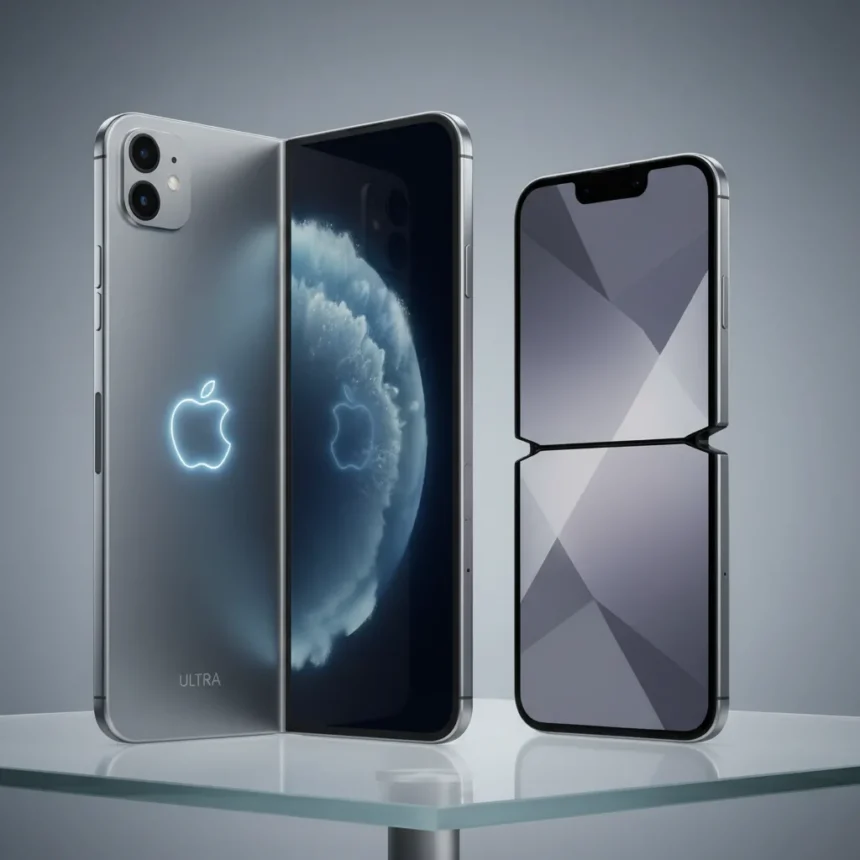
iPhone Ultra is Apple’s likely name for its upcoming book-style foldable smartphone, according to multiple leakers, and it is a far smarter branding choice than iPhone Fold. The shift from Fold to Ultra signals Apple’s intent to position the device as a premium flagship above the Pro lineup, not as a derivative competitor to Samsung’s Galaxy Fold series. For a company that has built its brand on precision naming, this distinction matters more than it might seem.
Key Takeaways
- iPhone Ultra is the expected name for Apple’s 2026 foldable, confirmed by leakers Digital Chat Station and Instant Digital
- Book-style design with wide-screen format, priced between $2,000 and $2,500
- Launch expected fall 2026 alongside iPhone 18 series; production in final stages with 11 million unit initial stock
- Ultra branding positions device above Pro models and avoids Samsung’s Fold naming convention
- Chinese foldable makers already considering Ultra branding for their own wide-screen devices
Why iPhone Ultra Beats iPhone Fold as Branding
Calling the device iPhone Fold would be a marketing blunder. Fold is Samsung’s territory—it is the name consumers associate with the Galaxy Fold, and Apple copying it would make the company look reactive rather than innovative. Ultra, by contrast, is already part of Apple’s premium product language. The company uses Ultra for its Apple Watch Ultra and M-series chips like the M1 Ultra and M3 Ultra, establishing it as the label for products that sit above the standard tier. Extending Ultra to a foldable iPhone signals that this is not just another phone with a hinge—it is a category-defining device positioned higher than even the Pro Max.
The naming choice also sidesteps a fundamental branding problem. Fold describes what the phone does mechanically, not what it offers strategically. Ultra describes a positioning: premium, powerful, uncompromising. As one leaker noted, ultra products are not necessarily about maxing out every spec, but about delivering premium experience in a distinct form factor. For a device expected to cost $2,000 to $2,500, that messaging is essential.
How iPhone Ultra Positions Apple’s Foldable Strategy
By choosing Ultra over Fold, Apple signals that the foldable is not a spin-off or variant of the iPhone 18 Pro line—it is a separate flagship tier. This positioning matters for marketing, retail strategy, and customer expectations. A Pro Max feels like an incremental upgrade; an Ultra feels like a leap. The device sits above the Pro lineup, not alongside it, which justifies both its premium price and its distinct identity.


Leaker Instant Digital confirmed that production is already in final processing stages, with launch likely alongside the iPhone 18 series in fall 2026, though a one-month delay is possible. Initial stock projections of 11 million units suggest Apple is committing real manufacturing capacity to the foldable, not treating it as a niche experiment. That scale demands a name that communicates premium positioning, not a description of its hardware feature.
The Global Naming Ripple: Chinese Competitors Already Following
Apple’s naming choices do not exist in isolation. Chinese foldable makers are already considering Ultra branding for their own wide-screen foldables, though likely at lower price points. This is both flattery and a warning: if Apple nails the Ultra positioning, competitors will chase it. The risk is that Ultra becomes as commodified as Fold, but Apple’s ecosystem advantage—integration with iOS, Apple Watch, and services—means the name will carry more weight coming from Cupertino than from rivals.



The foldable will lack Face ID and carry one fewer camera than Pro models, which are meaningful compromises for a $2,000-plus device. Ultra branding helps justify those trade-offs by emphasizing form factor innovation over spec completeness, whereas Fold branding would invite direct spec-by-spec comparison with the Pro Max.
What About iPhone Fold? Why It Falls Short
iPhone Fold would be the safe choice—descriptive, clear, immediately communicating what the device does. But safety is not Apple’s brand language. The company does not release products named for their primary feature; it releases products named for their positioning. iPhone Fold sounds like a feature update. iPhone Ultra sounds like a new product category. For a device that requires consumers to accept a $2,000 price tag and a form factor shift, that distinction is everything.
Alternative names floated by leakers—iFold, iPhone Duo, or MacBook Neo-style surprise branding—lack the premium resonance of Ultra. Ultra is already proven in Apple’s ecosystem. It carries weight.
Does iPhone Ultra avoid the Samsung problem?
Yes. Ultra is Apple’s branding language, not Samsung’s. While Fold is synonymous with the Galaxy Fold and feels derivative, Ultra is established across Apple’s premium product line, from smartwatches to processors. Using Ultra positions the foldable as an Apple innovation, not a Samsung response.



Will Chinese competitors use Ultra for cheaper foldables?
Likely. Leakers report that Chinese brands are already considering Ultra branding for wide-screen foldables at lower price points. This could dilute the Ultra positioning over time, but Apple’s ecosystem integration and premium pricing will likely keep the iPhone Ultra distinct in the market.
When will iPhone Ultra actually launch?
Fall 2026, most likely in September alongside the iPhone 18 series, though a one-month delay is possible. Production is in final processing stages with initial stock of 11 million units, suggesting the timeline is firm.
iPhone Ultra is not just a name change—it is a strategic positioning choice. By abandoning Fold, Apple avoids Samsung’s shadow and claims the premium tier above its own Pro lineup. For a device this expensive and this different, the name is the message. Ultra delivers that message perfectly.
Edited by the All Things Geek team.
Source: Tom's Guide