






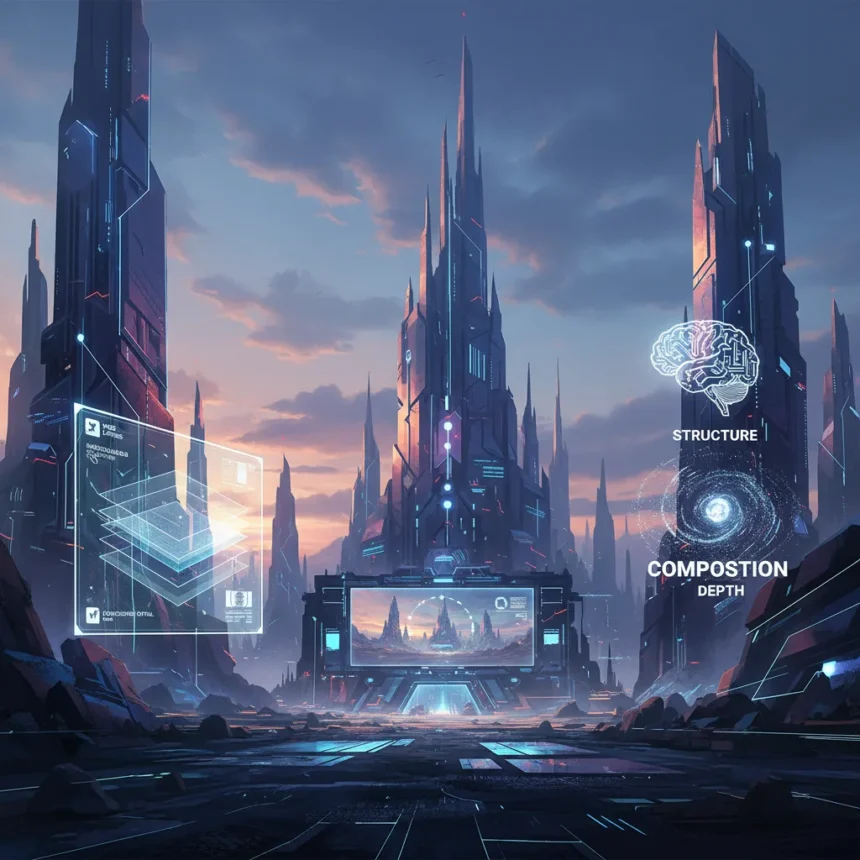
Matte painting structure refers to the organized framework that digital artists use to construct believable cinematic environments, game concepts, and personal illustrations. Unlike spontaneous digital painting, structured matte painting relies on deliberate composition planning, layering strategies, and depth management to create worlds that feel three-dimensional and immersive. Getting the structure right separates amateur digital environments from work that looks like it belongs in a film or AAA game.
Key Takeaways
- Matte painting structure begins with clear composition planning before any brushwork starts
- Layering organization determines how believable depth and atmosphere become in final renders
- Foreground, midground, and background separation is essential for cinematic impact
- Value study and tonal blocking establish visual hierarchy before adding detail
- Atmospheric perspective and color temperature shifts create distance illusion
Why Matte Painting Structure Matters for Cinematic Work
A structured approach to matte painting separates professional environment design from experimental digital painting. When you plan your matte painting structure upfront, you avoid the common trap of adding detail randomly across the canvas, which leads to muddy, unconvincing spaces. Professional concept artists and environment designers start with architecture, perspective, and spatial relationships before touching color or texture.
The difference between a flat digital painting and a cinematic environment comes down to intentional depth layering. Without matte painting structure, even technically skilled brushwork produces environments that read as 2D backdrops rather than spaces where characters or players could actually exist. Structure forces you to think three-dimensionally on a two-dimensional canvas.
Building Effective Matte Painting Structure: The Layering Foundation
The core of matte painting structure is organizing your work into distinct spatial zones: foreground, midground, and background. Each zone should be physically separated in your layer hierarchy and treated with different levels of detail, color saturation, and atmospheric effect. Foreground elements are sharp, detailed, and colorful. Midground elements show moderate detail and begin atmospheric shift. Background elements are soft, desaturated, and hazy.

This separation is not just aesthetic—it is structural. When you build matte painting structure this way, viewers instinctively read depth because their eyes process information the same way they do in real life. Objects that are sharp and saturated appear closer; soft and desaturated objects appear distant. This is atmospheric perspective, and it is the invisible backbone of every cinematic environment that works.
Within each zone, establish clear architectural or landscape logic. If your foreground contains ruins, those ruins should have weight, scale, and structural integrity. If your midground shows a distant city, the buildings should follow perspective rules consistently. Sloppy perspective within any zone of your matte painting structure undermines the entire composition, no matter how pretty the brushwork is.



Composition and Perspective in Matte Painting Structure
Before you paint a single stroke, establish your vanishing points and horizon line. Many digital artists skip this step because digital tools feel looser than traditional media, but this is precisely where matte painting structure fails for beginners. A clear perspective grid or at least a mental map of where your vanishing points sit will prevent your environment from feeling warped or disorienting.
Composition within matte painting structure should guide the viewer’s eye through the space. Use leading lines—roads, rivers, architecture edges—to direct attention toward your focal point. This is not accidental; it is structural. A well-composed matte painting pulls the eye naturally from foreground through midground to background, creating a sense of journey through the space.
Value structure is equally critical. Before introducing color, many professional environment artists block in their composition using only grayscale values. This forces you to establish clear light, shadow, and midtone relationships without getting distracted by color. Once your value structure is solid, color becomes an enhancement rather than a crutch masking poor underlying composition.
Atmospheric Effects and Color Temperature in Matte Painting Structure
Atmospheric perspective is the technical term for how air and distance affect what we see. Objects far away appear hazier, cooler in color temperature, and lower in contrast. Objects nearby are sharp, warmer, and higher in contrast. This is not optional in matte painting structure—it is mandatory if you want cinematic believability.



Apply this principle systematically across your layers. Foreground elements should have warm color temperatures, high saturation, and sharp edges. As you move back through your matte painting structure, gradually shift toward cooler temperatures, lower saturation, and softer edges. This creates the illusion of atmospheric depth without relying on blur filters, which can look artificial if overdone.
Lighting consistency is another structural requirement. All light sources in your matte painting structure should cast shadows in the same direction and maintain consistent color temperature. If your key light is warm golden sunlight, shadows should be cool and blue-tinted. If you violate this principle, the environment immediately feels like a collage of unrelated elements rather than a cohesive space.
Detail Distribution and Visual Hierarchy
One of the biggest mistakes in matte painting structure is distributing detail equally across the entire canvas. Professional environments concentrate detail where it matters most—usually the focal point and foreground—and simplify everything else. This is not laziness; it is visual hierarchy.
Your eye can only process so much information at once. By concentrating detail in strategic areas and simplifying peripheral zones, you actually make your matte painting structure more readable and cinematic. Video games and films use this principle constantly. The area the camera focuses on is highly detailed; the background is painterly and simplified.
How do you start planning matte painting structure?
Begin with thumbnail sketches that establish composition, perspective, and value distribution. These rough sketches should take minutes, not hours. The goal is to lock in your spatial organization before you commit to full-size painting. Sketch your foreground, midground, and background zones, establish your horizon line and vanishing points, and block in your light direction.
What is the difference between matte painting and concept art?
Matte painting structure is typically more photorealistic and focuses on creating a finished, camera-ready environment, while concept art explores ideas and variations more loosely. Both require structural thinking, but matte paintings usually target a specific final look, whereas concept art prioritizes communicating ideas quickly across multiple iterations.
Should you use 3D models within matte painting structure?
Many professional environment artists combine 3D models with digital painting to establish accurate perspective and architecture, then paint over the models to add detail and atmosphere. This hybrid approach can accelerate matte painting structure development while maintaining perspective accuracy that would be difficult to achieve through painting alone.
Matte painting structure is not a limitation—it is a framework that enables more convincing, immersive digital environments. Whether you are building worlds for games, concept art, or personal illustration, treating your composition as a structured spatial system rather than a flat canvas elevates every aspect of the final image. Start with clear planning, respect atmospheric perspective, and let your structure guide every brushstroke.
Edited by the All Things Geek team.
Source: Creativebloq