





Steam Machine 4K 120Hz support is coming, according to leaked firmware details tied to a massive US import shipment that signals Valve’s long-delayed console could launch within weeks. After years of false starts and supply chain chaos, the Linux-based home console is finally becoming real—and it might actually rival PlayStation 5 and Xbox Series X on raw specs.
Key Takeaways
- Steam Machine ships with semi-custom AMD Zen 4 CPU (6 cores, 12 threads) and discrete RDNA3 GPU for 4K gaming at 60fps with FSR
- Post-launch firmware update will unlock full HDMI 2.1 support for 4K 120Hz and Variable Refresh Rate, matching current-gen consoles
- 16GB DDR5 RAM is user-upgradeable via SODIMM; storage options include 512GB or 2TB SSD with SD card expansion
- Runs SteamOS optimized for TV; Steam Deck Verified games auto-verified; new games require only 1080p 30fps minimum
- Massive shipment to USA suggests May 2026 launch possible after Q1 delays tied to RAM and chip supply issues
Steam Machine 4K 120Hz: What You Need to Know
The Steam Machine is a compact Linux-based PC running SteamOS, designed as Valve’s answer to living-room gaming consoles. Unlike the original 2015 Steam Machines—third-party small form factor PCs that quietly disappeared by 2018—this version is built directly by Valve with fixed specifications and a discrete GPU, making it fundamentally more powerful than its predecessor. The surprise revelation is post-launch firmware support for full HDMI 2.1, unlocking 4K gaming at 120Hz with Variable Refresh Rate, a feature that positions it squarely against PlayStation 5 and Xbox Series X rather than as a mid-tier alternative.
Valve announced the Steam Machine alongside a second-generation Steam Controller and the Steam Frame wireless VR headset on November 12, 2025. The company initially promised pricing and launch details by now, but supply chain delays have pushed timelines back. Import data showing massive shipments arriving in the United States suggests the announcement window is narrowing—possibly to May 2026, though Valve has not confirmed an exact date.
Hardware Specs That Actually Matter
The Steam Machine runs a semi-custom AMD Zen 4 CPU with 6 cores and 12 threads, capable of boosting to 4.8GHz, paired with a semi-custom AMD RDNA3 discrete GPU. This is not a handheld like the Steam Deck; it is a stationary console with genuine desktop-class gaming power. The system includes 16GB of DDR5 RAM (user-upgradeable via SODIMM), 8GB of GDDR6 VRAM dedicated to the GPU, and storage options of either 512GB or 2TB SSD. An SD card slot allows expansion without cracking open the chassis.

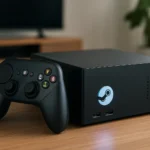
Out of the box, the Steam Machine supports 4K gaming at 60fps with FSR (FidelityFX Super Resolution) enabled. That is respectable, but not console-crushing. The real story is the firmware unlock: a post-launch update will enable full HDMI 2.1 support, allowing 4K at 120Hz with Variable Refresh Rate—the same visual ceiling as a PS5 Pro or Xbox Series X. This is not speculation; it is tied to actual firmware code found in import manifests and developer documentation.
SteamOS and Game Compatibility
The Steam Machine runs SteamOS, Valve’s Linux-based operating system optimized for television displays and big-screen gaming. All Steam Deck Verified games automatically verify for Steam Machine, meaning thousands of titles are ready on day one. New games submitted to Steam require only 1080p at 30fps minimum and must support the same input methods as the Steam Deck—a low bar compared to traditional console certification, but one that ensures a baseline experience across the library.


This is a massive advantage over the original Steam Machines, which suffered from fragmented third-party hardware and inconsistent driver support. By controlling the hardware and the OS, Valve eliminates the compatibility lottery that killed the first generation. You are buying a fixed platform, not guessing whether a game will run smoothly on some OEM’s custom build.
Steam Machine vs PlayStation 5 and Xbox Series X
On paper, the Steam Machine’s AMD Zen 4 CPU and discrete RDNA3 GPU are architecturally similar to what powers current-gen consoles, but Valve’s implementation is not identical. The PS5 and Xbox Series X use custom APUs (CPU and GPU on the same die), while the Steam Machine separates them. This difference matters for memory bandwidth and power efficiency, but the end result—4K gaming at 60fps standard, 120Hz via firmware—puts it in the same performance tier.
The real divergence is software. PlayStation and Xbox lock you into their ecosystems; Steam Machine gives you the entire Steam library of 100,000+ games, plus the ability to install any Linux-compatible software. You can emulate retro consoles, stream from a PC, or sideload indie projects. The Steam Machine is a console that does not pretend to be a walled garden. Whether that flexibility is a feature or a liability depends on your tolerance for tinkering.
When Will the Steam Machine Actually Launch?
Valve originally targeted Q1 2026 for the Steam Machine, with plans to announce pricing and launch dates by early 2026. Supply chain issues—specifically RAM and chip shortages—delayed that announcement. Leaked import data from the United States suggests shipments are arriving now, pointing to a possible May 2026 announcement and launch window. Valve has not confirmed this; the company has a track record of missing its own deadlines.


What we do know: units are moving. The massive import effort is real. Wishlists are live on steampowered.com/hardware. The accessories—the new Steam Controller and Steam Frame VR headset—are being manufactured in parallel. All of this points to a launch that is weeks or months away, not years. After a decade of failed attempts to crack the living room, Valve is finally serious about the Steam Machine.
Should You Wait for Steam Machine Over PS5 or Xbox?
If you own a gaming PC and already use Steam, the Steam Machine is a no-brainer: it brings your library to the living room without fragmentation or re-purchasing. If you are console-exclusive, the decision hinges on whether you value access to 100,000+ games over exclusive franchises like God of War, Halo, or Final Fantasy. The Steam Machine will not have day-one exclusive AAA titles; it will have breadth.
The 4K 120Hz firmware unlock is the wild card. If Valve actually delivers that post-launch, the Steam Machine becomes a genuine competitor on raw performance, not just a curiosity. But Valve’s history with hardware delays and firmware promises suggests healthy skepticism is warranted. Wait for independent testing before committing.
Will the Steam Machine support my existing Steam games?
Yes. All Steam Deck Verified games automatically work on Steam Machine, and the vast majority of Steam’s library runs on Linux or through Proton compatibility layers. Valve has spent years improving Proton to handle Windows-only games on Linux, and the Steam Machine benefits directly from that work. You should expect 95% of your Steam library to be playable on day one.
Is the Steam Machine really 4K 120Hz out of the box?
No. The Steam Machine launches with 4K at 60fps via FSR. The 4K 120Hz capability requires a post-launch firmware update to unlock full HDMI 2.1 support. This is not yet implemented, so treat it as a promise rather than a confirmed feature. Valve has a mixed track record on firmware updates—some deliver, others stall.
How does the Steam Machine’s CPU compare to a PS5?
Both use custom AMD architectures optimized for gaming, but the PS5’s APU integrates CPU and GPU on the same die, while the Steam Machine separates them. For practical gaming purposes, they are in the same performance class. The Steam Machine’s Zen 4 cores are newer than the PS5’s Zen 2, but clock speeds and memory bandwidth differ. Real-world performance will only be clear after independent benchmarks post-launch.
The Steam Machine is Valve’s second serious attempt at a home console, and this time the company has the hardware, the software, and the supply chain momentum to actually deliver. Whether it topples PlayStation and Xbox depends not on specs but on whether Valve can convince living-room gamers that an open Linux platform is worth the risk. The import shipments suggest that bet is about to be tested for real.
Where to Buy
Edited by the All Things Geek team.
Source: TechRadar




