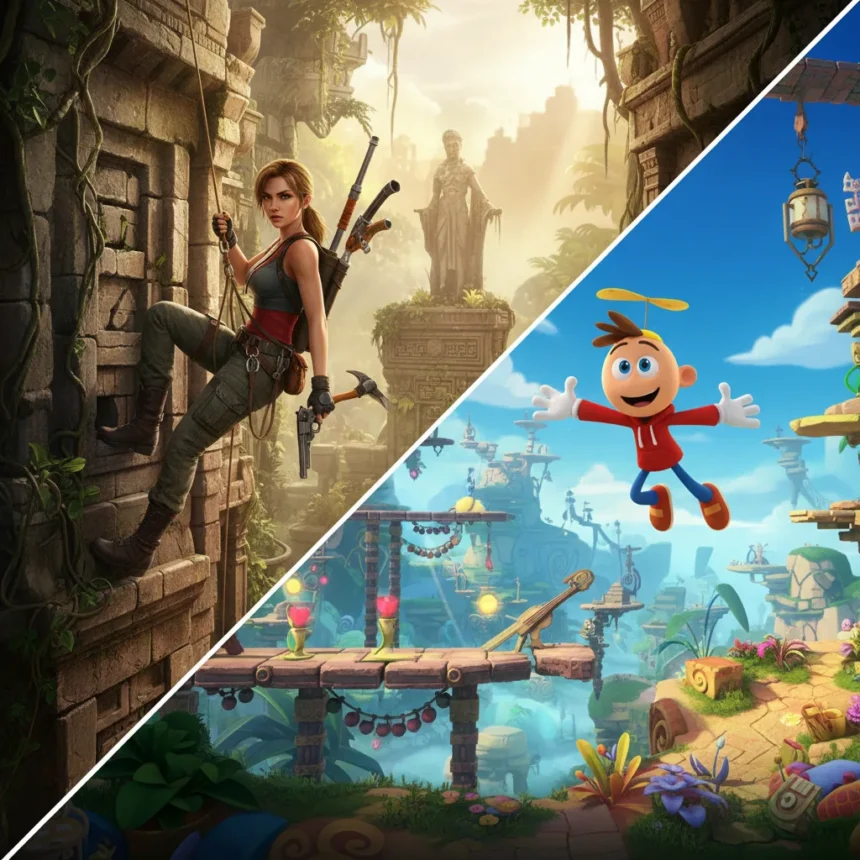
Tomb Raider and Rayman remakes are proving that faithful reimaginings can radically expand scope without abandoning what made the originals matter. Rather than chasing visual parity with a safe design language, these projects are taking structural risks—converting 2D platforming into dynamic hybrid spaces, rebuilding 3D exploration with systemic depth instead of linear progression. The question is no longer whether remakes can look better. It is whether they can feel truer to their source material while being something entirely new.
Key Takeaways
- Tomb Raider: Legacy of Atlantis rebuilds the 1996 original from the ground up in Unreal Engine 5, launching 12 February 2027
- Rayman Legends Retold converts the Glade of Dreams into a mix of 2D and 3D where platforming tilts, bends, and shifts dynamically
- Both remakes prioritize aesthetic risk-taking and distinct visual identity over engine uniformity
- Tomb Raider emphasizes stealth and non-lethal options, sidelining combat as a core mechanic
- These projects signal a broader trend toward reinterpretation rather than remastering
Tomb Raider and Rayman remakes embrace systemic design over visual shortcuts
Crystal Dynamics is rebuilding Lara Croft’s first adventure from the ground up in Unreal Engine 5. But the engine choice is not the story. The scope expansion is. The original Tomb Raider confined players to discrete puzzle chambers connected by narrow corridors. Legacy of Atlantis makes the world larger in scale and more continuous in structure, turning exploration into something less like a modern remaster and more like a full reinterpretation of the early ideas. Unreal Engine 5 contributes dense environments, heavier emphasis on lighting and atmosphere, and exploration that feels more systemic than linear. This is not a visual upgrade applied to an unchanged game. It is a structural rethink using modern tools to realize what the original could only suggest.
Rayman Legends Retold takes a different approach to the same principle. Instead of flattening the beloved 2D platformer into a 3D space, Ubisoft is moving the Glade of Dreams into a mix of classic 2D and 3D where platforming isn’t flat anymore—it tilts, bends, and shifts as the player moves through it. The levels function closer to a playable theatre than a straight left-to-right platformer. Both remakes reject the assumption that fidelity means visual replication. They reinterpret the original’s core mechanics through a new structural lens.
Combat takes a backseat in Tomb Raider: Legacy of Atlantis
The 1996 Tomb Raider was a combat game wrapped in an exploration shell. Legacy of Atlantis inverts that priority. Combat takes a back seat, with players relying on stealth, distractions, and non-lethal options to get past threats. This is a radical design choice for a franchise built on gunplay and boss encounters. It suggests that the remake’s designers saw something in the original that transcended its combat mechanics—perhaps the tension of navigating hostile spaces, the puzzle of understanding enemy patterns, the satisfaction of outsmarting rather than overpowering. By reducing combat’s role, the remake forces exploration and environmental problem-solving to carry more weight. It is a gamble that only works if the world itself is compelling enough to sustain tension without firefights.


A broader shift toward distinct identity in game design
These projects are part of a larger trend toward distinct identity and visual intent rather than a shared safe design language. God of War: Laufey, The Lost Wild, Kemuri: Hunt the Unseen, and revivals of Stuntman and Rayman all push against the visual uniformity that has made recent Unreal Engine 5 games feel interchangeable. Unreal Engine 5 is widely present in these projects, but the engine is said not to be the games’ defining identity anymore. Instead, each project is asking: what does this franchise need to say now? What can we build that honours the original while taking it somewhere new? That question produces remakes that feel less like products and more like artistic statements.
Are these remakes just nostalgia plays with better graphics?
No. Nostalgia remakes preserve the original experience and add polish—think of how a remaster works. These projects are reinterpreting the originals’ core ideas through new architectural frameworks. Tomb Raider: Legacy of Atlantis expands the world from discrete chambers into continuous spaces. Rayman Legends Retold converts flat platforming into dynamic 2D/3D hybrid design. Both are making choices that change how the games feel, not just how they look. A remaster asks players to revisit something. A reinterpretation asks them to experience something familiar in an unfamiliar way.



When does Tomb Raider: Legacy of Atlantis release?
Tomb Raider: Legacy of Atlantis is scheduled to release on 12 February 2027. That gives Crystal Dynamics time to refine the systemic exploration and stealth mechanics that define its reimagining. No pricing information has been announced.
What makes Rayman Legends Retold different from the original Rayman Legends?
Rayman Legends Retold moves beyond the left-to-right 2D platforming that defined the original by introducing a mix of 2D and 3D where the level itself tilts, bends, and shifts as players move through it. This transforms the Glade of Dreams into something closer to a playable theatre than a traditional platformer, fundamentally changing how players navigate familiar spaces.
These remakes matter because they prove that fidelity does not mean stagnation. A faithful reimagining can expand scope, restructure mechanics, and take artistic risks without betraying the original’s spirit. As Unreal Engine 5 continues to dominate game development, these projects stand out by refusing to let the engine define their identity. Instead, they let design philosophy lead, and the engine follows. That distinction—between tools that shape games and games that shape their tools—might be the most important lesson these remakes have to teach.
Edited by the All Things Geek team.


Source: Creativebloq