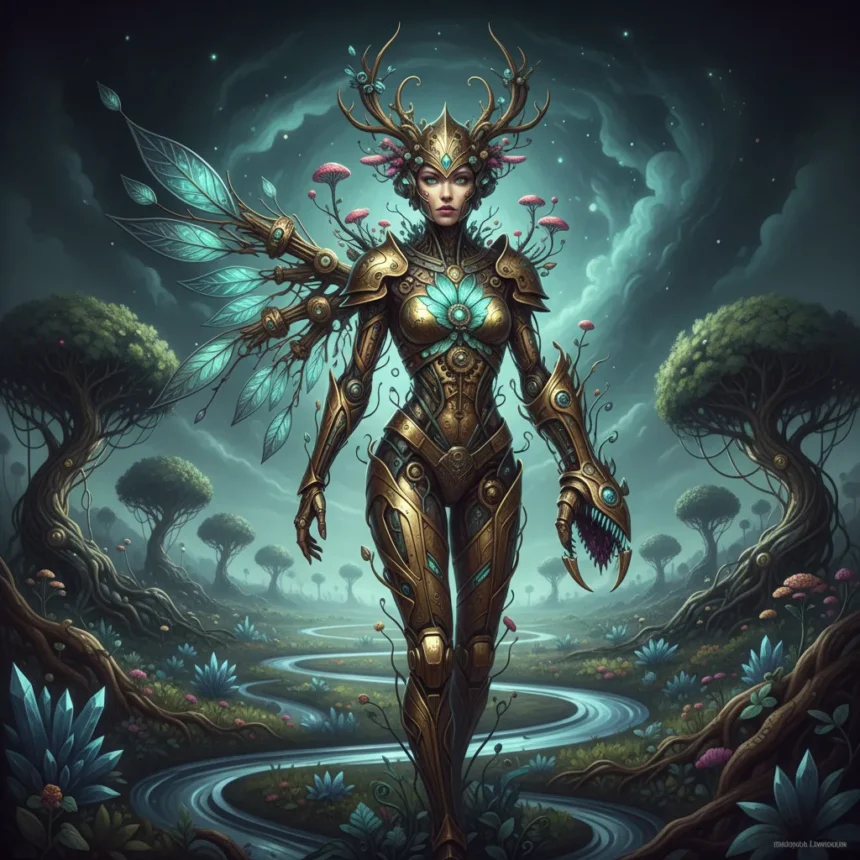
Anastasiya Landasseln is a digital artist known for creating fantasy character art that merges organic biomatter with intricate machinery, spanning from nature-inspired beings to technologically augmented warriors in the Warhammer 40,000 universe.
Key Takeaways
- Landasseln’s fantasy character art blends organic and mechanical elements into cohesive hybrid designs.
- Her work spans archetypes from natural forest creatures to tech-infused priests and warriors.
- The artist creates imaginative fantasy characters for the Warhammer 40K universe.
- Her approach combines biomatter aesthetics with detailed machinery and technological components.
- The fusion style creates distinctive visual identities across diverse character types.
The Fusion of Nature and Technology in Fantasy Character Art
Landasseln’s fantasy character art stands out by refusing to choose between organic and mechanical aesthetics. Instead, she weaves them together into single cohesive designs. A character might feature bark-like skin layered with exposed circuitry, or biological appendages reinforced with metallic frameworks. This approach creates visual tension that draws the eye—the viewer cannot immediately categorize what they are seeing as purely natural or purely artificial. That ambiguity is the strength of the work.
The range of her fantasy character art spans wildly different archetypes. Nature-inspired beings emerge from her process alongside tech priests and machine-augmented warriors. Where traditional fantasy art might keep these aesthetics in separate lanes—elves in forests, cyborgs in cities—Landasseln collapses the boundary. A creature inspired by forest mythology might carry technological implants. A warrior born of machinery might be overgrown with organic tendrils. This collision creates characters that feel genuinely alien rather than merely copied from existing fantasy templates.
Why This Approach Reshapes Fantasy Character Design
Most fantasy character art defaults to one visual language. You get either the organic route—creatures rooted in nature, biology, and ecological logic—or the mechanical route, where function drives form and every element serves a technological purpose. Landasseln’s fantasy character art rejects this false binary. By treating machinery and biomatter as equally valid design vocabularies, she creates characters that inhabit a third space entirely.


This matters because it expands what fantasy character art can express. A tech priest covered in biological growths reads differently than a tech priest in polished armor. The former suggests integration, symbiosis, or even corruption. The latter suggests control and dominion. By layering both languages onto the same character, Landasseln creates designs that carry narrative weight before a single word of backstory is written. The visual language itself tells you something about who these beings are and how they relate to the world around them.
The Warhammer 40K Context and Broader Fantasy Character Art
Landasseln’s work exists within the Warhammer 40,000 universe, a setting that has always embraced grimdark fusion aesthetics. The 40K universe itself blends gothic architecture with industrial machinery, organic corruption with technological decay. In this context, her fantasy character art feels native. Yet her approach distinguishes itself through the specificity of her hybrid designs. Rather than slapping some spikes and skulls onto a generic warrior, she commits to the fusion at every level—the character’s silhouette, anatomy, and surface detail all reflect the collision of organic and mechanical.



Compared to more traditional fantasy character design, which tends toward purity of concept, Landasseln’s work operates in a register of deliberate contradiction. A dragon in traditional fantasy art is a dragon—scaled, winged, recognizable. A dragon in her fantasy character art might be a dragon with exposed metallic vertebrae, or biological wings grafted to a mechanical frame. This approach demands more from the viewer’s imagination but rewards that investment with designs that stick in memory far longer than conventional alternatives.
What Makes Her Fantasy Character Art Distinctive
The technical execution of Landasseln’s fantasy character art reveals why the concept works so effectively. She does not simply paste machinery onto organic forms or vice versa. Instead, she designs characters where both elements feel structurally necessary. A biomechanical limb is not organic with metal bolted on—it is a unified system where flesh and metal support each other’s weight, share load-bearing functions, and create a believable hybrid anatomy. This level of integration is what separates her fantasy character art from simpler mashups.
The color and texture work reinforces this integration. Where machinery meets flesh in her designs, the transition zones show evidence of interaction—oxidation where metal touches moisture, scar tissue where implants have integrated, patina where organic growth has weathered metal surfaces. These details transform her fantasy character art from concept sketches into designs that feel lived-in, functional, and real within their own logic. A viewer can imagine how these characters move, how they maintain their hybrid bodies, what challenges they face in a world not designed for their particular fusion of nature and technology.
How Fantasy Character Art Influences Broader Design Thinking
Landasseln’s approach to fantasy character art demonstrates that constraint breeds creativity. By committing to the fusion of organic and mechanical, she eliminates the easy path of choosing one aesthetic language. Every design decision becomes a negotiation between two competing visual vocabularies. This generates more interesting characters than either language alone could produce.



Her fantasy character art also proves that specificity beats generality in visual design. Rather than creating a generic cyborg or a generic nature spirit, she creates specific characters where the organic-mechanical fusion serves the character’s identity and narrative purpose. A tech priest looks like a tech priest—but one whose relationship to technology is expressed through biological integration rather than merely wearing armor. This specificity is what makes her work resonate with audiences who have seen countless fantasy characters before.
FAQ
What defines Landasseln’s approach to fantasy character art?
Landasseln’s fantasy character art merges organic biomatter with intricate machinery into unified hybrid designs. Rather than treating these aesthetics as separate, she integrates them at the structural, anatomical, and textural levels, creating characters that feel believable within their own logic.
How does her fantasy character art differ from traditional character design?
Traditional fantasy character art typically commits to a single aesthetic language—either organic or mechanical. Landasseln’s fantasy character art operates in a third space where both languages coexist, creating designs that carry narrative weight through their visual contradiction and integration.
Why is the Warhammer 40K setting significant for her fantasy character art?
The Warhammer 40,000 universe embraces grimdark fusion aesthetics, making it a natural home for Landasseln’s fantasy character art. The setting’s existing blend of gothic, industrial, and organic elements provides context where her hybrid designs feel native rather than experimental.
Landasseln’s fantasy character art proves that the most memorable designs emerge not from purity of concept but from commitment to productive contradiction. By fusing organic and mechanical elements with equal weight and technical rigor, she creates characters that expand what fantasy art can express and how audiences imagine beings that inhabit worlds beyond the purely natural or purely artificial.
Where to Buy
11% OFFWacomMovinkPad 11$399.99$449.95shop now | 34% OFFHuion Inspiroy H640p£28.46£42.99shop now | 20% OFFWacomIntuos Small$39.95$49.95shop now | 19% OFFXPPenArtist13.3 Pro$209.98$259.99shop now
Edited by the All Things Geek team.
Source: Creativebloq