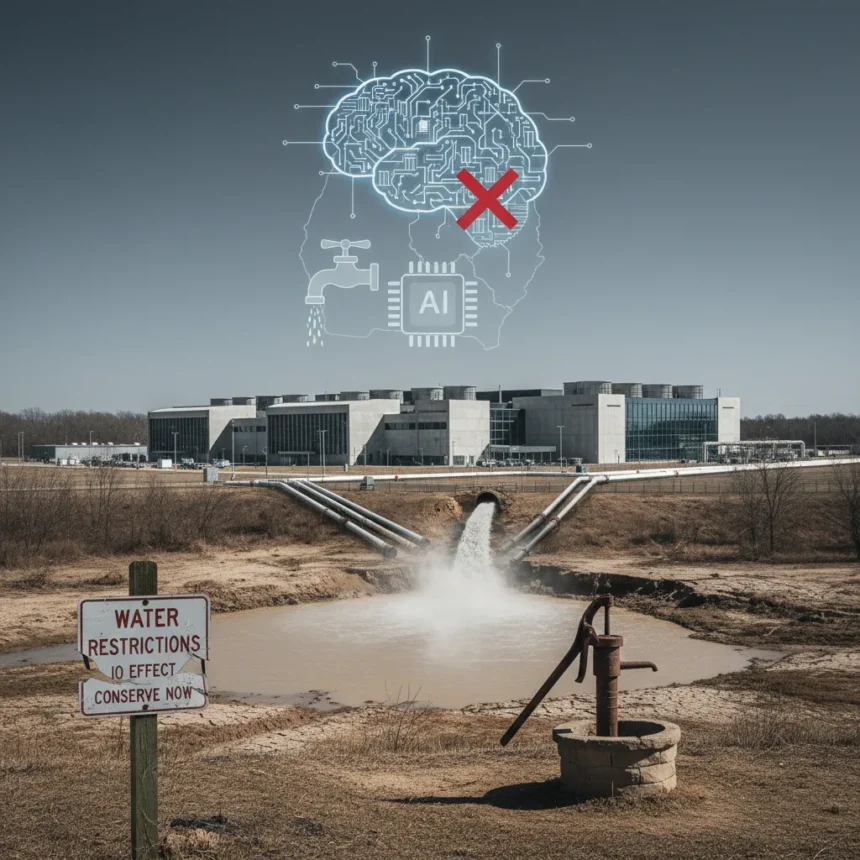
Data center water consumption has become one of the most pressing hidden costs of AI infrastructure expansion, and a recent case in Fayette County, Georgia, illustrates exactly why. A QTS data center project owned by Blackstone consumed nearly 29 million gallons of water over 15 months through two unauthorized utility hookups—while residents in the same county were being asked to stop watering their lawns due to low water pressure.
Key Takeaways
- A Blackstone-owned QTS data center in Georgia used 29 million gallons of water over 15 months through unauthorized connections.
- Local residents were told to reduce lawn watering while the data center secretly drained the water supply.
- The utility failed to detect the hookups during a transition to a cloud-based billing system.
- QTS claims most water use was temporary construction-related activity, not cooling operations.
- County officials declined to fine QTS despite the unauthorized consumption.
How a Data Center Outpaced Utility Oversight
The story began when residents noticed their water pressure dropping. Instead of investigating a major industrial consumer, the local utility initially blamed the community, asking residents to cut back on lawn irrigation. Only after residents complained further did officials discover two unaccounted-for water connections at the QTS site. The county’s utility had no record of these hookups because the connection process got mixed up during the county’s transition to a cloud-based system, according to officials managing the transition for an industrial customer. What should have been a straightforward permitting and billing process became a case study in how rapidly expanding data center projects can exploit gaps in local infrastructure management.
The disconnect between what residents were asked to do and what was actually happening reveals a fundamental problem: utilities are being caught flat-footed by the scale and speed of data center expansion. Most local water systems were designed and staffed for residential and light commercial use, not for industrial facilities that can consume as much water as thousands of households. When a county utility transitions its billing infrastructure, it creates exactly the kind of window where a major project can operate unmonitored.
Data Center Water Consumption and the Cooling Question
QTS claims it operates a closed-loop cooling system that does not consume water for cooling purposes. If true, this would be a significant distinction—data center chips generate enormous heat and typically require substantial water resources to prevent overheating, much like the cooling systems in consumer electronics scaled up dramatically. However, QTS acknowledged that most of its 2024 water consumption was tied to temporary construction activities: concrete work, dust control, and site preparation. Once operational, the company says the facility will use water only for domestic needs such as bathrooms and kitchens, equivalent to what four U.S. households consume per month.


The question remains whether QTS’s characterization of water use is accurate or a convenient explanation after being caught. The company had no incentive to disclose construction-phase consumption before the utility discovered the unauthorized hookups. Even if the closed-loop cooling claim is genuine, the fact that 29 million gallons flowed through the system undetected for 15 months suggests the company was not transparent about its water needs during the planning phase.
Why County Officials Declined to Enforce Consequences
Perhaps most troubling is that Fayette County declined to fine QTS after discovering the unauthorized water use. This decision reflects a pattern seen across the country: local governments desperate for tax revenue and job creation often prioritize keeping major corporate projects happy over enforcing utility regulations. QTS is a major data center developer with facilities across the country, and Blackstone is a titan of private equity—the kind of corporate entities that can afford to hire lawyers and lobbyists. A small county utility staff stretched thin during a systems transition is not in a strong negotiating position.



The utility director reportedly noted that her staff is small and at capacity, explaining how the connection process fell through the cracks. This is not an excuse—it is an indictment of how unprepared local infrastructure is for the data center boom. Communities are being asked to absorb the water costs of AI expansion without the regulatory tools or staffing to manage it.
What This Means for Data Center Expansion Elsewhere
The Georgia case is not an isolated incident. As AI companies race to build data centers to power large language models and other compute-intensive applications, water demand is spiking in regions already facing scarcity. Unlike traditional industrial facilities, data centers often operate with minimal local community input during the planning phase. They are approved quietly, built quickly, and their operational footprint—especially water consumption—often goes unexamined until residents start complaining.
What makes this situation particularly damaging is the optics: residents were being asked to sacrifice while a corporate project operated in the shadows. Trust in local institutions erodes fast when the rules appear to apply selectively. The county’s decision not to fine QTS sends a signal that data center developers can violate agreements with minimal consequences, as long as they are large enough and well-connected enough.
Could this have been prevented?
Yes. Utilities need to require detailed water management plans from data center projects before construction begins, not after. These plans should include independent monitoring of water use, automatic cutoffs if consumption exceeds agreed limits, and substantial penalties for unauthorized connections. Counties should also hire dedicated staff to oversee industrial projects during their construction and operational phases. The cost of a few additional utility employees is negligible compared to the cost of depleting a region’s water supply to support a single corporate facility.



Is data center water consumption regulated differently across states?
Regulation varies widely. Some states have begun requiring water impact assessments for large industrial projects, while others leave it entirely to local utilities. Georgia’s case suggests that local oversight alone is insufficient when utilities lack the resources or technical expertise to monitor complex industrial operations. States considering data center expansion should establish clear water consumption standards and independent monitoring requirements before approving new facilities.
What happens to the water a data center uses?
In QTS’s case, the company claims its closed-loop system recirculates water for cooling rather than consuming it. Construction water typically goes into concrete, dust suppression, and site preparation. Domestic water use—bathrooms, kitchens, landscaping—follows normal municipal treatment and discharge. The real issue in Georgia was not what happened to the water, but that nobody was tracking how much was being used or who was paying for it.
The Georgia data center water consumption case will likely become a cautionary tale for other communities facing similar projects. It exposes the gap between the pace of AI infrastructure expansion and the readiness of local utilities to manage it. Until utilities are properly staffed and equipped with enforceable regulations, data center projects will continue to operate in the shadows, consuming resources at scales that dwarf residential use while communities foot the bill.
Edited by the All Things Geek team.
Source: TechRadar