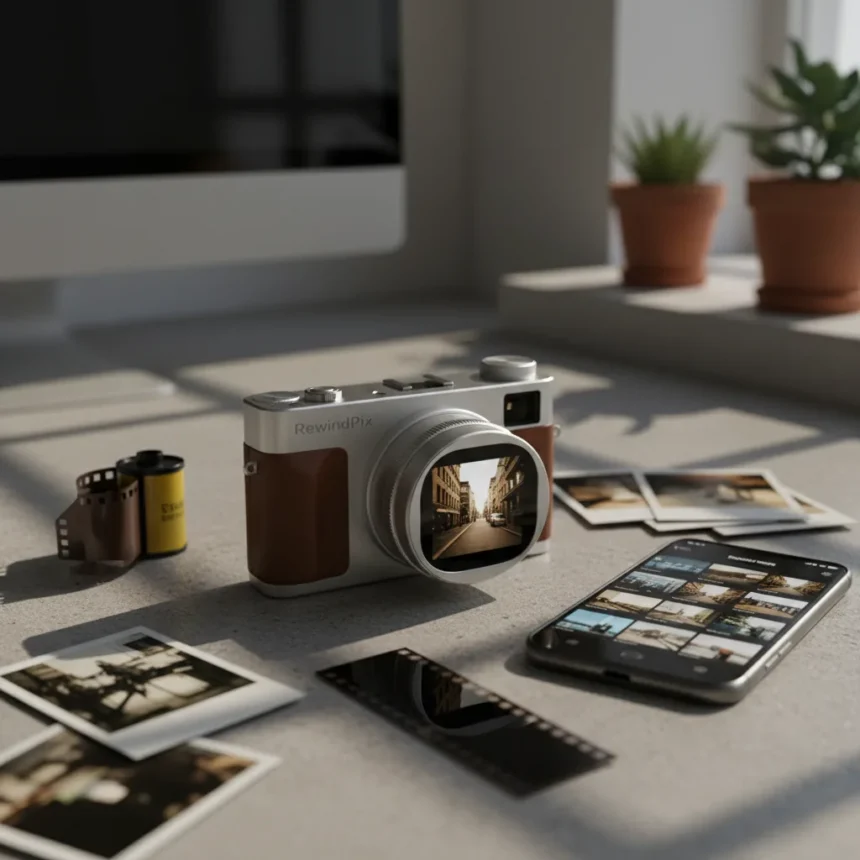
The RewindPix compact camera arrives at a moment when most digital cameras have abandoned the film photographer’s mindset entirely. While flagship mirrorless and smartphone cameras chase resolution and AI features, this cheap compact swims against the current by asking a simpler question: what if a digital camera could actually feel like shooting film?
Key Takeaways
- RewindPix delivers film-emulation through app-based looks rather than sensor magic alone.
- Positioned as affordable retro-focused compact for photographers nostalgic for analog shooting.
- App-driven approach lets users layer film aesthetics without expensive hardware.
- Targets the gap between digital convenience and analog feel that most compacts ignore.
- Emphasizes fun and creative shooting over technical specifications.
Why RewindPix Stands Out in the Compact Camera Market
The RewindPix compact camera succeeds where most digital compacts fail: it acknowledges that shooting film was never just about image quality. It was about constraint, tactile feedback, and the unpredictability that made the process feel alive. Most digital cameras treat this as nostalgia to be tolerated, not a core design principle. RewindPix inverts that logic.
The camera’s app-based film looks represent a deliberate choice to prioritize creative flexibility over pretending to be something it is not. Rather than chasing sensor-level authenticity that would require prohibitive hardware costs, the approach layers film simulations at the software level. This means users can experiment with different film stocks, adjust intensity, and iterate without committing to a single aesthetic in-camera. For photographers who spent years bracketing shots and hoping for the best with physical film, this hybrid approach offers something genuinely useful: the freedom to explore without the financial commitment.
The treasure-trove of app-based film looks transforms what could be a gimmicky feature into the camera’s strongest asset. Each look carries the character of a specific film stock—the color grading, grain structure, and tonal curve that made shooting Fujifilm Velvia or Kodak Portra feel distinct. Digital cameras have offered film simulation modes for years, but they typically live in buried menu systems and feel like afterthoughts. Here, the film emulation is central to the entire user experience.


RewindPix Compact Camera vs. Traditional Digital Compacts
Most compact cameras today occupy an awkward middle ground. They are too limited to replace a smartphone, yet too expensive and complicated to serve casual photographers seeking simplicity. The RewindPix compact camera rejects that formula by targeting a specific audience: people who actually loved shooting film and want that feeling back without the darkroom commitment.
Traditional digital compacts emphasize megapixels, autofocus speed, and zoom range. These specs matter for some users, but they miss the emotional core of why someone might choose a dedicated camera in an era of ubiquitous smartphone photography. The RewindPix compact camera instead asks what made film photography fun. The answer is rarely about technical precision. It is about the ritual of advancing film, the anticipation of waiting for development, and the aesthetic character baked into each emulsion. A cheap compact that captures that feeling is more valuable to its intended audience than a technically superior camera that ignores it entirely.



For photographers returning to compact cameras after years with film, the RewindPix compact camera bridges a gap that expensive mirrorless systems cannot. A full-frame camera with film simulation modes still feels like a computer. This compact maintains the simplicity and approachability that made film cameras accessible to casual photographers in the first place.
The App-Driven Film Look System Explained
The core innovation of the RewindPix compact camera lies in how it implements film emulation. Rather than locking users into fixed in-camera profiles, the app ecosystem allows for deeper customization and experimentation. This matters because film photographers were never locked into one aesthetic either—they chose film stocks based on mood, light, and intent, then adjusted development and printing to fine-tune results.
The app-based approach mirrors that flexibility. A photographer can shoot a scene, then explore how it looks through the lens of Kodak Gold, Fujifilm Pro 400H, or Ilford XP2. They can adjust grain intensity, color saturation, and tonal response without re-shooting. For photographers who loved the creative constraint of film but hated the financial and time cost of bracketing and waiting for lab results, this is genuinely liberating. The RewindPix compact camera becomes a playground for film aesthetics rather than a museum piece pretending to be something it is not.
The app integration also means the camera can evolve. New film looks can be added, existing ones refined, and user feedback incorporated without requiring hardware updates. This is a strength that traditional digital cameras cannot match—a Fujifilm compact from 2015 still has the same film modes it shipped with, while the RewindPix compact camera can grow and adapt.



Who Should Buy the RewindPix Compact Camera?
The RewindPix compact camera is explicitly designed for a narrow audience, and that is its strength. If you are someone who shot film seriously, who misses the aesthetic character of specific emulsions, or who finds smartphone photography creatively empty, this camera speaks directly to you. It is not for people seeking technical superiority or the highest resolution. It is for photographers who understand that the best camera is the one that makes you want to shoot.
Casual photographers and casual snapshooters should probably look elsewhere. A smartphone handles everyday photography better, faster, and with less friction. But for the photographer who has felt the gap between digital convenience and analog soul, the RewindPix compact camera offers something rare: acknowledgment that the gap exists and a genuine attempt to close it.
The affordability is also significant. Retro-focused compacts can demand premium prices, especially if they chase authentic mechanical simplicity. The RewindPix compact camera delivers retro feel through smarter software rather than expensive hardware, making the film photography aesthetic accessible to photographers who cannot justify thousands of dollars on a rangefinder or SLR.
Is the RewindPix compact camera actually fun to use?
Yes, according to reviewers who have characterized it as a heck of a lot of fun for retro-loving photographers. The camera prioritizes creative exploration and tactile shooting experience over technical metrics, which is exactly what makes it engaging for its target audience.
How does the RewindPix compact camera compare to shooting actual film?
It does not replicate film exactly—no digital camera can. However, the RewindPix compact camera captures the emotional and aesthetic essence of film shooting: the ritual of choosing a look, the anticipation of seeing results, and the character of specific film stocks. It offers that experience without the cost, time, and commitment of developing physical film.
Can you customize the film looks on the RewindPix compact camera?
The app-based system allows for customization and experimentation with different film emulations, giving users flexibility to adjust aesthetics without re-shooting. This is a core feature that sets the RewindPix compact camera apart from traditional fixed film simulation modes.
The RewindPix compact camera arrives at exactly the right moment for a specific audience: photographers who loved film but have moved into the digital era, seeking a camera that honors that heritage rather than dismissing it. By prioritizing feel and aesthetics over specifications, it has found a niche that most manufacturers ignore. That is not a weakness—it is precisely why it matters.
Edited by the All Things Geek team.
Source: TechRadar