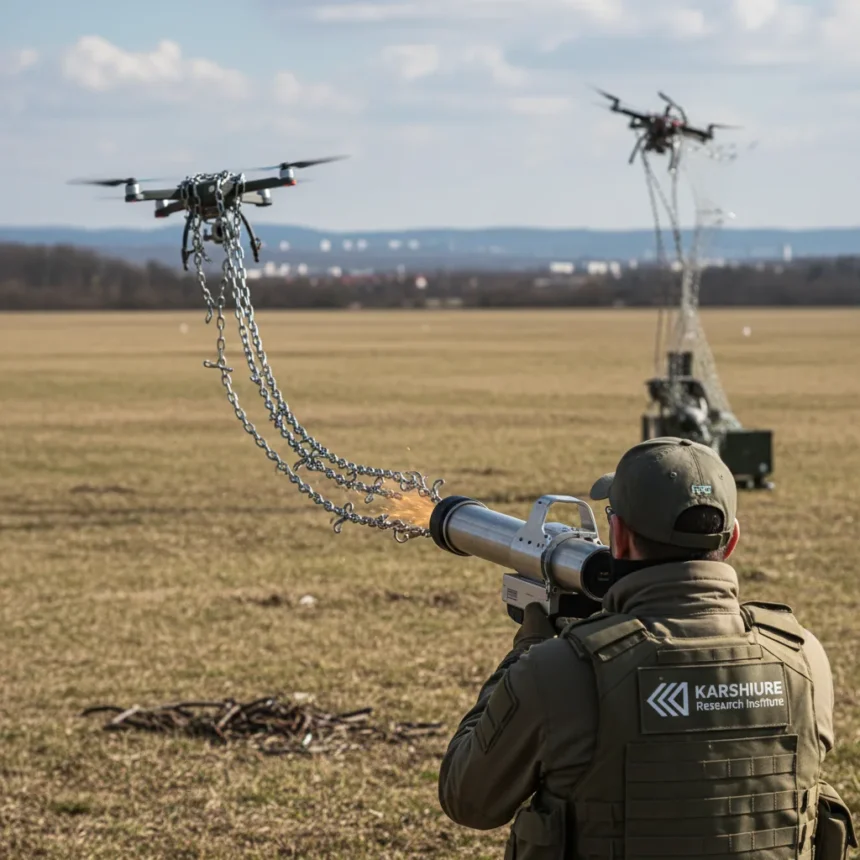
A chain-launcher drone defense system developed by researchers at Karlsruhe Institute of Technology (KIT) in Germany fires 6.5-foot steel chains from a portable 40mm launcher to mechanically entangle and disable quadcopters. The system launches chains at 80 meters per second—approximately 179 miles per hour—wrapping them around drone rotors and fuselages to bring aircraft down without requiring lasers, electromagnetic pulse systems, or any electronics.
Key Takeaways
- KIT’s chain-launcher fires 2-meter steel chains at 80 m/s from a man-portable 40mm launcher compatible with standard grenade systems.
- Concept revives the bola, a centuries-old South American entanglement weapon, adapted for modern counter-drone operations.
- Metal chains outperform textile nets by resisting wind, degradation, and tangling on complex drone surfaces.
- System eliminates electronic vulnerabilities inherent to laser and EMP-based drone defense methods.
- Effective for close-range urban and military counter-drone scenarios where mechanical simplicity beats high-tech complexity.
Why Mechanical Entanglement Beats Electronic Warfare
The chain-launcher drone defense approach abandons the fragility of electronic systems entirely. Laser-based systems require clear line-of-sight and can be defeated by reflective surfaces or atmospheric interference. EMP systems demand precise timing and risk collateral damage to nearby electronics. Mechanical entanglement sidesteps all of these vulnerabilities. A steel chain wrapping around a drone’s rotors does not care whether the aircraft is jammed, hardened, or equipped with counter-measures—physics handles the defeat.
KIT’s researchers recognized that textile-based net systems, while simpler than electronic alternatives, suffer from wind sensitivity and poor adhesion to modern drone bodies. Metal chains, by contrast, grip whatever they contact. The chains are reusable, require no batteries or targeting computers, and cost a fraction of what laser or programmable ammunition systems demand. In scenarios where speed and reliability matter more than precision, mechanical simplicity wins.
Chain-Launcher Drone Defense Versus Competing 40mm Systems
The 40mm launcher platform has become the standard for portable counter-drone weapons, creating a crowded competitive landscape. Textile-based alternatives like the B&T DDN-40 Drone Defense Net round deploy hand-woven nets and claim a 30-meter effective range, with a 50-meter variant in development. These systems work against both drones and personnel, offering versatility that KIT’s chains cannot match. However, textile nets fail in high wind and on complex drone geometries where chains excel at catching and holding.


Programmable 40mm airburst ammunition, such as Nammo’s 40x53mm rounds designed for H&K GMG automatic grenade launchers, reaches effective ranges of 1,000 to 1,500 meters against drones through controlled detonation—but requires sophisticated radar systems like Thales SQUIRE to function. This complexity introduces cost, power requirements, and maintenance burdens that KIT’s chain system avoids entirely. For military units operating in austere environments or without advanced targeting infrastructure, the chain-launcher drone defense concept offers a radical simplification.
Swarming drone munitions like DefendTex Drone40—quadcopters launched from 40mm systems with cameras, high-explosive warheads, or jamming payloads—represent the opposite philosophy: adding complexity to defeat complexity. These systems require oversized launchers like the H&K AG36 and introduce their own vulnerabilities. KIT’s approach asks a different question: what if you simply stopped the drone from flying at all?



Ancient Weapon Physics Meet Modern Threats
The bola, a throwing weapon used for centuries by South American herders to capture livestock by entanglement, works on a principle KIT’s researchers recognized as mechanically sound: wrap something around a moving target and it stops moving. A 2-meter steel chain fired at 80 meters per second carries enough kinetic energy to wrap around drone frames and rotors with lethal effectiveness. The launcher itself is man-portable and compatible with existing 40mm grenade systems, meaning military units already equipped with standard launchers could theoretically adopt this technology with minimal training or infrastructure changes.
What makes this approach genuinely novel is its rejection of the tech-arms-race mentality that has dominated counter-drone development for the past decade. As drones become more sophisticated, more hardened, and more resistant to electronic attack, KIT’s researchers chose to ignore those advances entirely and instead solve the problem at the mechanical level. A drone with advanced avionics, military-grade encryption, and electromagnetic hardening is still vulnerable to a steel chain tangling its rotors.
Where the Chain-Launcher Drone Defense Falls Short
KIT has not published detailed effective range specifications, which remains a critical gap. Textile net systems specify 30 to 50 meters; programmable ammunition reaches 1,000-plus meters. The chain-launcher’s effective range remains unclear, limiting its applicability to specific scenarios. Close-range defense makes sense in urban counter-drone operations or base perimeter protection, but longer-range threats demand different solutions. Additionally, the prototype remains in research phase with no commercialization timeline announced, meaning military and security forces cannot yet field this technology operationally.
Wind resistance, while superior to textile nets, has not been independently tested against real-world conditions. A steel chain in high wind may behave unpredictably during flight, potentially missing its target or losing velocity faster than ballistic models predict. Drone operators could theoretically adopt evasive maneuvers if they detect the launcher, though the system’s mechanical simplicity makes it harder to jam than electronic alternatives.



Is the chain-launcher drone defense system ready for deployment?
KIT’s prototype remains in research phase with no announced commercialization or military adoption timeline. The concept is proven in physics, but field testing against real drones under operational conditions has not been publicly documented. Military procurement typically requires extensive testing before adoption, meaning years may pass before this technology reaches frontline units.
How does the chain-launcher compare to net-based 40mm rounds?
Metal chains outperform textile nets by resisting wind, degrading less over time, and gripping complex drone surfaces more reliably. However, net systems offer longer effective ranges and can be deployed against both aerial and ground targets. The choice depends on operational requirements: mechanical reliability versus versatility.
Why did KIT choose chains instead of other mechanical methods?
Chains combine proven physics (the bola principle), durability (reusable, no electronics), and simplicity (compatible with existing 40mm platforms). Other mechanical methods like projectile nets or kinetic impacts either degrade faster or require more complex triggering systems. Steel chains solve the entanglement problem with minimal moving parts.
The chain-launcher drone defense system represents a philosophical shift in counter-drone strategy: sometimes the best answer to technological complexity is mechanical simplicity. As small drones proliferate across military and civilian airspace, KIT’s approach offers a cheap, reliable, EMP-proof alternative to the high-tech arms race. Whether this prototype reaches operational units depends on military testing and adoption timelines—but the concept itself has already proven that ancient weapons physics still solve modern problems.
Edited by the All Things Geek team.
Source: Tom's Hardware