







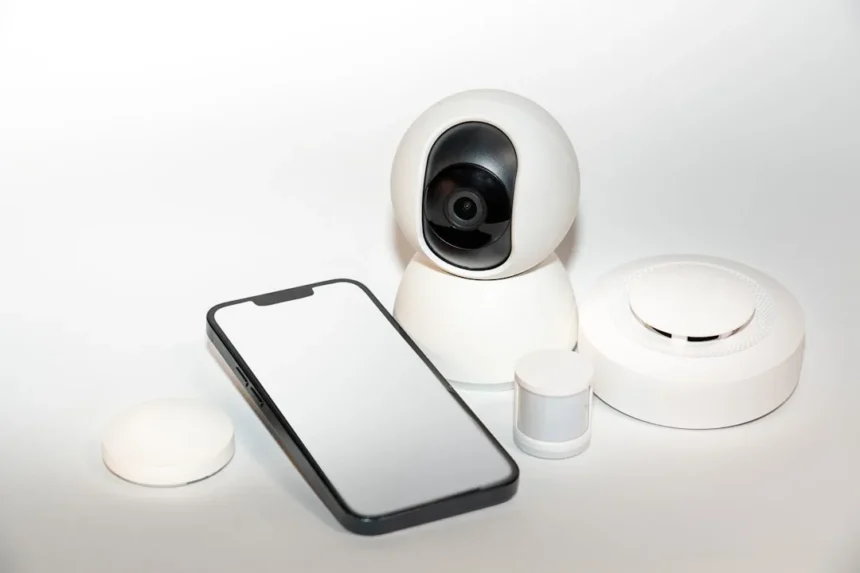
Affordable smart home security just got a serious price cut. Sky’s new smart home ecosystem brings motion sensors, video doorbells, and outdoor cameras to UK customers starting at just £5, with zero monthly subscription fees—a direct challenge to Ring and Blink, which charge ongoing costs and rely on cloud storage.
Key Takeaways
- Sky’s entry-level motion sensor costs £5; full starter kit under £150 with doorbell and two cameras
- No monthly subscription fees; all footage stored locally on Sky hub or microSD card
- Ring subscriptions rising 43% in 2025; Blink requires extra modules for full functionality
- Sky Video Doorbell priced £30–£50 with 1080p video and package detection
- Sky Outdoor Camera offers 2K resolution and color night vision for £60–£80
Why Sky’s Affordable Smart Home Security Matters Right Now
Ring and Blink have long dominated the UK smart doorbell market, but their subscription models are becoming harder to justify. Ring’s pricing is climbing 43% in 2025, pushing monthly costs higher for existing customers. Blink, meanwhile, starts at £50–£54 but demands an additional Sync 2 module (£20 extra) to unlock full features. Sky’s approach flips this model entirely: buy once, own forever, with no recurring charges eating into your budget year after year.
The timing matters. Post-holiday shoppers are scrutinizing smart home spending, and subscription creep has become a genuine pain point. A family that invests in Ring or Blink today faces not just the upfront cost but a permanent tax on their security system. Sky’s local storage architecture eliminates that trap.
Sky’s Affordable Smart Home Security Lineup and Pricing
Sky’s entry point is the Smart Home Sensor at £5—a motion detector that sends alerts via the Sky app on iOS and Android. It is the cheapest way to add smart detection to any UK home with Sky broadband. Step up to the Video Doorbell (£30–£50, battery or wired) and you get 1080p video with package detection. The Outdoor Camera (£60–£80) bumps resolution to 2K with color night vision and an IP65 weatherproof rating.


A complete starter kit—doorbell plus two cameras plus a sensor—comes in under £150. All footage stays local, stored either on the Sky hub itself or on a microSD card inserted into the camera, meaning no cloud subscription, no recurring charges, no data leaving your home. This architecture directly undercuts Ring’s model, where every feature beyond basic notifications requires a Protect subscription.
How Sky Compares to Ring, Blink, and Alternatives
Ring’s ecosystem looks expensive when you factor in subscriptions. A Ring Video Doorbell plus one camera easily exceeds £150, then you add £2.49 per month (rising) for cloud storage and advanced features. Blink is cheaper upfront (£50–£54) but incomplete—you need the Sync 2 hub (£20) to access full recording and playback, pushing the real entry cost higher.



Sky’s exclusivity cuts both ways. The system only works for Sky broadband customers and integrates tightly with Sky Glass or Sky Stream devices, so it is not a universal solution. For non-Sky households, Eufy offers subscription-free alternatives: the Eufy Video Doorbell Dual (£74.99, now discounted from £159.99) features 2K dual cameras and local microSD storage, while the single-camera Eufy Video Doorbell (£59.99) covers basic needs. Swann’s Buddy4K (£135.99, down from £169.99) delivers 4K recording with onboard storage and AI replies to visitors. TP-Link’s Tapo D230S1 (£95, originally £150) includes a chime, microSD support, and solid night vision.
What Sky wins on is simplicity and ecosystem integration for existing customers. If you already have Sky broadband and a Sky hub, adding a £5 motion sensor or £40 doorbell is a frictionless upgrade with no new apps or hubs to manage.
The Local Storage Advantage
Sky’s biggest differentiator is local storage. Every camera and sensor stores footage on the Sky hub or on the camera’s microSD card—not on distant servers. This matters for privacy (your video never leaves home), cost (no subscription), and reliability (no cloud outage, no service degradation). Ring and Blink rely entirely on cloud storage, making their subscriptions non-negotiable if you want to review footage beyond the last 24 hours.
Local storage also means faster playback and no bandwidth throttling. You control your data, and you do not pay monthly to access it.


Is Sky’s Affordable Smart Home Security Right for You?
If you are a Sky broadband customer, the decision is straightforward: a £5 motion sensor or £40 doorbell with zero ongoing fees is hard to beat. The ecosystem is designed to work smoothly with your existing Sky hardware, and local storage removes the subscription burden that haunts Ring and Blink owners.
If you are not a Sky customer, Eufy and Swann remain stronger choices. Eufy’s subscription-free doorbells are proven, affordable, and work with any home. Swann’s 4K option offers more resolution if you need it. But for the Sky ecosystem, Sky’s new lineup is the obvious upgrade path.
Does Sky’s affordable smart home security work without a Sky hub?
No. Sky’s doorbells and cameras require either a Sky Glass or Sky Stream device to function and store footage locally. If you do not have one of these devices, you cannot use Sky’s smart home lineup. This is a significant limitation for non-Sky customers or those without compatible hardware.
How much does Sky’s video doorbell cost compared to Ring?
Sky’s Video Doorbell runs £30–£50 with no monthly subscription. Ring’s equivalent starts around £80–£100 upfront, then adds £2.49 per month (rising in 2025) for cloud storage and features. Over two years, Ring costs roughly twice as much when subscriptions are included.
Can you use Sky’s cameras with other smart home systems?
Sky’s ecosystem is proprietary and works only with Sky Glass, Sky Stream, and the Sky app. It does not integrate with Apple HomeKit, Google Home, or Alexa, limiting flexibility for households using multiple smart home platforms.
Sky’s entry into affordable smart home security fills a real gap for UK customers tired of Ring and Blink’s rising costs. At £5 for a motion sensor and under £150 for a complete starter kit, Sky removes the subscription trap that has made smart home security increasingly expensive. For Sky broadband customers, it is the obvious choice. For everyone else, Eufy and Swann remain solid alternatives—but none of them match Sky’s ecosystem integration and zero-fee promise for the Sky-connected home.
Edited by the All Things Geek team.
Source: T3




