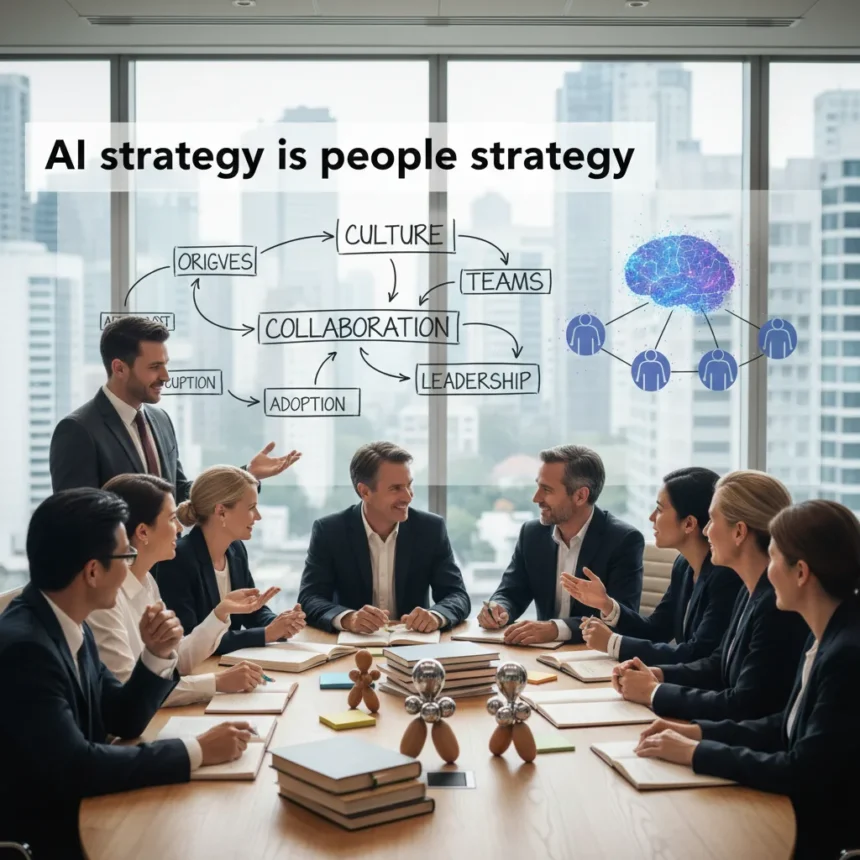
AI strategy is a people strategy, not a technology strategy. That deceptively simple insight separates leaders who will actually extract value from AI investments from those who will burn through budgets chasing algorithmic breakthroughs. Boston Consulting Group research reveals the uncomfortable truth: only 10% of AI value comes from algorithms themselves. Another 20% comes from implementation technology. The remaining 70%? Rethinking people components—culture, training, learning resources, and change management.
Key Takeaways
- 70% of AI value comes from people and culture, not algorithms or technology infrastructure
- AI has shifted from experimental pilot to core business strategy overnight, compressing timelines that took years in cloud transformation
- Financial discipline is critical—leaders must monitor AI spending as rigorously as CFOs track infrastructure costs to avoid budget drain without ROI
- Traditional consultancy models fail under AI’s speed and stakes; integrated, fast-path approaches are required
- Safeguards must be built from day one, not retrofitted—sensitive data access controls prevent critical failures like cardiology systems accessing psychiatric records
The Cloud Transformation Playbook CxOs Are Ignoring
AI is not a new problem. It is a compressed version of cloud transformation with higher stakes and faster timelines. The ground has shifted under tech leaders’ feet regardless of company size or sector; AI has moved from interesting experiment to core strategy almost overnight. That speed is the problem. Cloud adoption unfolded over years, giving organizations time to stumble, learn, and adjust. AI adoption is happening in months. CxOs who learned hard lessons during cloud migration—that buying infrastructure does not equal business transformation—now face the same choice with AI, except they have less time to get it right.
The cloud lesson that matters most is this: technology is not the constraint. People are. Organizations that treated cloud as an IT procurement exercise failed. Those that treated it as a cultural and organizational redesign succeeded. The same applies to AI, yet many CxOs are repeating the mistake by focusing first on model selection, compute capacity, and integration architecture instead of asking harder questions about who will use these tools, how their roles will change, and whether the organization’s culture can absorb that change.
Why the 70% Rule Changes Everything
The Boston Consulting Group breakdown is not aspirational; it reflects observed outcomes across hundreds of organizations. Spending heavily on latest models and GPU clusters while neglecting training, incentive structures, and organizational readiness is a recipe for expensive pilot projects that never scale. One unnamed senior technology leader captured the financial consequence bluntly: there was huge risk of AI consuming money without achieving return on investment. Turning into someone who cares more about the financial aspect and looking at costs frequently—rather than treating AI as a blank check—was a huge success.

That shift in mindset is not glamorous. It does not make for exciting board presentations. But it is what separates value creation from value destruction. CFOs manage infrastructure spend with quarterly reviews, cost allocation, and ROI benchmarks. AI spending deserves the same rigor. Without it, shadow IT accelerates as teams procure their own tools, and budgets fragment across departments chasing uncoordinated experiments.
Building Safeguards Before Crisis Hits
Cloud transformation taught another lesson: safeguards must be architected from the start, not bolted on after failure. A cardiology note generator should not have access to psychiatric records. Data isolation, role-based access controls, and audit trails take planning. They cannot be retrofitted cleanly into a system already in production. Yet organizations racing to deploy AI are often skipping this foundational work, betting they will solve governance later. That bet fails spectacularly when the first breach or misuse incident occurs.



The pressure to move fast is real and intense. Traditional consultancy models—the outside-in analysis approach that worked for slower transformations—collapse under AI’s speed and stakes. Organizations need integrated, fast-path approaches where strategy, technology, and people work in parallel, not sequentially. But speed without safeguards is recklessness.
What CxOs Should Do Monday Morning
Apply cloud lessons directly. Start by auditing your organization’s culture of innovation, training capacity, and change management infrastructure. If those are weak, no model will save you. Assign a CFO-equivalent owner to AI spending with quarterly cost reviews and ROI tracking. Stop treating AI as a technology purchase and start treating it as an organizational redesign. Finally, build data governance and access controls now, before you have a public failure that forces you to rebuild them under pressure.
AI is exciting, fast-moving, and genuinely scary. But it is not unprecedented. Cloud transformation already showed us what works and what does not. CxOs who ignore those lessons are not being bold—they are being careless.
How does the 70% rule apply to my organization’s AI roadmap?
The 70% rule means your budget, hiring, and training decisions matter more than your model selection. If you are spending 80% of AI investment on compute and infrastructure while allocating minimal resources to change management and team upskilling, your roadmap will stall. Reverse the ratio.



What safeguards should we build before deploying AI systems?
Start with data access controls—define which systems can access which data sets, and enforce those boundaries from day one. Add audit logging so you can trace who accessed what and when. Plan for role-based permissions so sensitive data (medical records, financial data, personal information) is isolated by default, not by exception.
Why are traditional consultants failing on AI projects?
Traditional outside-in consultancy models assume you have time for analysis, recommendations, and staged implementation. AI timelines do not allow that luxury. You need partners who can work in parallel on strategy, technology, and organizational change simultaneously, not sequentially. Speed and integration matter more than perfect analysis.
The AI transformation is not a technology problem waiting for the right algorithm or the biggest GPU cluster. It is an organizational problem that happens to involve technology. CxOs who learned this lesson during cloud migration will navigate AI successfully. Those who treat it as a new technology problem will repeat expensive, preventable mistakes.
Edited by the All Things Geek team.
Source: TechRadar