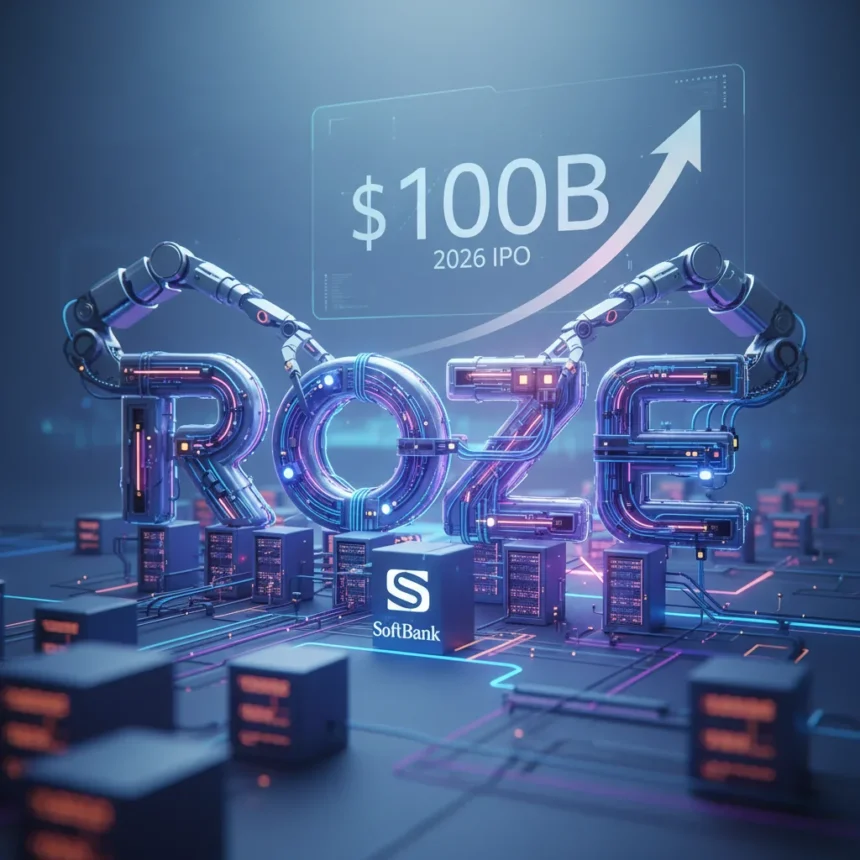
SoftBank robotics data center automation is about to get a dedicated company. The Japanese conglomerate is planning to create and list a new AI and robotics firm called Roze in the United States, targeting a valuation of $100 billion and an initial public offering as early as the second half of 2026. The move positions SoftBank to capitalize on the explosive growth in infrastructure needed to power artificial intelligence workloads globally.
Key Takeaways
- Roze will automate data center construction using autonomous robots and systems to build server farms faster and more efficiently.
- SoftBank is targeting a $100 billion valuation for Roze before it even constructs its first facility.
- Global data center construction spending is projected to exceed $300 billion annually by 2028, driven by AI demand.
- IPO timing ranges from this year to the second half of 2026, though some SoftBank executives remain skeptical.
- The venture is part of SoftBank’s broader infrastructure play, including its lead role in the Stargate data center project.
Why SoftBank robotics data center automation matters now
The infrastructure bottleneck is real. Building data centers fast enough to meet AI demand has become a critical constraint for tech giants racing to deploy large language models and neural networks. SoftBank robotics data center solutions aim to solve this by replacing manual construction with autonomous systems, reducing timelines and costs. Global data center construction spending is projected to exceed $300 billion annually by 2028, driven by AI workload growth. Roze enters a market where speed and efficiency directly translate to competitive advantage. Companies that can build and deploy infrastructure faster gain months or years of lead time over rivals.
SoftBank’s timing reflects confidence in this thesis. The company is not just investing in data centers—it is building a dedicated robotics company to own the automation layer itself. This vertical integration strategy differs from traditional infrastructure plays where construction is outsourced to general contractors. By automating the build process, Roze could potentially offer faster turnaround and proprietary efficiency gains that justify the $100 billion valuation target.
The $100 billion valuation challenge
A $100 billion valuation for a company that has not yet constructed a single facility is audacious. For context, this values Roze ahead of most established infrastructure operators and on par with major tech platforms. However, the valuation is not without precedent in the AI infrastructure boom—investors have shown appetite for companies positioned at the intersection of hardware, software, and automation. The bet is that Roze’s robotics and AI capabilities will command premium valuations once the company proves it can deliver faster, cheaper data center builds at scale.

Not everyone inside SoftBank agrees. Some executives within the conglomerate remain skeptical of the $100 billion target and the aggressive timeline. This internal disagreement is healthy—it reflects the genuine uncertainty around whether robotics automation can deliver the cost and speed improvements required to justify such a high valuation. Roze will need to demonstrate real construction wins and efficiency gains to convert skeptics and sustain investor confidence through and beyond an IPO.
SoftBank’s broader AI infrastructure bet
Roze does not exist in isolation. SoftBank is leading financing for the Stargate project, a massive data center development initiative in the United States. By launching Roze alongside this commitment, SoftBank positions itself as both an infrastructure operator and a technology provider. This dual role could create powerful synergies—Roze can test and refine its robotics on Stargate projects, while Stargate benefits from latest automation that competitors cannot easily replicate.



The strategy also hedges SoftBank’s bets. If Roze succeeds as an independent company, it becomes a high-value IPO candidate with recurring revenue from automation services. If the robotics approach proves less transformative than hoped, SoftBank still owns valuable data center assets through Stargate. This layered approach to infrastructure investment is characteristic of SoftBank’s playbook—enter multiple positions in a high-growth sector and let winners emerge.
What could go wrong
Robotics automation in construction is notoriously difficult. Labor, logistics, and site-specific challenges make it hard to achieve the standardization that robots require. Roze will need to overcome decades of construction industry inertia and prove that autonomous systems can handle the complexity of modern data center builds. Cost overruns, delays, or safety issues could quickly erode confidence in the robotics approach.
There is also the question of market timing. A $100 billion IPO in 2026 assumes sustained investor appetite for AI infrastructure plays and SoftBank’s ability to demonstrate tangible progress in less than two years. Macroeconomic shifts, interest rate changes, or a slowdown in AI spending could dramatically alter the valuation landscape. Reuters could not immediately verify the Financial Times report when it first surfaced, suggesting some caution about the company’s plans and timelines.
How does Roze compare to traditional data center builders?
Traditional data center construction relies on established contractors and manual labor, a process that can take 18 months to several years from planning to operation. Roze’s robotics approach promises to compress timelines and reduce costs by automating repetitive tasks like assembly, installation, and quality control. However, traditional builders have decades of experience, established supply chains, and proven track records. Roze must prove that robotics can match or exceed this institutional knowledge while remaining cost-competitive.



Could Roze’s IPO happen in 2025?
Some SoftBank executives are targeting an IPO as early as this year, though the second half of 2026 is more commonly cited. An IPO in 2025 would require rapid progress on robotics development, successful pilot projects, and strong market conditions. While possible, the 2026 timeline appears more realistic given the need to demonstrate real-world construction success before going public.
Is SoftBank betting too much on robotics automation?
SoftBank is diversifying its infrastructure strategy across multiple projects and companies, so Roze is one piece of a larger portfolio rather than an all-in bet. That said, a $100 billion valuation for an unproven robotics company is a significant commitment. Success depends on whether autonomous systems can genuinely transform data center construction economics. If they do, Roze could become one of the most valuable infrastructure companies in the world. If they do not, the valuation will face serious pressure.
SoftBank robotics data center automation represents a bold bet on technology, timing, and market demand. The company is positioning itself to capture value across the entire AI infrastructure stack—from capital deployment to automation services. Whether Roze delivers on its ambitious $100 billion valuation target depends on execution, market conditions, and the fundamental promise of robotics in construction. For investors and competitors watching this space, Roze’s trajectory will offer crucial insights into whether automation can truly reshape how the world builds the infrastructure that powers AI.
Edited by the All Things Geek team.
Source: Tom's Hardware