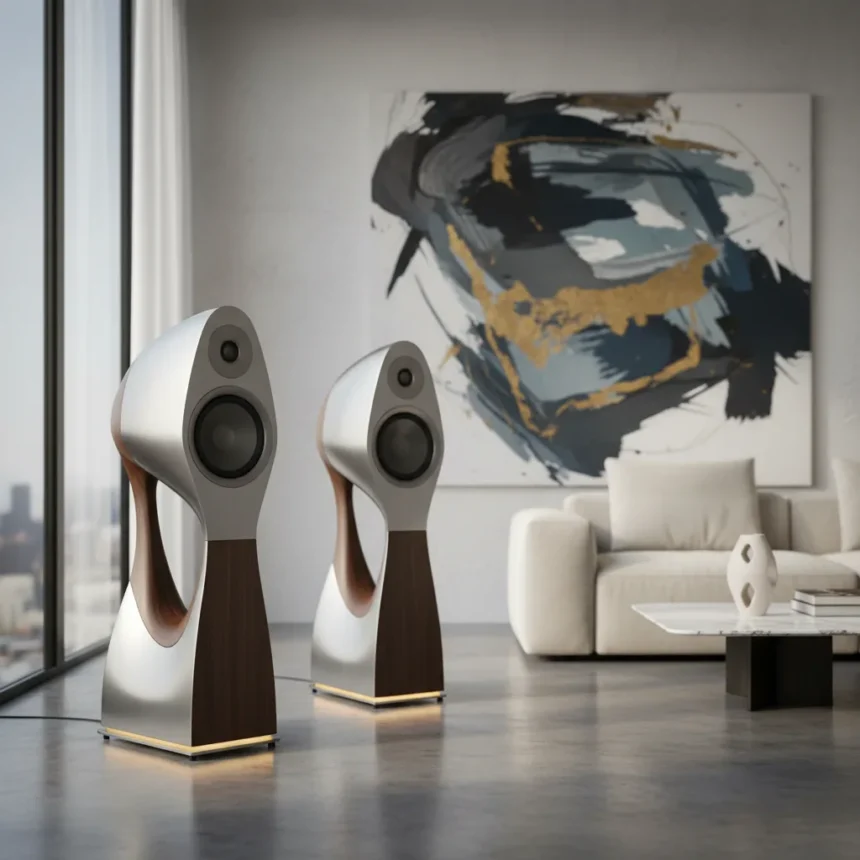
Oben Hi-Fi speakers represent a deliberate collision between high-end audio engineering and contemporary art direction. Founded by designer Jonathan Benali, the Los Angeles brand debuted at AXPONA 2024 with three core models—the Oben One floorstander, Oben Two bookshelf, and Oben Three center channel—each wrapped in hand-crafted composite cabinets and priced to match their sculptural ambition. Benali’s philosophy is direct: speakers should elevate listening experiences to art, not hide behind grilles in dark corners.
Key Takeaways
- Oben Hi-Fi speakers start at $18,000 per pair for the Oben Two bookshelf model.
- The flagship Oben One floorstander reaches $95,000 in premium finishes, featuring four 6.5-inch woofers and a beryllium tweeter.
- Cabinets use curved composite materials with automotive-grade finishes available in custom colors.
- Drivers source from Scan-Speak, SB Acoustics, and TAD, matching specs of competitors costing significantly more.
- US distribution operates through authorized dealers; international orders available on request.
Oben Hi-Fi speakers balance art direction with serious engineering
The Oben One is the statement piece. This 3-way floorstander houses four 6.5-inch woofers, a 5-inch midrange, and a 1-inch beryllium tweeter, delivering a frequency response of 25Hz–40kHz (±3dB) with 88dB sensitivity. Nominal impedance sits at 4 ohms, requiring between 50–500W of amplification. The Oben Two bookshelf strips that architecture down: one 6.5-inch woofer, one 1-inch beryllium tweeter, 40Hz–40kHz response, 86dB sensitivity, 6-ohm impedance, and 50–300W recommended power. The Oben Three center channel splits the difference with dual woofers, a midrange driver, and identical tweeter, hitting 87dB sensitivity across a 45Hz–40kHz range. All three use beryllium tweeters sourced from TAD—a choice that typically signals serious tuning ambition rather than marketing theater.
What distinguishes Oben Hi-Fi speakers from conventional luxury competitors is the cabinet treatment. Rather than machined aluminum (Magico’s signature) or exotic materials like zirconium (Børresen Acoustics), Benali’s team employs curved, hand-crafted composite construction with automotive-grade finishes. Gloss black and metallic silver ship standard; custom colors add 20–30% to the base price. This approach trades industrial minimalism for sculptural presence, positioning the speaker as a focal point rather than a component. In a living room designed by an architect, Oben Hi-Fi speakers belong on the wall like a statement artwork, not tucked beside a bookshelf.
Pricing positions Oben Hi-Fi speakers against established European luxury brands
The Oben Two starts at $18,000 per pair and climbs to $25,000 with premium finishes. The Oben Three center channel costs $22,000 each. The Oben One, the flagship, ranges from $75,000 to $95,000 depending on finish selection. For context, Børresen Acoustics’ comparable floorstanders exceed $100,000, while Wilson Audio’s custom-finish models hover around $50,000–$70,000. Magico’s sculptural minimalist designs land in the $40,000–$80,000 range. Oben Hi-Fi speakers position themselves as the American alternative—pricey but slightly more accessible than Danish exotica, with more artistic flair than Magico’s geometric austerity. KEF Blade speakers, a design-forward alternative, cost under $20,000 but sacrifice the hand-crafted cabinet philosophy. For buyers seeking statement hi-fi that photographs well, Oben Hi-Fi speakers justify the premium through both sonic engineering and visual identity.



Availability remains limited to authorized US dealers, with Audio Salon representing the brand across California, Texas, and Florida. International shipping accommodates custom orders, though logistics and tariffs likely add substantially to quoted prices. The brand’s debut timing—May 2024—suggests production is ramping rather than established, which means lead times may extend beyond typical retail cycles. Buyers accustomed to ordering Magico or Wilson Audio from stock should adjust expectations.
Oben Hi-Fi speakers challenge European dominance with American-made ambition
The ultra-luxury speaker market has long been dominated by European brands—Børresen from Denmark, Burmester and Acapella from Germany, Vivid Audio from South Africa. American competitors like Wilson Audio and Magico hold ground through engineering reputation and dealer networks, but they rarely lead on design conversation. Oben Hi-Fi speakers arrive at a moment when high-end audio buyers increasingly demand visual presence alongside sonic performance. The rise of open-plan homes and luxury interiors has made speaker aesthetics matter more than ever. A $95,000 speaker that looks like a black box invites skepticism; one that commands the room as sculpture justifies the investment. Benali’s background in industrial design, not audio engineering, is the point. Oben Hi-Fi speakers are designed by someone who understands how objects sit in spaces, not by someone chasing the next incremental tweeter improvement.



That said, the brand carries execution risk. A debut at AXPONA 2024 is a strong statement, but the market will demand evidence that sculptural ambition does not compromise acoustic performance. Competitors have decades of tuning refinement; Oben Hi-Fi speakers must prove they deliver not just visual drama but the transparency and dynamic control that justify five-figure price tags. Early reviews from What Hi-Fi acknowledge the visual impact while noting the sonic promise remains to be tested in diverse room conditions. Buyers betting on Oben Hi-Fi speakers are placing faith in Benali’s design vision and the sourcing choices (Scan-Speak, SB Acoustics, TAD drivers) that suggest serious engineering underneath the art direction.
What makes Oben Hi-Fi speakers different from Magico and Wilson Audio?
Magico prioritizes geometric minimalism and machined precision, with cabinets that disappear into contemporary interiors through sheer industrial refinement. Wilson Audio emphasizes custom finishes and dealer relationships, allowing buyers to match their speakers to existing décor. Oben Hi-Fi speakers, by contrast, demand attention—they are designed to be focal points, not background components. The curved composite cabinets and sculptural proportions echo modern art more than traditional hi-fi aesthetics. If you want speakers that blend smoothly with minimalist design, Magico wins. If you want speakers that announce themselves as art objects while delivering audiophile-grade sound, Oben Hi-Fi speakers are the play.
Can you customize Oben Hi-Fi speakers?
Yes. Custom color finishes are available beyond the standard gloss black and metallic silver options, though these add 20–30% to base pricing. International orders and custom configurations are accommodated through authorized dealers, with lead times extending the typical retail cycle.
Are Oben Hi-Fi speakers worth the price?
That depends on whether you value visual statement alongside sonic performance. The beryllium tweeters and proven driver sources (Scan-Speak, SB Acoustics) suggest serious acoustic engineering. But at $18,000–$95,000, these speakers compete on presence and design identity as much as raw sound quality. If aesthetics matter as much as frequency response in your buying calculus, Oben Hi-Fi speakers deliver a rare combination. If you prioritize pure acoustic performance over visual impact, Wilson Audio or Magico may offer better value per dollar spent on sound alone.



Oben Hi-Fi speakers represent a shift in how luxury audio brands think about product design. Rather than hiding engineering behind traditional enclosures, Benali’s team embraces the speaker as an object worthy of exhibition. That philosophy justifies the price for buyers who see hi-fi as interior design, not just a utility. For everyone else, the question remains whether art and audio can truly merge at these price points—or whether one will always compromise the other.
Edited by the All Things Geek team.
Source: What Hi-Fi?