






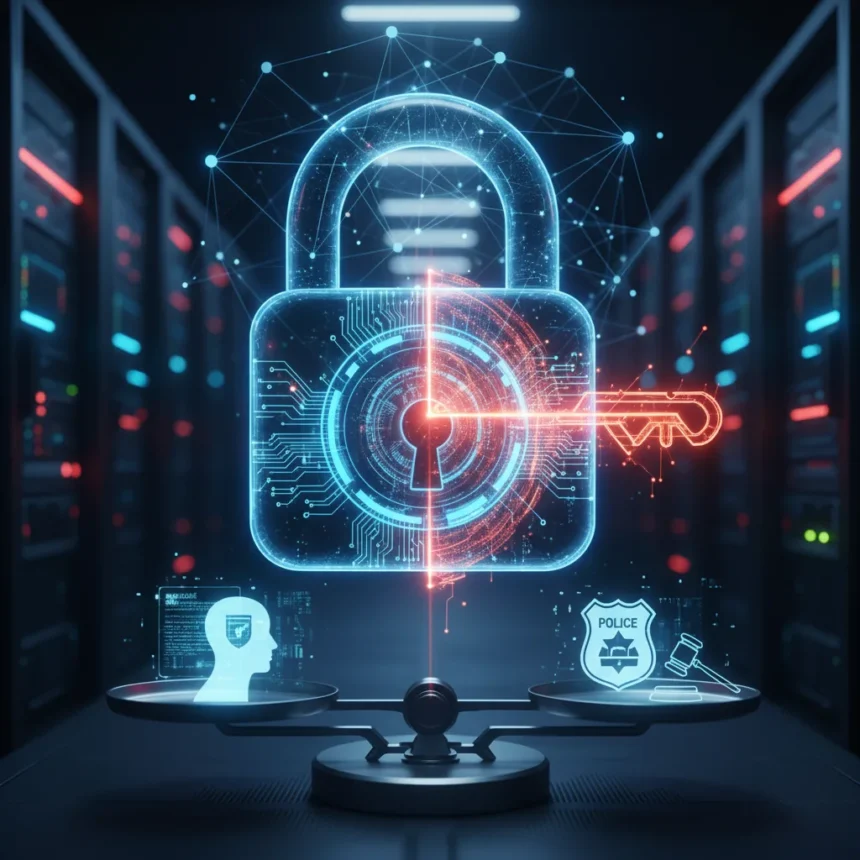
The debate over encryption backdoors and lawful access has reached a critical inflection point. Governments worldwide, particularly in Europe, are pushing for technical solutions that would allow law enforcement to access encrypted communications while maintaining security for ordinary users. But the fundamental question remains: can encryption backdoors and lawful access coexist, or is this a false choice masquerading as compromise?
Key Takeaways
- Encryption backdoors and lawful access are framed as separate concepts but serve identical purposes in law enforcement surveillance.
- The EU is pursuing a roadmap targeting 2030 implementation for accessing end-to-end encrypted communications.
- Security experts argue that weakening encryption undermines protection for everyone, not just suspects.
- The terminology shift from “backdoor” to “lawful access” reflects political rebranding rather than technical innovation.
- A workable compromise between privacy, security, and law enforcement access remains elusive.
What Encryption Backdoors and Lawful Access Actually Mean
Encryption backdoors and lawful access are not technically distinct concepts—they are the same mechanism dressed in different language. A backdoor is a deliberate weakness built into encryption systems that allows authorized parties to decrypt communications without the user’s knowledge or consent. Lawful access proposes the same outcome through different framing: law enforcement would obtain decryption keys or plaintext access through legal process rather than hacking. The semantic shift matters politically but changes nothing technically. Both require creating a vulnerability in systems designed to be invulnerable.
The distinction between these terms reflects a strategic rebranding effort. Calling something a “backdoor” invokes images of break-ins and unauthorized access, triggering public resistance. Rebranding the same mechanism as “lawful access” sounds orderly, legitimate, and accountable. Yet the underlying cryptographic problem remains identical: you cannot selectively weaken encryption for “good actors” without creating exploitable weaknesses for everyone else.
Why Law Enforcement Wants Encryption Backdoors and Lawful Access
Law enforcement agencies argue that end-to-end encryption has created a surveillance blind spot. When communications are encrypted between sender and recipient, neither the service provider nor government agencies can intercept them—even with a warrant. Investigators contend this hampers criminal investigations, terrorism prevention, and child safety efforts. The frustration is genuine: a warrant that would once guarantee access to communications now yields nothing.


The European Union has moved beyond rhetoric into concrete policy. The EU’s ProtectEU initiative, unveiled in April 2025, targets 2030 implementation for accessing encrypted communications. This is not theoretical debate—it is a regulatory roadmap with enforcement timelines. Europol, the EU’s law enforcement agency, has made clear it wants more than just message content; it also seeks metadata—who is communicating, when, and how often. This expanded scope reveals that encryption backdoors and lawful access, as currently conceived, would grant unprecedented surveillance capabilities far beyond what traditional warrants permitted.
The Technical Impossibility of Selective Weakness
The core engineering problem is this: encryption either works or it does not. You cannot build a lock that is secure against criminals but opens for police. Every vulnerability created for authorized access is a vulnerability that sophisticated adversaries can exploit. Security researchers have repeatedly demonstrated that backdoored systems leak faster than systems designed without them. Malicious actors—foreign governments, criminal syndicates, hackers—will reverse-engineer and weaponize any deliberately weakened encryption.



The VPN industry has been particularly vocal about this risk. Security firms argue that weakening encryption would make European security worse overall, exposing citizens to greater threats from cybercriminals and hostile state actors than from the communications of suspects. A backdoor designed for law enforcement becomes a backdoor for everyone. Once you publish the key or the weakness, it is public knowledge. Once it is public knowledge, it is exploitable by anyone with the resources to use it.
This is not speculation or ideology—it is cryptographic mathematics. The technical community has reached near-consensus that encryption backdoors and lawful access frameworks, as currently proposed, cannot be implemented without catastrophic security consequences.
What a Real Compromise Would Require
A genuine compromise would need to address three irreconcilable demands: law enforcement needs investigative access, citizens need unbreakable encryption, and security experts need systems free from deliberate weaknesses. Current proposals sacrifice the second and third to achieve the first.
Some have suggested metadata collection as a middle ground—tracking who communicates with whom without decrypting content. But Europol’s interest in metadata alongside message content suggests law enforcement views this as a starting point, not a destination. Governments rarely accept incrementally expanded powers; they use them as stepping stones to broader surveillance.



Others propose encryption backdoors and lawful access systems controlled by trusted third parties, with multiple key-holders required to unlock communications. This adds bureaucratic friction but does not solve the underlying problem: you still have created a weakness, and you still have multiple parties holding keys that could be compromised, coerced, or leaked.
The Real Cost of Encryption Backdoors and Lawful Access
If governments succeed in implementing encryption backdoors and lawful access frameworks, the consequences extend far beyond law enforcement investigations. Authoritarian regimes would demand the same tools. Dissidents, journalists, and activists in repressive countries would lose the only secure communication channel available to them. Ordinary citizens in democracies would face normalized surveillance, with every communication subject to potential access under laws that expand faster than public debate can keep pace.
The privacy cost is not abstract. Encryption backdoors and lawful access represent a permanent shift in the power balance between individuals and institutions. Once implemented, they are nearly impossible to reverse.
Can Compromise Actually Work?
The honest answer is no—not in the way current proposals frame the problem. Encryption backdoors and lawful access cannot coexist with unbreakable encryption. You must choose: either encryption remains mathematically sound and some law enforcement investigations face barriers, or encryption is weakened and everyone faces greater security risk.
This is not a failure of negotiation or political will. It is a failure of the premise itself. The question assumes a technical solution exists to a political and philosophical problem. It does not.
FAQ
What is the difference between an encryption backdoor and lawful access?
Technically, there is no difference. Both create a mechanism for decrypting communications without user consent. The terminology distinction is political, not cryptographic. “Backdoor” sounds sinister; “lawful access” sounds orderly. The underlying vulnerability is identical.
Will the EU actually implement encryption backdoors by 2030?
The EU has published a roadmap targeting 2030 for accessing end-to-end encrypted communications. Whether this timeline holds depends on technical feasibility, political pressure from privacy advocates, and industry resistance. The regulatory intent is clear; the technical path remains uncertain.
Could metadata-only collection be a compromise on encryption backdoors and lawful access?
Metadata collection—who communicates with whom—is less invasive than decrypting message content, but law enforcement has historically used metadata access as a stepping stone to content access. It may delay encryption backdoors and lawful access implementation, but it does not solve the underlying tension between privacy and surveillance.
The encryption backdoors and lawful access debate will continue, but the technical reality remains unchanged: you cannot weaken encryption for “good actors” without weakening it for everyone. Until policymakers accept this constraint, compromise will remain elusive. The choice is not between security and privacy with surveillance, but between different security risks—and which ones a society is willing to accept.
This article was written with AI assistance and editorially reviewed.
Source: TechRadar