



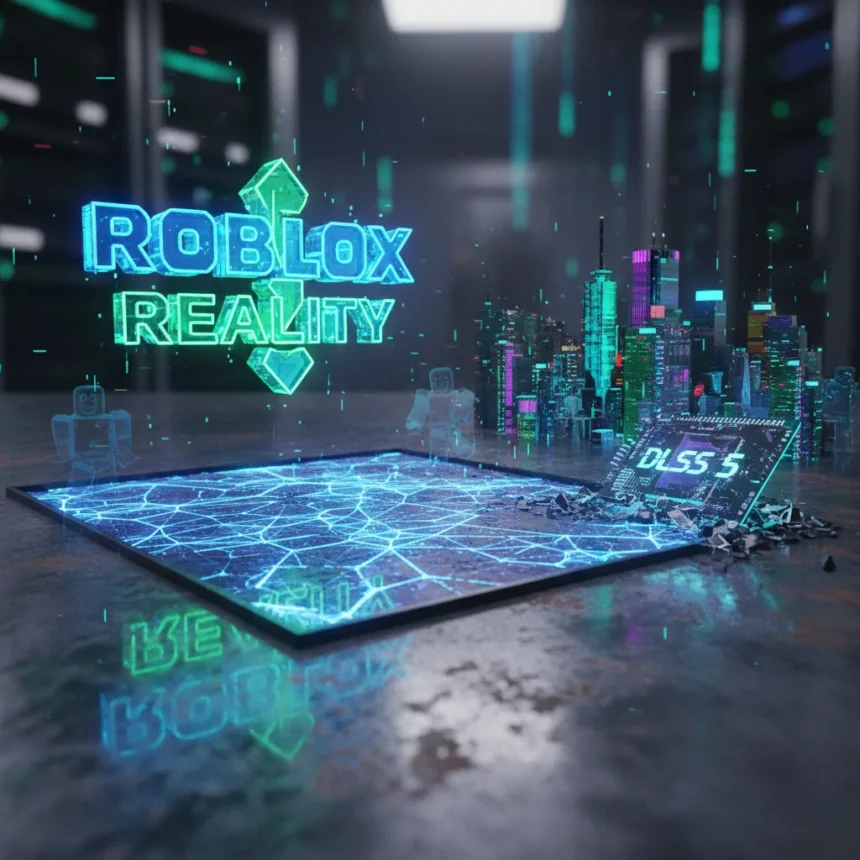
Roblox Reality AI upscaling represents the latest attempt to make game graphics hyperreal through artificial intelligence, but the platform’s approach carries the same fundamental flaws that made NVIDIA’s DLSS 5 notorious for producing visually sloppy results. Roblox announced a new AI platform designed to replace the blocky, colorful aesthetic that defines its 200+ million-player ecosystem with what the company calls “photorealistic multiplayer gaming,” but the promise masks a troubling reliance on generative AI to do the creative work that game artists have traditionally handled.
Key Takeaways
- Roblox Reality pairs video world models with the Roblox engine to upscale blocky graphics into photorealistic visuals
- The platform avoids mentioning “AI” in promotional materials, using “democratizing” instead to obscure the underlying technology
- Early comparisons to NVIDIA’s reviled DLSS 5 suggest similar quality control problems and visual artifacts
- No launch date, hardware requirements, or performance benchmarks have been disclosed
- Existing Roblox graphics improvements like occlusion culling and dynamic lighting achieve better results without AI
Why Roblox Reality Risks Becoming Another AI Upscaling Disaster
Roblox Reality AI upscaling promises “breathtaking realism, secondary motion, natural dynamic environments, and fluid physics,” but each claim arrives with substantial baggage. The platform uses video world models—generative AI systems trained on real-world footage—to transform Roblox games into photorealistic experiences. The problem is that generative AI excels at plausible-looking averages, not at the precise, consistent visual language that successful games require. NVIDIA learned this lesson the hard way with DLSS 5, which produced visually incoherent results when tasked with upscaling game footage. Roblox appears to be walking the same path, relying on a tool that mistakes itself for an artist rather than a technical enhancement.
The framing matters here. Roblox’s marketing emphasizes “democratizing” photorealistic gaming without explicitly mentioning AI in its official blog post. This linguistic choice is telling. The company is attempting to sidestep the growing skepticism surrounding generative AI in creative industries. Gamers have already rejected AI-generated art in major titles, and the Roblox community is unlikely to embrace AI-slop filters applied indiscriminately to user-created games. What sounds like accessibility—enabling low-end devices to run photorealistic games—actually means applying a uniform visual transformation that strips away the intentional design choices developers made.
Roblox Reality AI upscaling faces stiff competition from simpler alternatives
The real question is whether Roblox Reality AI upscaling solves a problem that actually needs solving. Roblox games run on everything from mobile phones to integrated graphics chipsets, and the platform’s strength has always been accessibility, not visual fidelity. AMD’s FSR upscaling technology exists as an alternative, but testing shows it actually worsens framerates on the low-end GPUs and integrated graphics that dominate Roblox’s player base. DLSS, NVIDIA’s proprietary upscaling tech, requires high-end hardware that most Roblox players do not own. This means Roblox Reality AI upscaling is not really competing with existing upscaling solutions—it is attempting to create a new category that may not be necessary.
Meanwhile, Roblox has already demonstrated that traditional graphics improvements work. Occlusion culling, higher-resolution textures, and dynamic lighting have all improved Roblox’s visual quality without relying on generative AI. These techniques are slower, more labor-intensive, and less flashy than an AI upscaling system, but they produce consistent, intentional results. A developer can control exactly how a scene looks. With Roblox Reality AI upscaling, a developer hands control to a neural network and hopes the output matches their vision.
What Roblox Reality AI upscaling actually means for creators
For Roblox creators, this announcement raises uncomfortable questions about creative control. If Roblox Reality AI upscaling becomes standard, will developers be expected to design games knowing that an AI system will transform their work? Will the platform favor creators who embrace the photorealistic aesthetic, pushing blocky, stylized games toward obsolescence? The announcement offers no clarity on adoption—whether the system will be optional, mandatory for new games, or available only to certain developer tiers. Without specifics on launch timing, hardware requirements, or performance benchmarks, it is impossible to assess whether this is a genuine feature or a speculative announcement designed to generate headlines.

Google attempted something similar with its “AI worlds” presentation, which produced vague, game-like videos that lacked any grounding in actual game design. Roblox claims better integration with its engine, but without public demos or benchmark data, that claim remains unverified. The company has not released footage showing Roblox Reality AI upscaling in action on actual games, which is conspicuous. If the results were compelling, Roblox would have shown them.
Is Roblox Reality AI upscaling actually launching?
The absence of a launch date is perhaps the most telling detail. Roblox announced Roblox Reality AI upscaling as a capability, not as a product with a timeline. This suggests the technology may still be in early experimentation, or that the company is gauging community response before committing resources. Given the backlash against AI art in gaming and the technical challenges inherent in applying generative AI to real-time game rendering, it is entirely possible that Roblox Reality AI upscaling never reaches production. Vaporware announcements are common in tech, especially when a company wants to signal innovation without the risk of public failure.
What alternatives exist for Roblox developers?
Developers frustrated with Roblox Reality AI upscaling’s vagueness have other options. SuperbulletAI, a free AI game builder for Roblox, offers 1 million tokens per month and generates production-ready code and GUIs without relying on photorealistic upscaling. It is a narrower tool, but it is available now and does not require waiting for Roblox to finalize a speculative feature. For graphics specifically, sticking with proven techniques—better lighting, higher-resolution assets, optimized geometry—remains the most reliable path to visual improvement.
Will Roblox Reality AI upscaling reach the market?
The honest answer is uncertain. Roblox has not provided a launch date, performance benchmarks, or hardware requirements, making it impossible to assess feasibility. The company may be testing the concept internally, or it may be using the announcement to signal technological ambition to investors. Either way, the gap between announcement and shipping product in AI-driven graphics is often measured in years, if the product ships at all.
How does Roblox Reality AI upscaling compare to DLSS 5?
Both systems attempt to use generative AI to enhance game visuals, but DLSS 5 requires NVIDIA hardware and has been widely criticized for producing visually incoherent results. Roblox Reality AI upscaling theoretically works on any device, but that breadth comes at the cost of control. DLSS 5 at least integrates with established game engines; Roblox Reality AI upscaling is a black box applied on top of existing games. Neither approach has solved the fundamental problem: generative AI is not a substitute for intentional artistic direction.
Roblox Reality AI upscaling represents a bet that players care more about photorealism than the aesthetic identity that makes Roblox distinctive. That bet may be wrong. The platform’s strength has never been visual fidelity—it has been accessibility, community, and creative freedom. Slapping an AI upscaling filter onto that ecosystem risks alienating the developers and players who chose Roblox precisely because it is not trying to be Unreal Engine. Until Roblox releases concrete details on performance, availability, and actual visual results, Roblox Reality AI upscaling should be treated as aspirational marketing, not a confirmed feature.
This article was written with AI assistance and editorially reviewed.
Source: Windows Central