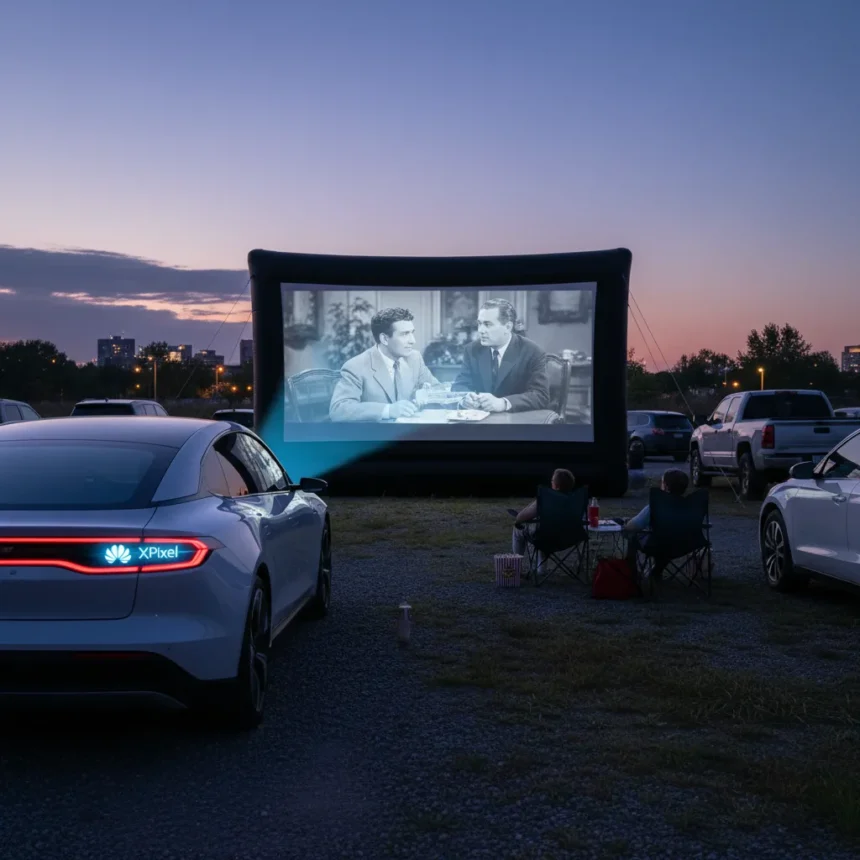
Car headlights with projectors are transforming how we think about outdoor entertainment, reviving the drive-in movie concept through latest automotive technology developed by Huawei Technologies in partnership with Baic Motor. The Stelato S9 sedan features headlights equipped with two-megapixel resolution that can project movies, navigation arrows, and crosswalk markings onto surfaces in front of the vehicle, including a 100-inch outdoor screen. This innovation, branded as XPixel by Huawei, represents a significant shift in how carmakers are approaching advanced lighting systems—moving beyond mere safety improvements to entertainment capabilities.
Key Takeaways
- Huawei’s XPixel headlights project movies onto 100-inch screens and cast navigation graphics on roads.
- Two-megapixel resolution enables both entertainment and functional safety projections from car headlights.
- Seres Group’s Aito M line vehicles feature this technology as a key selling point alongside driver-assistance systems.
- Advanced lighting systems market valued at US$1.1 billion in 2025, expected to roughly double over the next decade.
- Chinese carmakers are integrating entertainment features faster than BMW and Mercedes-Benz, which focus primarily on road lighting improvements.
How Car Headlights With Projectors Work
The XPixel system transforms traditional automotive headlights into projection devices capable of displaying high-resolution content. Rather than simply illuminating the road ahead, these car headlights with projectors use two-megapixel sensors to cast images onto external surfaces, whether a wall, screen, or the ground itself. The technology serves dual purposes: entertainment during stationary use and practical safety functions while driving, such as projecting arrows and crosswalk markings to guide pedestrians and navigation cues for the driver.
Huawei’s approach differs fundamentally from competitor efforts. While BMW and Mercedes-Benz are developing pixelated headlights primarily to improve road lighting precision and safety, Chinese carmakers have accelerated the integration of entertainment applications. John Zhang, president of Seres Group, highlighted that this feature became one of the key selling points of their popular M line of vehicles, alongside advanced driver-assistance systems. This distinction reveals a strategic divergence: Western manufacturers prioritize incremental lighting improvements, while Chinese innovators are pursuing experiential features that appeal directly to consumers.
The Entertainment Revolution in Automotive Design
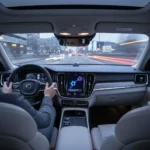
The emergence of car headlights with projectors signals a broader shift in how automakers view vehicle functionality. Huawei’s partnership extends beyond the Stelato S9, with similar projection technology integrated into Seres Group’s Aito M line. The company also offers an interior projection system that can display content onto roll-up screens positioned behind front seats or project from a raised tailgate, creating a complete entertainment ecosystem within and around the vehicle.


This revival of drive-in cinema through automotive innovation addresses a nostalgic gap in entertainment culture. Drive-in theaters have largely disappeared from developed markets over recent decades, but car-based projection technology offers a modern alternative for outdoor movie experiences. The convenience factor is significant: any vehicle equipped with this technology becomes a portable cinema, eliminating the need for dedicated drive-in infrastructure while offering flexibility in location and timing.
Market Growth and Competitive Landscape
The advanced lighting systems market is experiencing rapid expansion, valued at US$1.1 billion in 2025 and expected to roughly double over the coming decade, according to Intelmarket Research. This growth reflects broader industry recognition that automotive lighting is evolving beyond basic illumination toward integrated systems combining safety, navigation, and entertainment functions. Chinese manufacturers are capturing significant momentum in this space by introducing consumer-facing features earlier than established Western competitors.



The competitive dynamics reveal an interesting pattern: established luxury brands like BMW and Mercedes-Benz are developing sophisticated pixelated headlight technology, but their focus remains narrower—primarily improving road lighting quality rather than exploring entertainment applications. This creates an opportunity for Chinese automakers to differentiate themselves in a hyper-competitive market by offering features that appeal to modern consumers seeking integrated technology experiences. As the market continues to mature, expect pressure on Western manufacturers to follow suit or risk losing appeal to tech-forward buyers.
Practical Limitations and Real-World Considerations
While car headlights with projectors represent genuine innovation, practical deployment raises questions about consistency and user experience. Projection quality depends on ambient lighting conditions, surface texture, and distance—variables that outdoor environments present unpredictably. The technology performs best in controlled conditions such as evening gatherings or designated outdoor spaces with suitable projection surfaces, limiting its everyday utility compared to traditional entertainment setups.
Additionally, the integration of projection systems into automotive headlights adds complexity to vehicle maintenance and repair. Any malfunction affecting the projector compromises both entertainment and safety lighting functions simultaneously, creating potential reliability concerns that manufacturers must address through robust engineering and warranty support.
Is this the future of automotive entertainment?
Car headlights with projectors demonstrate genuine innovation, but widespread adoption depends on cost, reliability, and consumer demand. The technology appeals most to buyers in markets where outdoor entertainment and vehicle customization carry cultural significance, particularly in Asia where Chinese automakers dominate. Western markets may see slower adoption until prices decline and the feature becomes standard rather than premium.



How does projection quality compare to dedicated projectors?
Automotive headlight projectors prioritize portability and integration over image quality. Two-megapixel resolution suits entertainment and navigation graphics but falls short of dedicated home theater or cinema projectors. The technology excels at functional projections—navigation arrows, crosswalk markings—where precision matters less than visibility and recognition.
Can these headlights replace traditional drive-in theaters?
Car headlights with projectors offer a convenient alternative for informal outdoor viewing but lack the infrastructure and experience of dedicated drive-in venues. They excel for personal use—camping trips, backyard gatherings, tailgating—but cannot replicate the social experience and professional-grade presentation of traditional drive-ins. Instead, they represent a complementary technology that modernizes the drive-in concept for mobile, flexible entertainment.
The emergence of car headlights with projectors reflects a genuine shift in automotive innovation priorities. Chinese manufacturers are pushing beyond incremental improvements toward experiential features that reshape how vehicles function in daily life. Whether this technology becomes mainstream depends on cost reduction and consumer adoption rates, but it undeniably challenges the assumption that car technology must prioritize only safety and performance. For now, it remains a compelling proof-of-concept that automotive innovation extends far beyond traditional boundaries.
Edited by the All Things Geek team.
Source: What Hi-Fi?