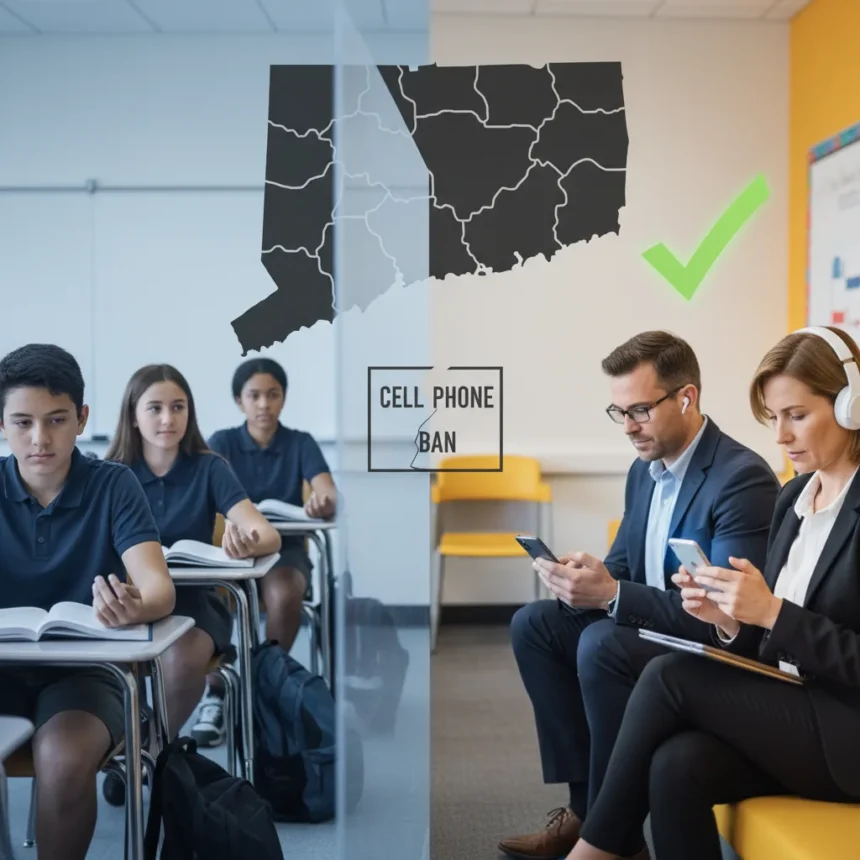
Connecticut’s cell phone ban in schools just cleared a major hurdle. House Bill 5035, titled “An Act Requiring School Districts to Ban Cellular Phones in the Classroom,” passed the Connecticut House of Representatives on April 27, 2026, by a vote of 117-31 with bipartisan support, advancing one of the nation’s strictest statewide restrictions on student phone use. The Connecticut school phone ban now heads to the Senate before the legislative session ends May 6, 2026.
Key Takeaways
- Connecticut House passed HB 5035 with 117-31 vote, imposing bell-to-bell phone ban in public schools during school day.
- Students can bring phones but cannot use them; districts choose storage method (backpacks, locked pouches).
- Students with IEPs, 504 plans, or health plans requiring phone access are exempt.
- Teachers and administrators remain exempt; proposed amendment to include them failed.
- Bill overrides current state guidance allowing phone use at lunch and between classes.
Why the Connecticut School Phone Ban Matters Right Now
Connecticut is making a bold move. If the Senate approves HB 5035 before May 6, the state will enforce a uniform, statewide bell-to-bell phone ban across all public schools—a stricter mandate than the current state Department of Education guidance, which allows use at lunch, between classes, and for instruction. This overrides whatever local policies individual districts have already established. The timing matters because the national conversation around phones in schools is intensifying, with districts and parents increasingly concerned about distraction and mental health impacts.
The bill’s supporters frame it as both a distraction issue and a mental health measure. Rep. Amy Romano called it “a mental health bill, it’s a safety bill”. Rep. Leeper argued plainly: “There is no data that says cellphones in schools are good for children. We know phones are not good for children in schools”. The Connecticut Education Association, which backed the bill, emphasized the need for “a consistent, statewide standard that makes clear cell phones do not belong in our children’s hands during the school day”.
The Hypocrisy Problem Nobody Can Ignore
Here’s where Connecticut’s well-intentioned bill hits a credibility wall. Teachers, administrators, and school staff remain exempt. Students cannot touch their phones. Adults can. Rep. Gale Mastrofrancesco (R-Wolcott) spotted this immediately and proposed a floor amendment to extend the ban to teachers and administrators—a move that would actually enforce the principle being sold to students. The amendment failed.


Rep. Zupkus (R) nailed the problem: “Teachers, administrators can walk around with their cellphones, but students can’t, and that is, to me, not good role modeling at all”. This is not a minor critique. If the state’s message to students is that phones are distracting and harmful to mental health during the school day, but teachers are scrolling through email and texts in the hallway, the rule becomes a power dynamic rather than a principle. Students notice hypocrisy. They internalize it. A blanket ban on one group while exempting another sends the message that the rule exists to control students, not to protect them.
Local Control vs. State Mandate: The Republican Pushback
Opposition to HB 5035 came primarily from Republicans, though not all—20 Republicans voted in favor. The core objection: this is not filling a void. Many Connecticut school districts already have cellphone policies in place. Rep. Tina Courpas (R-Greenwich) made this explicit: “This bill is not filling a void where there is no policy. This bill is affirmatively overriding local policy which has already been established”. The argument is federalism at the school board level. Why impose a statewide mandate when districts can decide for themselves?


That argument has merit, especially when districts have already acted. But the counter-argument is also clear: without a statewide standard, schools with weaker policies create a patchwork, and peer pressure from neighboring districts with looser rules undermines stricter ones. Connecticut’s House chose consistency over local flexibility. Whether that trade-off was worth it depends on whether you believe statewide standards are necessary to level the playing field.
What the Ban Actually Allows—and What It Doesn’t
The Connecticut school phone ban is strict but not absolute. Students can bring phones to school; they simply cannot use them during the school day on school grounds. Individual districts will decide the storage method—some may use locked pouches, others backpacks. Critically, students with IEPs (Individualized Education Programs), 504 plans, or health plans requiring phone access are exempt. This carve-out is essential; a student using a phone to manage a medical condition or access an accessibility tool should not be penalized.
The ban does not extend to school buses, which are not considered part of the bell-to-bell school day or school grounds. Local districts also retain control over phone use during after-school activities and the discipline policies for violations. In other words, Connecticut has imposed a ceiling on phone use but left districts room to manage implementation and exceptions.
Does This Actually Solve the Problem?
The Connecticut school phone ban rests on the assumption that removing phones from students’ hands during the school day reduces distraction and improves mental health. That assumption is reasonable but not proven in the brief the House voted on. Supporters cite “no data that says cellphones in schools are good for children,” but the absence of positive data is not the same as evidence that a ban works. Other states and districts have tried phone restrictions with mixed results. Without post-implementation data, Connecticut cannot yet claim victory.


What the bill does accomplish is clarity. Instead of 180 school districts with 180 different policies, there is now one statewide rule—if the Senate approves it. That simplicity has value, even if the underlying science remains uncertain.
Will the Senate Pass It?
The House vote of 117-31 suggests strong bipartisan appetite, though the Republican dissent signals this is not a slam-dunk in the Senate. The bill has to pass by May 6, 2026, when the legislative session ends. If it does, Connecticut joins a small but growing list of states tightening phone policies in schools. If it stalls in the Senate, the debate over local control vs. statewide standards will continue, and the hypocrisy of exempting teachers will remain unresolved.
Could the ban actually improve student focus without addressing teacher phone use?
Technically, yes. Removing student phones might reduce peer distraction even if teachers use theirs. But the educational message fractures. Students learn that rules apply selectively based on status, not principle. That lesson often outlasts any benefit from reduced phone distraction.
What happens if a student violates the Connecticut school phone ban?
The bill leaves discipline policies to individual districts. Some may confiscate phones for the day, others might involve parents, and some might impose detention. Connecticut has not mandated a uniform consequence, only a uniform rule.
Are there exceptions to the Connecticut school phone ban?
Yes. Students with IEPs, 504 plans, or health plans requiring phone access are exempt. This protects students who need phones for accessibility or medical reasons. The exemption is the bill’s most thoughtful element.
Connecticut’s House has passed a bold bill that tackles a real problem—student phone distraction—with a blunt instrument. The Connecticut school phone ban is strict, statewide, and overdue if you believe phones harm learning. But it also exposes a credibility gap: teachers and administrators remain exempt, which undermines the moral authority of the rule. If the Senate approves it, implementation will matter more than the law itself. A ban enforced fairly and consistently, with genuine adult buy-in, could shift school culture. A ban treated as a student-only rule while adults remain glued to their screens will teach the opposite lesson.
Where to Buy
Apple iPhone 17 Pro | Samsung Galaxy S26 | Samsung Galaxy S26 Plus | Samsung Galaxy S26 Ultra | Google Pixel 10
Edited by the All Things Geek team.
Source: TechRadar