




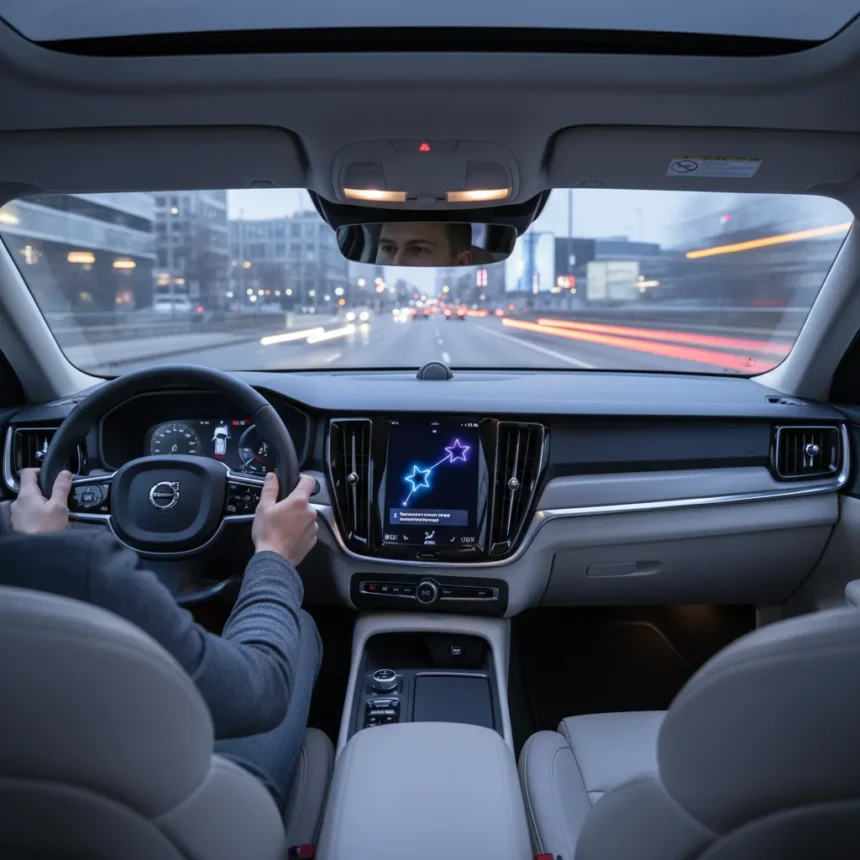
Gemini in car systems is arriving in Volvo vehicles across the UK as part of a broader shift in how automakers deploy artificial intelligence behind the wheel. The rollout, scheduled for later in 2025, positions Volvo as one of the first manufacturers to replace its voice assistant with Google’s conversational AI platform, marking a pivotal moment for automotive technology partnerships.
Key Takeaways
- Gemini replaces Google Assistant in Volvo cars with Android Automotive, enabling conversational AI with memory and natural language processing.
- UK Volvo drivers with supported models (EX90, XC40 Recharge, Polestar 2) will receive the update free via OTA software update later in 2025.
- Android Automotive is a native in-car operating system used in over 50 vehicle models globally, distinct from Android Auto which runs from a phone.
- General Motors is rolling out Gemini to over 4 million Android Automotive vehicles in the US, accelerating industry-wide adoption.
- The Google-Volvo partnership, which began in 2017, positions Volvo as a reference platform for testing new Android Automotive features.
Why Gemini in car systems matters now
Gemini in car systems represents a fundamental upgrade over traditional voice assistants like Siri or Alexa. Instead of responding to precise commands—”navigate to the nearest petrol station”—Gemini understands conversational context and can maintain memory across multiple interactions. This shift matters because driving demands a fundamentally different interface than smartphones. A driver asking “Is it too cold for my planned route tomorrow?” expects the system to connect weather data, calendar information, and route history without needing to rephrase the question three times. Volvo’s early adoption signals that automakers see conversational AI not as a luxury feature but as a safety and usability necessity.
The timing of the rollout also reflects competitive pressure in the automotive AI space. General Motors is deploying Gemini to over 4 million Android Automotive vehicles in the US, while Android Auto—the phone-based version—will receive Gemini starting November 2025 but with a slower, more limited rollout. By integrating Gemini natively into the car’s operating system rather than relying on phone mirroring, Volvo gains faster response times, offline functionality for certain features, and a more seamless user experience. This architectural advantage is why Gemini in car systems through Android Automotive outpaces the phone-based alternative.
Gemini in car systems vs. traditional voice assistants
The distinction between Gemini and older voice assistants hinges on memory and context. Google Assistant in Volvo cars operated on a command-response model—you asked, it answered, the conversation ended. Gemini, by contrast, builds conversational memory within a session, allowing drivers to ask follow-up questions without restating context. If you ask “What’s the weather ahead on my route?” and then follow with “Will that affect visibility?”, Gemini understands you’re still discussing the same route and weather, not issuing an unrelated query. This reduces cognitive load for drivers and makes the system feel less robotic.



Compared to Apple’s Siri integration via CarPlay or Amazon Alexa via optional adapters, Gemini in car systems offers deeper integration with Android Automotive’s native features. Siri and Alexa are primarily phone-based systems that mirror to the car’s display; Gemini runs directly on the vehicle’s hardware. This means faster response times, fewer connectivity dependencies, and the ability to leverage vehicle-specific data—fuel levels, tire pressure, maintenance schedules—without routing queries through a phone first. For Volvo drivers, this native integration is a tangible advantage over aftermarket or mirrored solutions.
Which Volvo models get Gemini in car systems
The rollout applies to Volvo vehicles equipped with Google built-in and Android Automotive OS, primarily electric and newer models. Supported vehicles include the Volvo EX90, XC40 Recharge, and Polestar 2 (Polestar is Volvo’s performance brand). These models have had Android Automotive since around 2020, making them eligible for the Gemini update via over-the-air (OTA) software delivery. The free OTA mechanism means Volvo owners won’t need to visit a dealership or pay for the upgrade—it arrives automatically as a system update.



Volvo’s decision to prioritize these electric models reflects a broader industry trend: AI-driven infotainment systems are becoming standard in premium electric vehicles, where over-the-air updates are already normalized. Older Volvo models with traditional infotainment systems won’t receive Gemini, as they lack the underlying Android Automotive architecture. This creates a clear generational divide in Volvo’s lineup, with newer EVs gaining advanced AI capabilities while older petrol and diesel models retain legacy systems.
The Google-Volvo partnership and why Volvo leads
Volvo’s early access to Gemini stems from a deep, decade-long partnership with Google. The collaboration began in 2017 for infotainment development, was formalized in June 2021 for OTA update delivery, and Volvo became the first manufacturer to deploy Google Assistant in production vehicles in 2022. This history positions Volvo as one of Google’s reference hardware platforms for Android Automotive—essentially, Volvo cars serve as test beds for new features before broader rollout. When Google develops a new Gemini capability, Volvo’s vehicles are among the first to validate it in real-world driving conditions.
Patrick Brady, Google’s vice president of Android for Cars, stated: “For years, Google and Volvo have collaborated closely to bring latest technology to connected cars. We’re excited to deepen this partnership, accelerating the pace of innovation that will not only improve the driving experience for Volvo customers but also set new benchmarks for the automotive industry”. This partnership structure gives Volvo a competitive moat—early feature access, direct influence on development roadmaps, and the credibility of being Google’s trusted automotive partner. Other manufacturers using Android Automotive, including GM, will receive Gemini, but Volvo’s earlier timeline and deeper integration suggest Google prioritizes this relationship.
What Gemini in car systems means for the broader automotive industry
The Gemini rollout signals that AI is moving from the smartphone—where it has dominated for five years—into embedded automotive systems. This shift has profound implications. First, it suggests that voice and conversational interfaces will become the primary way drivers interact with vehicles, replacing touchscreen-heavy infotainment systems over the next five years. Second, it indicates that automotive OEMs are willing to cede significant control of the user experience to big tech platforms; Volvo, GM, and others are essentially outsourcing their voice interface to Google rather than developing proprietary systems. Third, it accelerates the timeline for autonomous driving features, as Gemini’s natural language understanding can be extended to handle complex driving queries—”take the scenic route” or “find a charging station with a café nearby.”



The competitive landscape matters here. Apple and Amazon have not achieved the same level of native automotive integration as Google. CarPlay and Alexa remain primarily phone-based or optional add-ons, whereas Android Automotive is a full operating system that OEMs can install as the car’s primary interface. This architectural advantage gives Google leverage in shaping how automotive AI evolves globally.
When will UK Volvo drivers get the update?
Volvo has announced that Gemini will roll out “later this year” (2025) via OTA update, with more specific timing details coming in the coming months. The vagueness is typical for major software rollouts—manufacturers often stagger updates to manage server load and gather early feedback from a subset of users before pushing to the full fleet. UK Volvo drivers should expect the update sometime in the second half of 2025, though exact dates remain unconfirmed. Once available, the update will be free and automatic, requiring no action from owners.
Is Gemini in car systems available outside the UK?
Yes, Gemini in car systems is not limited to UK Volvo drivers. The rollout applies globally to supported Volvo models with Android Automotive. However, specific regional timing and feature availability may vary based on local data privacy regulations, network infrastructure, and market priorities. The UK is highlighted because Volvo and Google have emphasized the UK market in their announcements, but European and other international Volvo owners with compatible vehicles should expect similar rollout schedules.
What features does Gemini bring to Volvo cars?
Gemini in car systems enables several capabilities beyond traditional voice commands. Conversational interaction allows drivers to ask multi-part questions and follow-ups without repeating context. Enhanced navigation integrates real-time traffic, weather, and route optimization with natural language requests. Expanded use cases go beyond precise commands—instead of saying “navigate to 123 Main Street,” drivers can say “find a good Italian restaurant near my destination” and Gemini handles the interpretation. The system also supports natural language processing that understands accents, colloquialisms, and incomplete sentences, making voice interaction feel less formal and more intuitive than older assistants.
Gemini in car systems represents a maturation of automotive AI, moving from novelty feature to essential infrastructure. For Volvo drivers, the 2025 rollout delivers a tangible upgrade to daily driving experience. For the broader industry, it signals that the smartphone era of AI is giving way to distributed, embedded systems optimized for specific contexts—and the car is the next major battleground.
Where to Buy
This article was written with AI assistance and editorially reviewed.
Source: T3