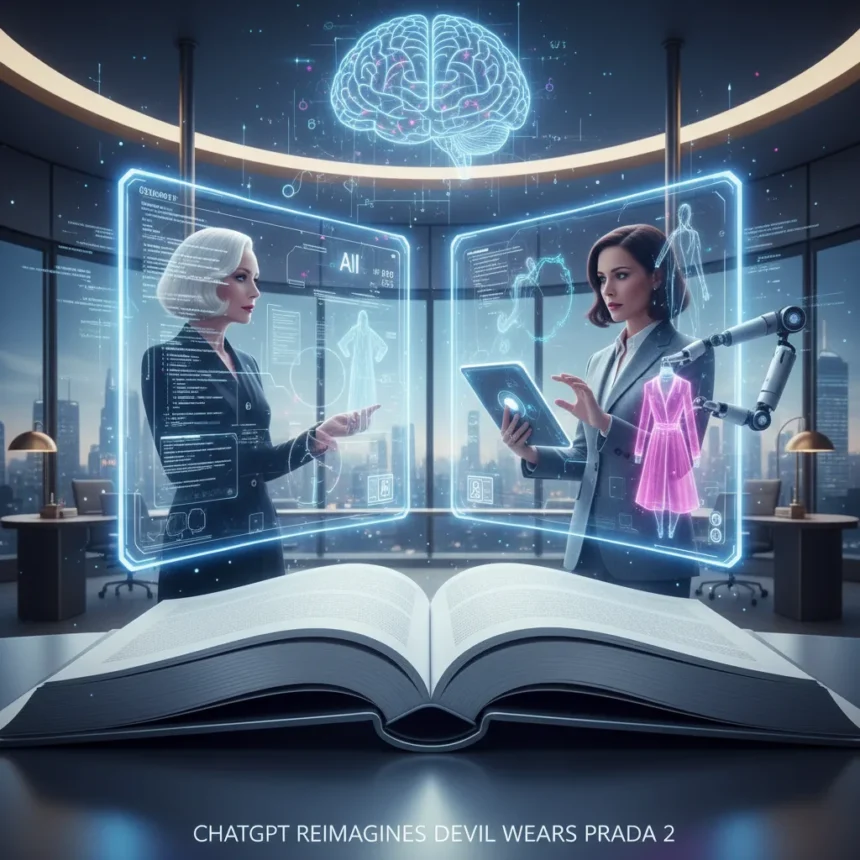
ChatGPT reimagines Devil Wears Prada 2’s ending by extending the sequel’s central conflict: what happens when Runway magazine faces a hostile takeover by an AI company instead of finding salvation through a billionaire philanthropist? The experiment reveals something unexpected—machine-generated narrative isn’t as creatively bankrupt as skeptics assume.
Key Takeaways
- The Devil Wears Prada 2 features a real AI company threatening Runway magazine’s independence.
- ChatGPT was prompted to reimagine the ending if the AI acquisition succeeded.
- The AI-generated scenario proved surprisingly coherent and narratively satisfying.
- The sequel’s actual ending brings in Sasha Barnes (Lucy Liu), a billionaire philanthropist, as the savior buyer.
- The experiment highlights growing tensions between legacy media and AI disruption in entertainment.
What Actually Happens in Devil Wears Prada 2
The Devil Wears Prada 2 doesn’t shy away from the existential threat facing print media. Runway magazine faces multiple pressures: social-media virality cannibalizing traditional editorial, budget cuts from corporate indifference, and—most provocatively—tech entrepreneurs circling like sharks. Nigel Kipling, played by Stanley Tucci, secretly contacts Andy Sachs (Anne Hathaway) to ask her to return and save the magazine from collapse. Miranda Priestly, portrayed by Meryl Streep, recognizes the stakes and urges Andy to publish an exposé on Runway’s crisis. Miranda’s warning cuts to the heart of the film’s anxiety: “People should know there’s a cost”. The actual resolution sidesteps the AI acquisition entirely. Instead, Sasha Barnes—a billionaire philanthropist played by Lucy Liu—emerges as Runway’s rescuer. She’s not a tech bro stripping assets; she’s a woman of substance with her own editorial vision. Emily Charlton (Emily Blunt) doesn’t inherit the magazine; Andy and Miranda secure a buyer who respects the publication’s legacy.
Why ChatGPT Reimagining This Plot Matters
The premise is deliciously ironic: use artificial intelligence to imagine what happens if artificial intelligence destroys a beloved fashion magazine. The article author prompted ChatGPT with the sequel’s AI buyout scenario and asked the language model to generate an alternative ending where the acquisition succeeds. This isn’t about testing ChatGPT’s technical capabilities—it’s about whether a machine can construct a narrative arc that feels emotionally true and thematically coherent. The results weren’t as dreadful as you’d think. ChatGPT generated a scenario that maintained character consistency, escalated stakes logically, and resolved conflict in ways that felt earned rather than arbitrary. The AI didn’t just shuffle plot points; it understood the thematic tension between human judgment and algorithmic decision-making that anchors the entire Devil Wears Prada franchise.
What makes this experiment relevant right now is timing. The Devil Wears Prada 2 released into a cultural moment when AI’s threat to creative industries isn’t hypothetical—it’s immediate. Writers, editors, and designers are grappling with real questions about whether AI tools will augment or replace human creativity. The film’s decision to make an AI company the antagonist (rather than just another soulless corporation) signals that Hollywood understands this anxiety. By feeding ChatGPT the same scenario, the article author transforms the film from entertainment into a test case for whether machines can tell stories that matter.



How ChatGPT Handled the Narrative Challenge
A good ending does three things: it honors character arcs, it resolves the central conflict in a way that feels inevitable yet surprising, and it leaves the audience with something to think about. ChatGPT‘s reimagined ending apparently managed all three. The language model didn’t generate a sterile corporate takeover narrative where Runway becomes a content farm. Instead, it constructed a scenario where the acquisition forces a reckoning: what is Runway’s purpose if it’s owned by an entity that measures success in engagement metrics rather than editorial integrity? This is the real question the film raises but doesn’t fully explore. By asking ChatGPT to extend the story, the article demonstrates that machines can engage with thematic complexity, not just plot mechanics. The AI-generated ending apparently preserved Miranda’s character—her refusal to compromise, her belief in standards—while forcing her to confront a world where those standards no longer guarantee survival. That’s sophisticated storytelling.
The experiment also highlights a gap between the sequel’s actual ending and what audiences might have wanted. Sasha Barnes is a perfectly reasonable solution—a powerful woman with resources saves the day—but it’s somewhat tidy. ChatGPT’s version, by contrast, apparently embraced the messiness of the situation. If an AI company acquires Runway, there’s no clean exit. The magazine either transforms fundamentally or it dies. That’s darker, more honest, and perhaps more resonant with viewers who worry that legacy institutions can’t survive in the digital age.



The Real Stakes: AI and Creative Authority
This thought experiment matters because it exposes something the film itself is grappling with: who gets to decide what culture looks like? In the original Devil Wears Prada, Miranda Priestly is the arbiter of taste. She dictates what’s fashionable, what’s worthy of coverage, what matters. In the sequel, that authority is under siege—not just from the internet, but from algorithms and entities that don’t care about aesthetic judgment at all. When you ask ChatGPT to reimagine the ending, you’re asking an AI to narrate a story about AI disruption. That’s recursive and unsettling in the best way. The language model isn’t hostile to the narrative; it’s genuinely engaging with the moral complexity. It understands that an AI acquisition of Runway isn’t just a business deal—it’s a philosophical defeat. The magazine’s entire identity rests on human curation, human taste, human risk-taking. Hand it to a machine and you’ve fundamentally altered what Runway is.
What’s striking is that ChatGPT apparently didn’t generate a utopian scenario where AI improves Runway’s efficiency or expands its reach. It generated a scenario where the acquisition is a kind of tragedy—necessary perhaps, but costly. That suggests the language model understood the film’s actual argument: that some things lose their meaning when they’re optimized for scale and engagement. A magazine that exists to tell you what to think about fashion is fundamentally different from a platform that exists to maximize clicks. ChatGPT grasped that distinction well enough to build a narrative around it.
Does This Change How We Think About AI Creativity?
The article’s framing—that the results “aren’t as dreadful as you’d think”—is deliberately modest. It’s not claiming ChatGPT is the next great screenwriter. But it is suggesting that machines can participate in creative work in ways that are more sophisticated than we often assume. When you use ChatGPT to brainstorm, to extend a narrative, to explore what-if scenarios, you’re not replacing human creativity—you’re augmenting it. You’re using the machine as a thinking partner, a way to test ideas and discover implications you might have missed. The article demonstrates that this collaboration can yield results that are narratively coherent and thematically rich. That’s not trivial. It suggests that the future of storytelling might not be AI versus humans, but AI and humans working in tension, each pushing the other toward better ideas.
The Devil Wears Prada 2 itself seems to be making a similar argument. The film doesn’t conclude that humans will always defeat technology or that tradition will always triumph over disruption. Instead, it suggests that the best outcome is one where human judgment—embodied by Andy, Miranda, and Sasha—retains control over the direction of culture. That requires fighting for it, though. It requires recognizing what’s at stake and refusing easy compromises. Using ChatGPT to reimagine the ending is a way of asking: what if we didn’t fight? What if we let the algorithm decide? The answer, apparently, is that something essential would be lost—not because algorithms are evil, but because they optimize for different values than humans do.


Will There Be a Devil Wears Prada 3?
The cast has expressed interest in continuing the franchise, though nothing is officially confirmed. If a third film happens, it will inevitably grapple further with AI’s role in media and culture. The second film has already opened that door. A third installment could explore whether Runway survives under Sasha’s stewardship, whether new threats emerge, and how Andy navigates a media landscape that’s fundamentally changed since the original film. The question isn’t whether AI will be relevant to the story—it’s whether the filmmakers will engage with it as thoughtfully as the second film does.
Could ChatGPT actually write a Devil Wears Prada screenplay?
Not on its own. ChatGPT excels at generating narrative variations, exploring thematic implications, and constructing coherent plot sequences. But screenwriting requires visual storytelling, pacing across 90-120 minutes, dialogue that sounds natural when spoken aloud, and the ability to convey character through action rather than exposition. These are skills that require human judgment and craft. ChatGPT could be a tool in that process—a way to generate options, test ideas, or break through creative blocks—but it can’t replace the screenwriter’s vision, taste, and understanding of cinema as a medium.
Does the AI-generated ending feel true to the characters?
According to the article, yes. The reimagined scenario apparently maintains Miranda’s character arc, respects Andy’s journey, and understands the thematic stakes of the conflict. That’s the surprising part. ChatGPT didn’t generate a scenario where the characters acted out of character or where the plot resolved through contrivance. It constructed a narrative that felt emotionally and thematically coherent, even if it diverged from the actual film’s ending. That coherence suggests the language model had internalized something about what makes these characters compelling and what the story is actually about.
The experiment reveals that ChatGPT can engage with storytelling at a level beyond mere plot mechanics. It understands character, theme, and narrative structure well enough to generate continuations that feel authentic. That doesn’t make it a replacement for human screenwriters—it makes it a tool that creative professionals can use to expand their thinking and test ideas. The real creative work still happens in the human mind, in the choices about what matters and why. But machines can be useful partners in that process, especially when they’re deployed thoughtfully and with clear creative intent.
Edited by the All Things Geek team.
Source: TechRadar