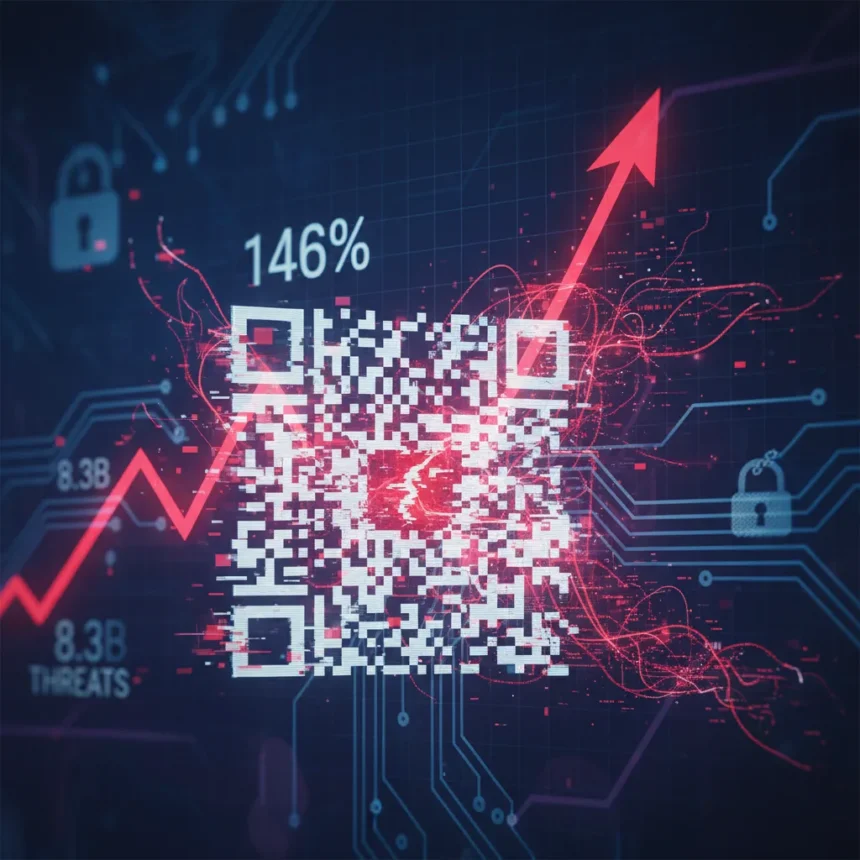
QR code phishing has become the fastest-growing attack vector in 2026, with volumes more than doubling in the first quarter alone. Microsoft Threat Intelligence detected approximately 8.3 billion email-based phishing threats in Q1 2026, but the real story is hidden in the numbers: QR code phishing attacks jumped from 7.6 million in January to 18.7 million in March—a staggering 146% increase over just three months.
Key Takeaways
- QR code phishing volumes surged 146% in Q1 2026, from 7.6 million attacks in January to 18.7 million in March.
- Microsoft detected 8.3 billion total email phishing threats across Q1 2026, with link-based attacks accounting for 78%.
- Direct email body embeds of malicious QR codes jumped 336% in March, bypassing attachment-based defenses.
- PDFs remain the primary delivery vehicle for QR codes at 65-70% of attacks, while malicious payloads fell from 19% to 13%.
- 73% of users scan QR codes without verifying their legitimacy, making them ideal targets for mobile-based phishing.
Why QR Code Phishing Is Winning Right Now
The surge in QR code phishing reflects a fundamental shift in attacker tactics. Traditional email security relies on text-based scanning engines that flag suspicious links and malicious content. By embedding URLs inside QR codes—which are images, not text—threat actors exploit a blind spot in legacy defenses. When a victim scans the code with their mobile device, they are redirected to a phishing site on an unmanaged phone, where they are far more vulnerable to credential theft.
What makes this vector especially dangerous is its invisibility to email filters. A QR code is just a picture. It contains no suspicious keywords, no flagged domains, no telltale phishing indicators that text-based scanners can detect. Microsoft’s own analysis shows that link-based threats still dominate overall attack volume at 78%, but QR code attacks are growing at a velocity that link-based threats never achieved. The quarterly increase of 146% dwarfs the growth rate of other vectors, signaling that attackers have found a genuinely effective workaround to email security infrastructure.
The Evolution of Delivery Methods Shows Attackers Adapting Fast
The way attackers deliver QR codes reveals how quickly they iterate when they discover what works. In January 2026, PDFs accounted for 65% of QR code delivery. By March, that rose to 70%—PDFs are reliable, widely trusted, and commonly opened without suspicion. But the real alarm bell is what happened with direct email body embeds. In March alone, QR codes embedded directly in the email message body surged 336%, reaching 5% of total QR code volume. This matters because an email attachment can be scanned and quarantined by security gateways. An image embedded in the email body itself is far harder to isolate and block without disrupting legitimate email flow.

Meanwhile, the overall phishing threat landscape showed slight consolidation. Malicious payloads—the actual malware or credential-stealing code—dropped from 19% of attacks in January to 13% by February and March, settling around 5-6% by quarter end. Attackers are increasingly abandoning direct malware delivery in favor of URL-based social engineering. They do not need to infect a machine anymore; they just need to trick a user into entering credentials on a fake login page.
How QR Code Phishing Compares to Other Emerging Threats
The acceleration of QR code phishing outpaces other security concerns that dominated earlier in 2025. The Anti-Phishing Working Group tracked a 400% increase in image-based phishing into 2025, setting the stage for what we see now. However, QR codes represent a distinct subcategory—they are not just images with embedded text, but machine-readable vectors that automatically redirect users without requiring them to manually copy or type a URL. ZenSec identified 1.7 million unique malicious QR codes in 2025 attachments alone, yet Q1 2026 volumes suggest the problem has accelerated further.



CAPTCHA-gated phishing has also evolved in parallel, with attackers using CAPTCHA challenges to verify that a victim is human before redirecting them to credential harvesting pages. This adds friction but also legitimacy—users are more likely to complete a CAPTCHA than to immediately suspect a phishing trap. Microsoft’s broader threat report for Q1 2026 also flagged a 41% surge in Microsoft Teams attacks and 49% increase in calendar-based phishing, suggesting attackers are diversifying across multiple collaboration platforms. Yet none of these vectors match the raw growth rate of QR code phishing.
Why Mobile Devices Are the Weak Link
The effectiveness of QR code phishing hinges on one simple fact: most users scan QR codes without verification. Research cited in threat reports found that 73% of users scan QR codes without checking where they lead. On mobile devices, there is no address bar visible until the page loads, no obvious way to inspect a URL before committing to it, and no institutional security controls like those on managed corporate devices. When an employee at a company scans a QR code from a phishing email on their personal phone, that employee lands on a credential-stealing page with no corporate security appliance standing in the way.
This represents a fundamental asymmetry: email gateways have evolved sophisticated defenses against text-based threats, but mobile browsers have no equivalent. A phishing page that would be instantly flagged by a corporate email filter loads unobstructed on an unmanaged phone. Attackers are exploiting this gap ruthlessly, and the 146% quarterly surge proves the tactic works at scale.
What This Means for Email Security Strategy
The rise of QR code phishing exposes a critical gap in traditional email security. Text-based scanning engines, URL reputation systems, and domain blocklists are all effective against conventional phishing—but they are blind to images. Organizations that rely solely on these tools are now facing a vector that grows faster than any other threat in the Q1 2026 threat landscape.



The shift also reveals why attackers abandoned Cloudflare as a hosting platform for phishing infrastructure in favor of alternative providers—a tactical change that suggests coordination and planning rather than opportunistic attacks. When a hosting provider becomes too hostile or monitored, threat actors simply migrate. The underlying attack methodology—QR codes, mobile redirects, credential harvesting—remains unchanged and effective.
Is QR code phishing going to keep growing?
Almost certainly. The 146% quarterly increase reflects the early adoption phase of a tactic that bypasses existing defenses. Until organizations deploy image-based scanning, mobile threat detection, or user training specifically addressing QR codes, the vector will remain attractive to attackers. The fact that direct email body embeds surged 336% in March suggests attackers are still experimenting and optimizing their delivery methods.
How can organizations defend against QR code phishing?
Effective defenses require a multi-layered approach. Email gateways should scan images for embedded QR codes and flag suspicious ones. User training must specifically address QR code verification—employees should be taught to hover over or screenshot a QR code to inspect the destination URL before scanning. Mobile device management policies should restrict access to unmanaged devices, and organizations should consider blocking QR codes in email altogether until they can be scanned safely.
Why didn’t email security vendors catch this sooner?
QR codes existed long before 2026, but their adoption as a phishing vector accelerated only when attackers realized how effectively they bypass text-based defenses. Email security vendors have historically optimized for link scanning, domain reputation, and malware detection—all text-based indicators. Image-based threats were always lower priority. Now that attackers have found a reliable way to exploit this blind spot, vendors are scrambling to add QR code detection to their platforms. The lag between tactic discovery and defense deployment is where attackers operate most effectively.
The Q1 2026 phishing landscape reveals a security industry in transition. Traditional defenses are still effective against conventional threats, but attackers have found a workaround that scales. QR code phishing is not the future of phishing—it is the present. Organizations that ignore this trend will find themselves defending against a vector that grows faster than their ability to respond.
Edited by the All Things Geek team.
Source: TechRadar