




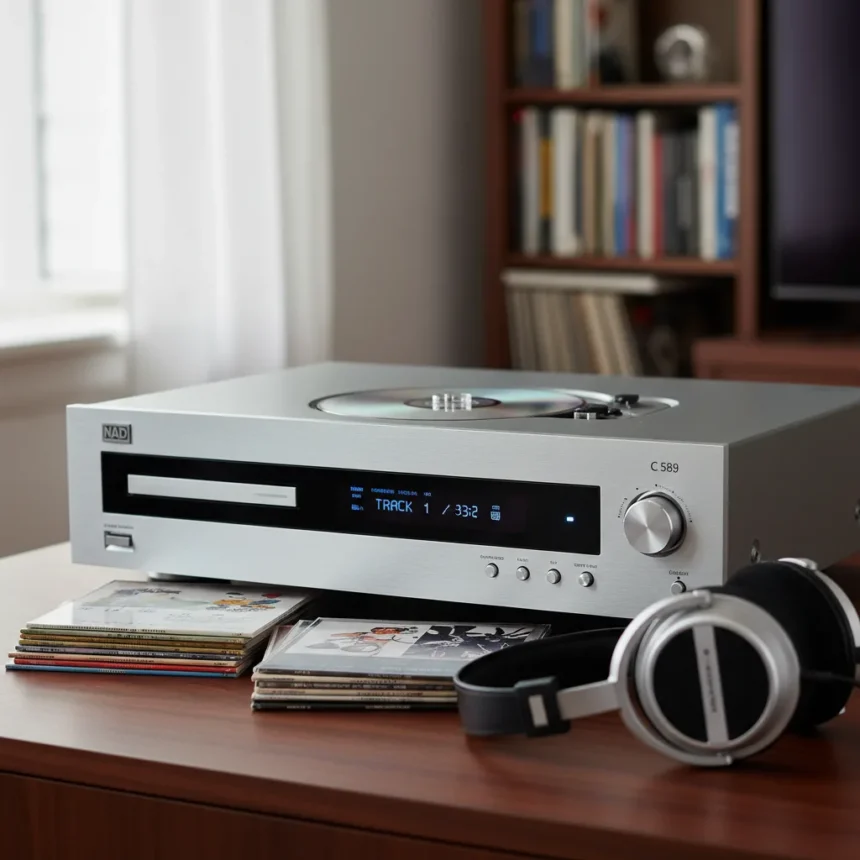
Premium CD players have become a genuine consideration for audiophiles serious about their disc collections. The resurgence in CD ownership has created a market where brands like NAD are competing for listeners willing to invest in dedicated hardware. But what separates a premium CD player from the rest, and is one actually worth the investment?
Key Takeaways
- Premium CD players like the NAD C 589 target serious collectors seeking superior audio quality from their disc collections.
- Format compatibility matters: verify CD, CD-R, and CD-RW support before purchasing.
- High-end alternatives include the Rotel Michi Q5 (£5,499/$7,499) and Cyrus 40 CD (£2,995/$3,995).
- Premium CD players compete directly with streaming solutions but offer tangible audio advantages for disc enthusiasts.
- Build quality and component selection differentiate premium models from budget alternatives.
What Makes Premium CD Players Worth Considering
A premium CD player is a dedicated audio component designed to extract maximum fidelity from compact disc media, built with high-quality components and engineering that prioritizes sound reproduction over cost efficiency. These players represent a deliberate choice to invest in physical media playback rather than streaming services. For collectors who have spent years building disc libraries, a premium player can unlock qualities in familiar recordings that casual listening never revealed.
The appeal extends beyond nostalgia. Premium CD players address a specific problem: standard players treat CDs as a legacy format, applying minimal engineering resources to their playback chain. Premium models reverse this logic, treating the CD as a primary listening source deserving of serious attention. This philosophical difference translates into audible improvements for listeners with trained ears and quality speaker systems.
What separates premium from standard is component selection. Better power supplies, superior laser assemblies, improved digital-to-analog conversion stages, and more robust mechanical construction all contribute to cleaner signal paths. These are not marketing terms—they represent measurable engineering decisions that affect what you hear.


Format Compatibility and Practical Considerations
Before committing to a premium CD player, verify which disc formats it actually supports. Not all premium players handle CD-R (recordable CDs) or CD-RW (rewritable CDs) with equal success. Some collectors own pressed CDs exclusively, while others have burned thousands of CD-Rs over the years. A player that struggles with homemade discs is useless for half your collection.
This compatibility question seems straightforward but catches buyers off guard. A premium player optimized for pressed CDs might read CD-Rs inconsistently. The laser assembly and error-correction algorithms differ between formats, and manufacturers must engineer around these variables. Check the specifications carefully—it is a detail that separates a player suited to your actual collection from an expensive paperweight.
Build quality matters equally. Premium players use heavier chassis, better vibration isolation, and superior component shielding. These design choices reduce electrical noise and mechanical interference, both of which degrade audio quality. Budget players skip these refinements to hit price targets. Premium models make different trade-offs, accepting higher costs to eliminate audible compromises.
Competing Premium Options and Market Context
The premium CD player market is small but active. The Rotel Michi Q5, priced at £5,499/$7,499, represents one high-end extreme. The Cyrus 40 CD, at £2,995/$3,995, sits in a different segment. These players occupy distinct positions based on engineering philosophy and target audience. Comparing them requires understanding what each prioritizes—some emphasize warmth and musicality, others pursue clinical accuracy.
Premium CD players compete not with each other but with streaming services. That is the real market dynamic. A listener choosing between a premium CD player and a high-end streaming subscription service is making a format choice, not a product choice. This context matters because it explains why premium CD players exist at all. They serve listeners who believe CDs sound better, cost less per album than streaming subscriptions over time, or who simply prefer owning their music.
The market remains niche. Streaming dominates consumer audio. But within that niche, premium CD players represent genuine engineering efforts, not nostalgia products. Manufacturers would not invest in new designs if demand did not exist among serious listeners.


Is a Premium CD Player Right for Your Collection
A premium CD player makes sense if three conditions align: you own a substantial disc collection you actually listen to, you have a quality speaker system capable of revealing sonic differences, and you view music as a primary hobby rather than background accompaniment. Casual listeners gain nothing from premium players. The improvements are subtle enough that untrained ears struggle to detect them in typical listening rooms.
Budget also matters. Premium players demand five-figure investments in some cases. That capital could upgrade speakers, which deliver more audible improvement for most listeners. Or it could fund streaming subscriptions for decades. The financial calculus differs for each collector.
For those who meet these criteria, a premium CD player transforms disc listening. It is not a purchase that pays dividends in convenience or features. It pays dividends in sound quality—which is precisely what premium audio equipment is supposed to do.
How do I choose between premium CD players?
Listen to them if possible. Specifications alone cannot predict how a player will sound in your system. Bring familiar recordings you know well, listen carefully, and trust your ears over marketing claims. Different players emphasize different strengths—some excel with classical music, others shine with rock or jazz.
Do premium CD players actually sound better than streaming?
This depends on the streaming service, your internet connection, and your ears. High-resolution streaming services like Qobuz can match or exceed CD quality. Standard streaming services use heavy compression. For most listeners, the difference matters less than system quality. For trained listeners with premium equipment, CDs and high-res streaming offer comparable quality, while standard streaming falls noticeably short.
Should I buy a premium CD player if I mostly stream music?
No. A premium CD player serves collectors with substantial disc libraries who listen to physical media regularly. If streaming is your primary source, the investment makes no sense. The player will sit unused while you pay for both a subscription service and expensive hardware.
Premium CD players represent a specific choice: investing in physical media playback for listeners who value sound quality and own the discs to justify the expense. They are not universal upgrades or necessary purchases. They are specialized tools for a specialized audience. If you fall into that category, the right premium player can genuinely transform how you experience your collection. If you do not, save your money for speakers or a streaming subscription.
This article was written with AI assistance and editorially reviewed.
Source: What Hi-Fi?