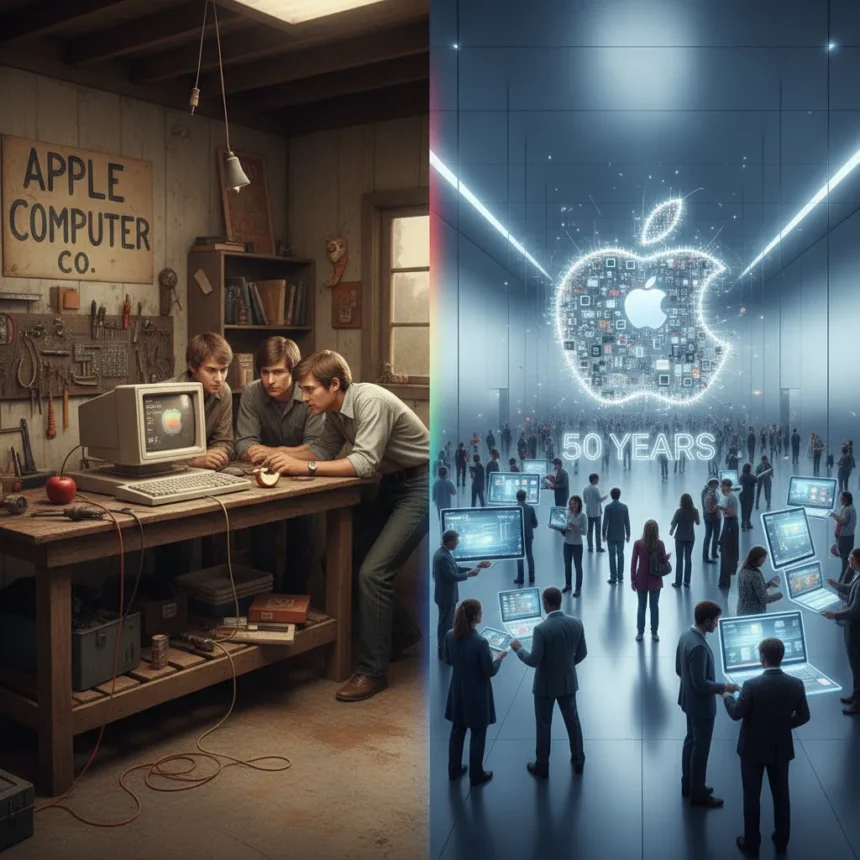
Apple turns 50 on April 1, 2026, marking half a century since Steve Jobs and Steve Wozniak founded the company in a small garage with a radical conviction: technology should be personal. From that hobbyist beginning, Apple evolved into the most valuable company on the planet, reshaping culture, design, and daily life for billions of people worldwide.
Key Takeaways
- Apple was founded April 1, 1976, by Steve Jobs and Steve Wozniak in a garage with the belief that technology should be personal.
- The Apple II (1977) became the first successful mass-market personal computer with color graphics and brought computing to homes and schools.
- The iMac G3 (1998) revived Apple after near-collapse with its iconic Bondi Blue design by Jony Ive and USB integration.
- Iconic products including the iPhone, iPad, iPod, and AirPods transformed entire industries and created new markets.
- A Computer History Museum exhibit runs through September 7, 2026, featuring rare prototypes spanning Apple’s five decades.
How Apple Turned Hobbyist Computers Into a Global Force
The story of Apple turns 50 this April, but the company’s influence extends far beyond a milestone birthday. When Jobs and Wozniak started assembling circuit boards in that garage, personal computing was the domain of electronics enthusiasts and engineers. The Apple I broke that mold by making computers accessible to everyday people. Two years later, the Apple II arrived as the first successful mass-market personal computer with color graphics, expandability, and intuitive design. It didn’t just sell computers—it brought computing into homes, schools, and small businesses across America and beyond, fundamentally democratizing technology access.
What separated Apple from competitors wasn’t raw power or technical specifications. It was philosophy. The company’s core belief that technology should be personal shaped every product decision, from industrial design to user interface choices. This philosophy persisted even when Apple nearly collapsed in the 1990s, a period when the company seemed destined for obsolescence as Microsoft dominated the market.
The Products That Redefined Industries
Apple turns 50 having reshaped not one industry but several. The Macintosh democratized computing by making graphical interfaces mainstream rather than experimental. The iPod didn’t invent the digital music player—it made the technology so elegant and intuitive that it ended the CD era entirely. The iPhone created the smartphone revolution and, more importantly, the app economy that now generates hundreds of billions in annual revenue. Each product followed the same pattern: Apple entered an existing market, applied obsessive attention to design and usability, and transformed how people thought about that category.

The iMac G3 deserves special mention because it saved the company. Designed by Jony Ive and released in 1998, the translucent Bondi Blue machine was radical—a computer that didn’t hide in beige boxes but celebrated itself as design object. It featured USB ports when competitors still relied on legacy connectors, signaling Apple’s willingness to obsolete the past. The iMac became one of the best-selling computers ever and proved that Apple’s design-first approach resonated with consumers globally.
Beyond computers, Apple extended its ecosystem into services, wearables, and spatial computing. The App Store created a new economic model for software distribution. Apple Music, Apple Pay, iCloud, and Apple TV formed an integrated ecosystem that locked users into Apple’s vision of seamless, interconnected technology. The Apple Watch and AirPods became category leaders not because they were first but because they were best-in-class in design and integration. The Apple Vision Pro represents the latest frontier—Apple’s bet on spatial computing as the next major computing platform.



How Apple Turns 50 Into Cultural Moment
The 50th anniversary is more than a corporate milestone. Museums including MoMA have recognized Apple products as culturally significant artifacts worthy of permanent collection. The Computer History Museum in Mountain View is hosting an exhibit running through September 7, 2026, that showcases rare prototypes spanning five decades—original Apple I boards, the Apple IIc, the Lisa, the Macintosh, the Newton, the iPod, and the iPhone. These aren’t just machines; they’re evidence of how one company’s obsession with simplicity and elegance reshaped civilization’s relationship with technology.
Tim Cook, Apple’s current CEO, framed the anniversary around the company’s foundational principle: Thinking different has always been at the heart of Apple. That phrase, borrowed from the famous advertising campaign, captures something true about the company’s DNA. Apple didn’t follow trends—it created them. When the industry moved toward thinner bezels, Apple moved there first. When the industry resisted removing ports, Apple removed them anyway, forcing the entire ecosystem to follow.
What Apple Turns 50 Means for the Future
A company that began with two people and a garage now employs over 160,000 people globally and generates annual revenue exceeding 390 billion dollars. It survived near-death in the 1990s, thrived through the iPod era, dominated the smartphone age, and is now positioning itself in artificial intelligence and spatial computing. The 50th anniversary is not a moment of reflection on past glory but a marker of Apple’s continued relevance and ambition.
What separates Apple from other tech giants is consistency of vision. Microsoft pivoted to cloud computing and enterprise. Google built an advertising empire. Meta bet everything on the metaverse. Apple remained focused on the intersection of technology and humanity—on making tools that disappear into the background so people can focus on what matters. That philosophy, born in a garage fifty years ago, remains the company’s competitive advantage.



Can Any Company Replicate Apple’s Success?
Apple’s trajectory from hobbyist computers to global dominance required factors beyond brilliant design: timing, capital, relentless execution, and willingness to cannibalize your own products before competitors do. Most tech companies excel at one or two of these. Apple has consistently mastered all four. The company’s ecosystem—hardware, software, services, and retail—creates friction that makes leaving nearly impossible once you’re invested. No competitor has replicated this integrated approach at scale.
Why Does Apple’s 50th Anniversary Matter Now?
In 2026, as artificial intelligence reshapes technology and consumer expectations shift toward privacy and sustainability, Apple‘s 50-year history offers perspective. The company has survived multiple technology cycles, market crashes, and competitive threats by staying true to core principles rather than chasing every trend. That consistency—thinking different when different thinking is needed—remains Apple’s most valuable asset as it enters its next chapter.
What rare artifacts are on display at the Computer History Museum?
The Computer History Museum exhibit features original prototypes of the Apple I, Apple IIc, Lisa, Macintosh, Newton, iPod, and iPhone—spanning the full arc of Apple’s innovation from 1976 through the smartphone revolution. The exhibit runs through September 7, 2026, and provides a tangible look at how design and engineering evolved across five decades.
How did the iMac G3 save Apple?
Released in 1998, the iMac G3’s iconic translucent Bondi Blue design by Jony Ive and its integration of USB ports signaled that Apple was moving forward while competitors clung to legacy technology. It became one of the best-selling computers ever and proved that consumers valued design and usability enough to choose Apple despite Microsoft’s market dominance.
Apple turns 50 as a company that has repeatedly proven it can define entire product categories and then dominate them through relentless focus on simplicity, design, and user experience. From a garage in Los Altos to the world’s most valuable corporation, Apple’s five decades demonstrate that thinking different isn’t just a slogan—it’s a business strategy that works.
Edited by the All Things Geek team.
Source: Tom's Hardware