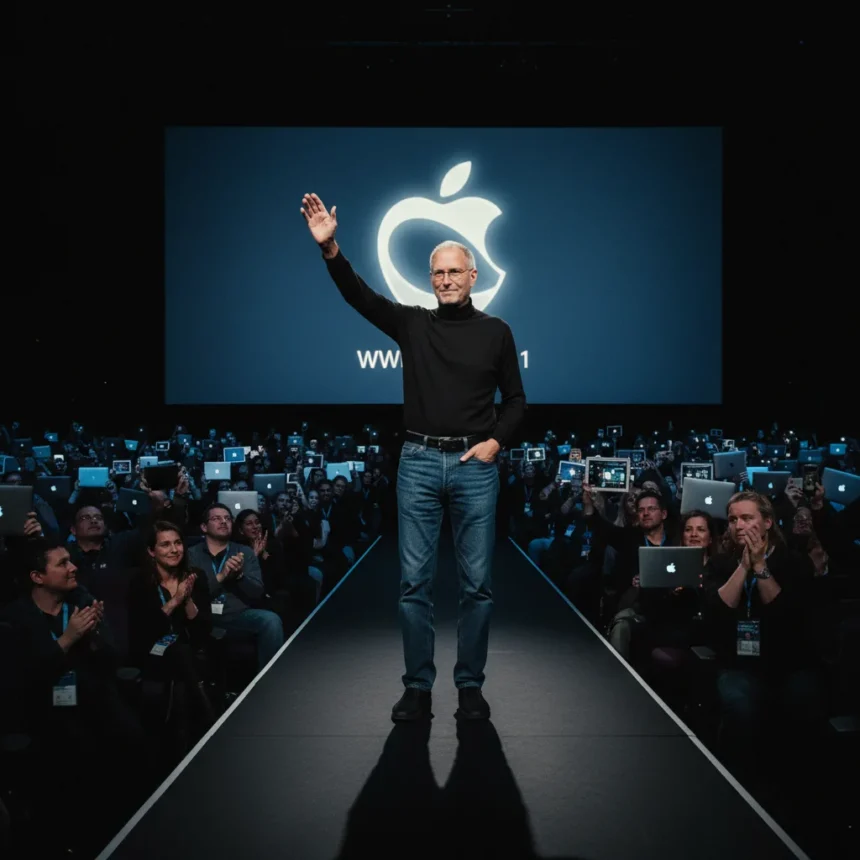
The Steve Jobs final WWDC presentation took place on June 6, 2011, and it changed how I understood Apple’s future. Jobs appeared on stage visibly weakened by illness, yet when he returned to introduce iCloud, he nearly jumped. That moment—watching a dying man summon energy for technology he believed in—crystallized something I had only suspected: Apple would survive him, and thrive.
Key Takeaways
- Steve Jobs’ last WWDC keynote unveiled iCloud, iOS 5, and Mac OS X Lion, technologies still core to Apple today.
- Jobs died four months after the June 2011 presentation, yet Apple smoothly transitioned under Tim Cook’s leadership.
- The 2011 keynote demonstrated Apple’s ability to operate independently of its founder through proven management succession.
- Technologies launched at WWDC 2011—iCloud, iMessage, AirDrop—remain foundational to Apple’s ecosystem 15 years later.
- Apple’s ascent to world’s most valuable company in 2011 validated the company’s institutional strength beyond Jobs.
The Final Keynote: Frailty and Fire
Jobs opened the keynote visibly diminished. His frame had shrunk. His voice carried less of its characteristic snap. But when he took the stage a second time to present iCloud, something shifted. He moved with renewed energy, animated in a way that suggested this product mattered to him in a way few others did in those final months. He wasn’t just announcing a cloud service; he was demonstrating that Apple’s vision could persist beyond his physical presence.
The Steve Jobs final WWDC presentation revealed something crucial about how Apple was built. This was not a company held together by one man’s charisma or force of will. It was a company with systems, with a pipeline of ideas, with a management structure that could absorb the loss of its founder and continue forward. Tim Cook was already running operations. The keynote itself featured segments from other executives. The machinery was in place.
Why 2011 Mattered More Than We Knew
Looking back from 2026—Apple’s 50th anniversary and 15 years after Jobs’ death—the significance of that June keynote becomes impossible to ignore. Jobs had taken medical leave in January 2011, stepping back from daily operations while Tim Cook assumed the CEO role. In March, Jobs returned personally to present the iPad 2, delivering one of his final public statements: people don’t want tablets, they want iPads. By October, after Jobs’ death, Tim Cook led the iPhone event without him, and the company did not stumble.

The technologies announced at WWDC 2011 were not flashy experiments. They were foundational. iCloud, iOS 5, iMessage, and AirDrop are not legacy systems gathering dust in Apple’s archives—they are still central to how hundreds of millions of people use Apple devices. A company can announce products that disappear. Apple announced products that became permanent infrastructure. That distinction matters.
The Institutional Strength Behind the Visionary
Steve Jobs final WWDC presentation proved that Apple had transcended the founder-dependent startup model. The company had achieved something far rarer: it had built an institution. Institutions outlast individuals. They have processes, talent pipelines, and decision-making frameworks that do not collapse when one person leaves. Apple was no longer a company that would die with Jobs—it was a company that could absorb his absence and continue.



This is not to diminish Jobs’ contribution. His vision shaped every aspect of Apple’s culture and product philosophy. But the 2011 keynote demonstrated that vision had been encoded into the organization itself. The people on stage alongside him—the engineers, the product managers, the designers—had internalized his standards. They could carry forward without his direct involvement.
Compare this to what happened at other companies when founders departed. The difference is stark. Apple did not fragment. It did not lose direction. It accelerated. The company that Jobs left behind became the world’s most valuable company, a title it achieved during his final year. That is not accident. That is the result of deliberate institutional building.
What Made the Keynote Unforgettable
Watching Steve Jobs final WWDC presentation in real time, most observers focused on the products. iCloud promised to sync your devices smoothly. iOS 5 added features. Mac OS X Lion brought new capabilities. These were important, but they were not what stuck with me. What stuck was the meta-moment: watching a founder prove his company no longer needed him, and doing so while visibly dying.
There was no drama. No farewell address. No acknowledgment of mortality. Jobs simply came on stage, did his job, and left. The next person came on stage and did theirs. The machine continued. That ordinariness was the whole point. A great institution should be able to function without theater, without the founder’s presence, without depending on any single person’s charisma to operate.



The 50-Year Question
Apple is now 50 years old. It has outlasted its founder by 15 years. The company faces new challenges—regulatory scrutiny, market saturation in developed nations, competition from every direction. But the foundation Jobs and his team built, and the institutional strength demonstrated at WWDC 2011, suggests Apple has the infrastructure to compete for decades more. Institutions do not last forever, but they can last much longer than the people who build them. Apple proved it in 2011.
Could Apple have failed after Jobs’ death?
Yes. Many companies have collapsed or declined sharply after losing a founder. Apple could have fragmented under leadership uncertainty or lost direction without Jobs’ perfectionism. Instead, the succession plan worked because it had been built intentionally, not left to chance.
What makes WWDC 2011 different from other Apple keynotes?
It was Jobs’ last. But more importantly, it demonstrated that the company’s future did not depend on his continued presence. The products announced—particularly iCloud—are still core infrastructure 15 years later, proving the keynote’s strategic vision endured.
Did Apple’s product pace change after Jobs?
Yes. The cadence of Apple presentations became slower and more measured after 2011, reflecting a shift in how the company approaches product cycles and public announcements.
The Steve Jobs final WWDC presentation was not a farewell concert or a greatest-hits retrospective. It was a working keynote by a man doing his job one last time. That ordinariness—the absence of drama, the smooth handoff to other leaders, the products that became permanent—is exactly why Apple endures. Jobs built a company that did not need him to survive. Fifteen years later, that remains his most important legacy.
Edited by the All Things Geek team.
Source: TechRadar