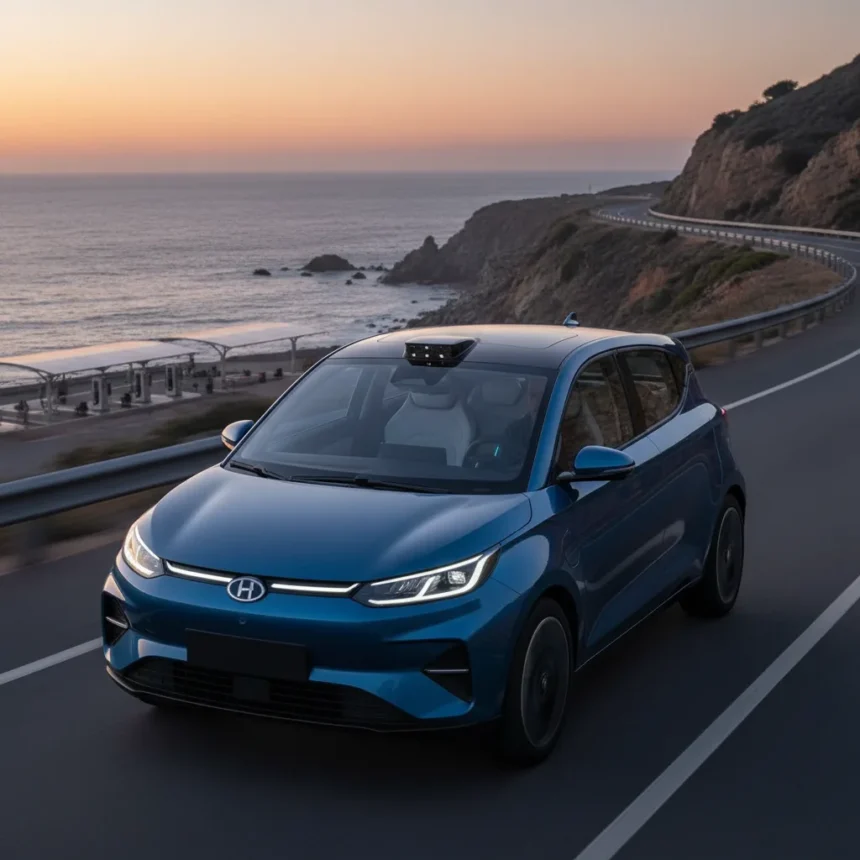
The BYD Seagull 2026 is rewriting the rules for what affordable electric vehicles can deliver. This is a low-priced EV made by BYD, featuring 250-mile range and LiDAR-based self-driving capability—specifications that until recently belonged exclusively to premium models commanding three times the price.
Key Takeaways
- BYD Seagull 2026 offers 250-mile range in an affordable EV segment
- LiDAR self-driving technology moves into the budget EV market
- Low price tag challenges the premium positioning of advanced EV features
- Vehicle bridges the gap between mainstream affordability and autonomous driving capability
- Positions BYD as a serious competitor in the global affordable EV space
Why the BYD Seagull 2026 matters now
For years, the EV market has operated in tiers. Budget buyers got stripped-down range and basic features. Premium buyers paid six figures for self-driving tech and extended range. The BYD Seagull 2026 demolishes that hierarchy. A 250-mile range eliminates range anxiety for most daily commutes, while LiDAR self-driving capability—the sensor technology that powers advanced driver assistance—has historically been locked behind premium price tags. This vehicle proves that equation is changing.
The timing matters. As global EV adoption accelerates, manufacturers are racing to prove that autonomous-adjacent features and longer range can exist in affordable vehicles without bankrupting buyers. The Seagull 2026 appears to be BYD’s answer to that challenge. By bundling these capabilities into a low-priced package, BYD is signaling that the future of mainstream EV adoption isn’t about luxury—it’s about accessibility.
Range and self-driving tech that shouldn’t exist at this price
The 250-mile range is the headline, but it is the LiDAR integration that changes the conversation. LiDAR (light detection and ranging) creates 3D maps of the vehicle’s surroundings with precision that cameras and radar alone cannot match. It is the sensor choice for serious autonomous driving development, used by Tesla competitors and legacy automakers building Level 3 and Level 4 autonomous systems.

Putting LiDAR into a budget EV is unconventional. Most manufacturers reserve advanced sensor suites for higher trim levels or premium models. The Seagull 2026 suggests BYD sees self-driving technology not as a luxury differentiator but as table stakes for the mass market. That shift in thinking—treating autonomous capability as a standard feature rather than an upsell—could accelerate the timeline for mainstream autonomous driving adoption. When self-driving tech becomes affordable, adoption accelerates. When adoption accelerates, infrastructure and regulatory frameworks follow.
How the BYD Seagull 2026 compares to traditional budget EVs
Conventional budget electric vehicles typically offer 150 to 200 miles of range and rely on camera-based driver assistance systems, which are less precise than LiDAR for autonomous functions. The gap between a traditional affordable EV and a premium EV with advanced autonomy has been substantial—both in capability and cost. The Seagull 2026 narrows that gap dramatically. It is not claiming to be a fully autonomous vehicle, but the presence of LiDAR suggests a pathway toward more advanced self-driving features than most budget competitors currently offer.



This positioning also matters for BYD’s competitive standing. BYD is already the world’s largest EV manufacturer by volume, and the Seagull 2026 reinforces why. The company is not chasing premium margins on luxury models; it is flooding the market with capable, affordable vehicles that make EV ownership accessible to the broadest possible audience. That strategy has proven effective in China and is beginning to reshape global EV competition.
What this means for the EV market
If the BYD Seagull 2026 delivers on its specifications—250 miles of real-world range and functional LiDAR-based self-driving features at a low price—it will force competitors to rethink their product strategies. Tesla’s entry-level models, traditional automakers’ budget EV offerings, and Chinese competitors will all face pressure to match or exceed these capabilities. The race to democratize EV technology just accelerated.
The broader implication is that premium EV features are becoming commoditized faster than expected. Five years ago, 250-mile range was a differentiator. Today it is baseline. LiDAR self-driving was a luxury 18 months ago. The Seagull 2026 suggests it is becoming standard. This compression of innovation timelines is good for consumers but challenging for automakers trying to justify premium pricing on older technology.
Is the BYD Seagull 2026 available outside China?
The research brief does not confirm regional availability or whether the Seagull 2026 will be sold outside China. BYD has been expanding into European and other international markets, but specific distribution plans for this model remain unverified. Interested buyers outside China should check with BYD’s regional representatives for availability and timeline information.



What makes LiDAR self-driving different from camera-only systems?
LiDAR creates precise 3D maps of surroundings using laser pulses, while camera-only systems rely on image recognition and machine learning. LiDAR provides more accurate distance measurement and performs better in low-light conditions, making it more reliable for autonomous driving functions. This is why autonomous vehicle developers prioritize LiDAR integration for safety-critical features.
How does 250-mile range compare to other affordable EVs?
Most budget electric vehicles offer between 150 and 220 miles of EPA-estimated range. A 250-mile range in an affordable vehicle is competitive with or exceeds many mainstream options, reducing the need for frequent charging and making the Seagull 2026 practical for longer commutes and road trips without constant battery anxiety.
The BYD Seagull 2026 represents a genuine inflection point in the EV market. It proves that advanced features no longer require premium pricing, and it forces the entire industry to accelerate innovation in the affordable segment. For buyers who have hesitated on EVs due to range concerns or who thought autonomous features were forever out of reach, the Seagull 2026 changes the equation. The question now is whether competitors can match it—and whether BYD’s pricing strategy will hold as demand scales.
Where to Buy
Edited by the All Things Geek team.
Source: T3