





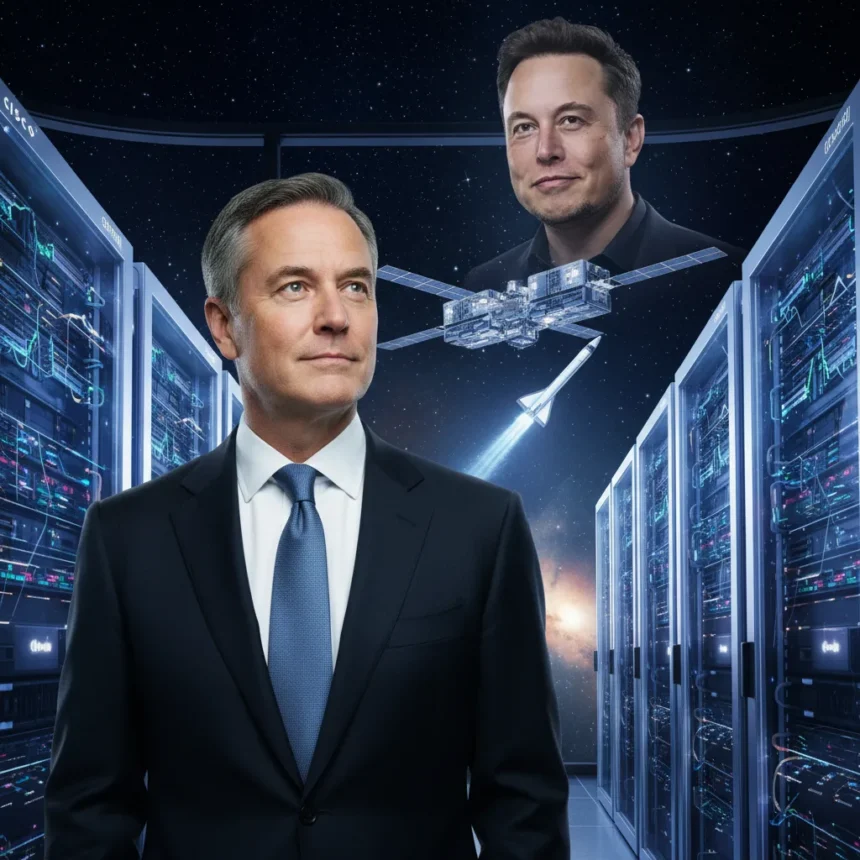
Chuck Robbins, CEO of Cisco, is betting on space data centers as the future of AI infrastructure. In an April 2026 interview with The Verge’s Decoder podcast, Robbins stated flatly that Cisco is actively preparing networking equipment for orbital deployment—a move that seemed absurd to him just months earlier.
Key Takeaways
- Cisco product teams approached Robbins around January 2026 about preparing for space-based data centers.
- Cisco is designing networking equipment to withstand vacuum, extreme temperatures, and orbital launch challenges.
- Earth-based power constraints and community opposition to new data centers make space an attractive alternative.
- Robbins sides with Elon Musk over Sam Altman on the feasibility of orbital AI infrastructure.
- Cisco’s AI networking business has grown from near-zero revenue five years ago to billions annually.
When Cisco’s CEO Thought Space Data Centers Were Crazy
Robbins recalls the moment his product leadership team pitched the idea. “Our teams came to me literally, I think it was about 2 or 3 months ago,” Robbins explained in the interview. “My head of product came and said, ‘We really have to be prepared for data centers in space.'” His initial reaction was skepticism. But after deeper consideration of the constraints facing Earth-based infrastructure, he changed his mind.
The shift reflects a broader reality: building massive data centers on the ground faces mounting obstacles. Power grids struggle to supply the electricity that AI training demands. Communities oppose new facilities. Land is finite. Space, by contrast, offers what Robbins calls “unlimited unimpeded” potential. “Right now we’re dealing with lots of power constraints, and up there you don’t have that,” he said.
Cisco’s Space-Ready Networking Challenge
Preparing networking equipment for orbit is not trivial. Cisco’s engineering teams must design silicon and systems that function in vacuum, withstand extreme temperature swings, survive launch forces, and maintain secure connectivity for AI data centers and GPU clusters. The company’s 2016 acquisition of Israeli chip firm Leaba positioned Cisco as one of only three companies globally capable of building custom networking silicon for AI infrastructure—a competitive advantage now driving hyperscaler revenue.

This expertise matters because space data centers will not work without reliable, purpose-built networking. The equipment must handle the unique physics of orbit while maintaining the low-latency, high-throughput connections that AI workloads demand. Cisco’s existing dominance in hyperscaler infrastructure gives it a credibility advantage over pure aerospace vendors.
Robbins Backs Musk Over Altman on Space Infrastructure
When asked whether he would bet against Elon Musk’s vision of orbital infrastructure, Robbins was unambiguous: “I wouldn’t bet against Elon.” This is a pointed contrast to Sam Altman, OpenAI’s CEO, who has publicly dismissed orbital data centers as a “pipe dream.” Robbins disagrees.



The CEO also offered a sobering view of the broader AI infrastructure boom. He compared current spending to the dot-com bubble, predicting that while many companies will “shut their doors,” winners will emerge and consolidate. Cisco, with its networking dominance and space-ready capabilities, positions itself as a survivor in that shake-out.
Why This Matters for AI’s Future
Robbins’ public endorsement of space data centers reflects a shift in how serious infrastructure players view the problem. Five years ago, the idea was pure speculation. Today, Cisco has dedicated engineering resources to the challenge. This signals that space-based AI infrastructure is moving from science fiction to early engineering reality.
The timing is significant. As AI models grow larger and training demands accelerate, Earth-based power and real estate constraints are becoming genuine bottlenecks. Space offers a potential escape valve—if the networking, cooling, and launch logistics can be solved. Cisco’s willingness to invest engineering effort suggests those problems are not insurmountable.
Is Cisco actually building space data centers right now?
Not yet. Cisco is in the preparation phase, designing networking equipment that will be ready when orbital facilities become viable. Robbins emphasized that his teams are working on the technical challenges now, but deployment remains future-focused. The company is not launching hardware into orbit tomorrow.



Why would space data centers be better than Earth-based ones?
Space offers unlimited power potential (solar energy unfiltered by atmosphere), no community opposition, no land constraints, and no zoning restrictions. The tradeoff is extreme engineering complexity and launch costs. As those costs decline and power demands rise, the equation shifts in space’s favor.
How does Cisco’s networking silicon compete with other AI infrastructure vendors?
Cisco is one of three companies globally with the capability to design custom networking silicon for hyperscalers. This puts it in direct competition with the few other players capable of similar work, but Cisco’s decade-plus experience in data center networking and its Leaba acquisition give it architectural advantages. Most networking vendors cannot match this depth.
Robbins’ April 2026 comments mark a turning point: space data centers are no longer dismissed as fantasy by serious infrastructure leaders. Whether Cisco’s engineering teams can deliver on the promise is another question—but the fact that they are trying signals that the future of AI infrastructure may literally be above our heads.
Edited by the All Things Geek team.
Source: TechRadar




