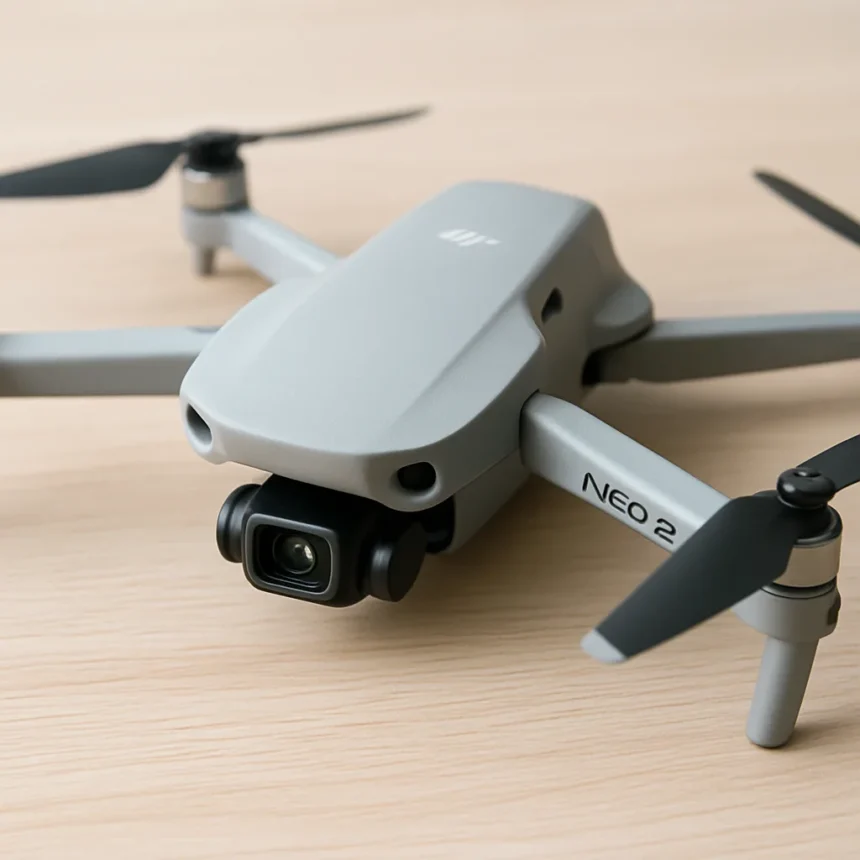
The DJI Neo 2 is a compact camera drone made by DJI, launched in November 2025, now available at its lowest price point. Weighing just 160g with the digital transceiver and 151g without it, this sub-249g machine packs 4K video recording at 60fps, a 12MP camera, and a 2-axis mechanical gimbal—features that once belonged to heavier, more expensive drones.
Key Takeaways
- DJI Neo 2 weighs 151g (without transceiver) or 160g (with transceiver), staying under the 249g regulatory threshold
- Records 4K at 60fps and 100fps slow-motion, plus 2.7K vertical video for social media
- 19-minute flight time with 49GB internal storage—no SD card required
- ActiveTrack follows subjects at speeds up to 12 m/s with 8-direction tracking
- Starts at £209 in the UK and €239 in Europe, now cheaper than ever
Why DJI Neo 2 Matters Right Now
The DJI Neo 2 arrives at a critical moment when sub-249g drones avoid registration requirements in many countries, but most competitors in that weight class sacrifice video quality or stabilization. This drone doesn’t. The 2-axis gimbal handles both tilt and roll, paired with Electronic Image Stabilization, delivering smooth footage even in moderate wind. Compare that to the original DJI Neo, which used a single-axis gimbal and relied more heavily on software stabilization—the Neo 2’s mechanical upgrade is the difference between shaky phone footage and actually watchable video.
The price drop matters because DJI Neo 2 now undercuts its own launch positioning. At £209 in the UK, it costs less than many entry-level smartphones, yet records 4K at speeds competitors reserve for drones three times heavier. For casual creators, travel vloggers, or anyone curious about drone footage without the learning curve of larger machines, the barrier to entry just dropped significantly.
Camera and Video: 4K Performance on a Pocket-Sized Sensor
The DJI Neo 2 uses a 12MP, 1/2-inch CMOS sensor with an f/2.2 aperture—smaller than the sensors in flagship drones, but large enough to capture detail in daylight and handle moderate low-light scenarios. Video is where the Neo 2 flexes. It shoots 4K at 60fps and 100fps for slow-motion, plus 2.7K in vertical format for TikTok and Instagram Reels without cropping. The gimbal keeps footage level while the EIS handles minor vibrations that would otherwise ruin handheld shots.

Storage is integrated: 49GB of internal memory holds roughly 1 hour 40 minutes of 4K/60fps footage, with QuickTransfer capable of 80 MB/s offload speeds. No SD card slot means one less thing to manage, though it also means you cannot expand beyond the built-in capacity. That constraint matters only if you plan to record continuously for hours—most casual users will offload footage daily anyway.
Flight Performance and Tracking: ActiveTrack at 12 m/s
The DJI Neo 2 tracks moving subjects at speeds up to 12 m/s using ActiveTrack, with coverage in all eight directions—forward, backward, left, right, and diagonals. This is a significant jump from the original Neo’s slower tracking, making the drone useful for action content where the subject moves quickly. Omnidirectional monocular vision, forward-facing LiDAR, and downward infrared sensing give the Neo 2 spatial awareness to avoid obstacles and maintain tracking even in dynamic environments.



Flight time reaches 19 minutes in ideal conditions, which is respectable for a sub-200g machine. The drone resists wind up to Level 5, and full-coverage propeller guards protect it from minor crashes—critical for a beginner-oriented platform. Control options range from gesture recognition to voice commands, mobile app, or a paired remote controller like the DJI RC-N3. Palm takeoff and landing eliminate the need to fumble with controls, a feature that appeals to first-time drone users.
Intelligent Modes: Dolly Zoom, QuickShots, and FPV
The DJI Neo 2 includes automated shooting modes that handle composition for you. Dolly Zoom creates a cinematic depth effect, QuickShots generates short highlight reels, MasterShots combines multiple angles into a single video, and SelfieShot offers waist-up, full-body, or long-shot framing. FocusTrack lets you choose between ActiveTrack (follows a person), Spotlight (keeps the drone centered while moving), or Point of Interest (orbits a fixed location).
For FPV enthusiasts, the Neo 2 works with DJI goggles and the Motion Controller, transforming it into a first-person camera that responds to head movement. This versatility means the same drone serves casual snapshot users, content creators chasing automated montages, and FPV pilots seeking immersive footage—a rare combination at this price and weight.
How DJI Neo 2 Compares to Alternatives
The DJI Neo 2 sits between ultra-compact pocket drones and mid-range machines. Against the original DJI Neo, the improvements are substantial: better image quality from the upgraded sensor, a true 2-axis gimbal instead of single-axis, LiDAR for obstacle avoidance, faster and smoother tracking, automated shooting modes, a built-in screen for mode switching, and optional digital transceiver control. The Neo 1 feels like a prototype in comparison.



Versus the DJI Flip, the Neo 2 trades a slightly larger sensor for portability and weight savings. Both record 4K/60fps and 4K/100fps slow-motion with a 2-axis gimbal, but the Flip is heavier and more expensive—a trade-off for users who prioritize image quality over regulatory simplicity. For the DJI Mini 3, the Neo 2 offers something different: ultra-portability with surprisingly capable video, whereas the Mini 3 targets users willing to carry extra weight for a larger sensor and longer flight time.
Is the DJI Neo 2 worth buying at this price?
At its current lowest price, the DJI Neo 2 represents exceptional value for beginners, travel creators, and casual enthusiasts. If you want 4K video without registration bureaucracy or the learning curve of larger drones, this is the machine to buy. The gimbal stability, ActiveTrack speed, and intelligent modes set it apart from older compact drones that recorded mediocre stabilized video.
Does the DJI Neo 2 work with other DJI controllers?
Yes. The DJI Neo 2 pairs with remote controllers like the DJI RC-N3, as well as the optional digital transceiver for smartphone control. You can also use gesture, voice commands, or the DJI Fly app for hands-free operation.
How long does the DJI Neo 2 battery last?
Flight time reaches 19 minutes in ideal, windless conditions. Real-world flights typically run shorter depending on wind, payload, and flying style. The small battery charges quickly via USB-C.
The DJI Neo 2 proves that regulatory weight limits do not mean sacrificing video quality. At its new lowest price, it is the most accessible entry point to 4K drone footage, and the 2-axis gimbal plus ActiveTrack upgrades over the original Neo make it a genuinely useful tool for anyone who wants smooth, stabilized video without the baggage of larger machines.
Where to Buy
Shop all DJI deals on Amazon | DJI Neo 2 (Drone only): | £19
Edited by the All Things Geek team.
Source: T3