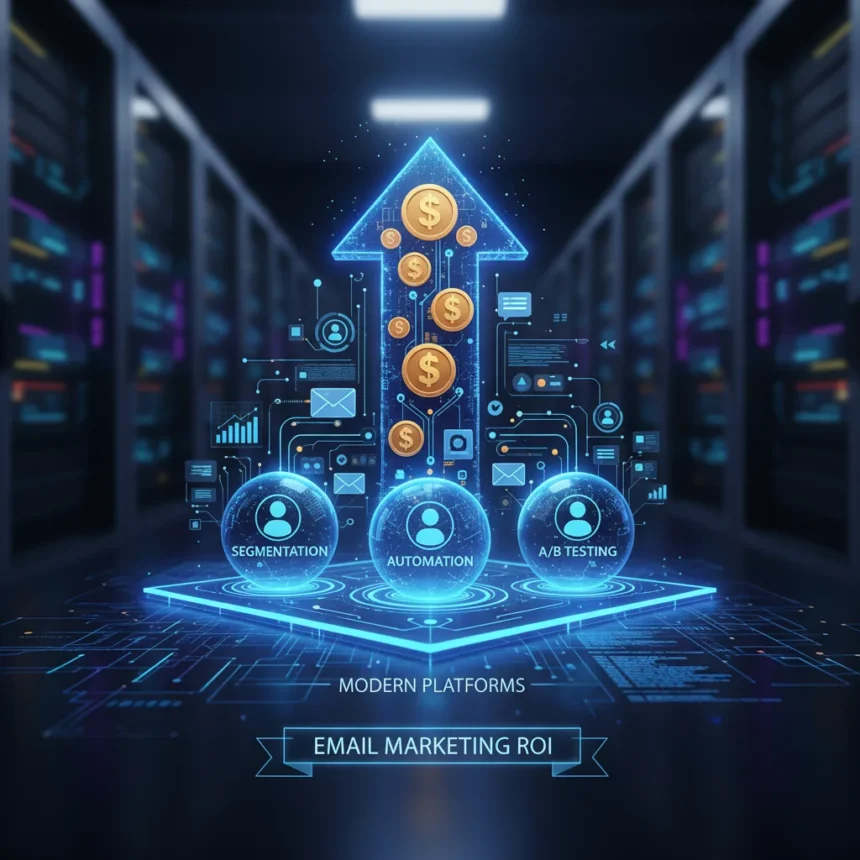
Email marketing ROI refers to the measurable return on investment from email campaigns, calculated by comparing revenue generated against the cost of sending and managing those campaigns. Modern email marketing platforms help businesses improve email marketing ROI by implementing three core mechanisms: segmentation, automation, and A/B testing.
Key Takeaways
- Email marketing ROI depends on proper audience segmentation and targeting strategies.
- Automation reduces manual work while improving campaign timing and relevance.
- A/B testing identifies which message variations drive higher engagement and conversions.
- Modern platforms provide tracking tools to measure campaign performance against revenue goals.
- Many businesses still send emails without tracking ROI metrics.
Why Email Marketing ROI Matters Now
Businesses face increasing pressure to prove that marketing investments generate measurable returns. Email remains one of the highest-ROI marketing channels available, but only when campaigns are properly targeted and tracked. The challenge is that many organizations still send marketing emails without systematically measuring their impact on revenue.
Modern email marketing platforms address this gap by providing built-in analytics and revenue tracking. Instead of treating email as a broadcast channel, these tools enable marketers to connect campaign performance directly to business outcomes. The shift from volume-based sending to precision-targeted campaigns is what separates high-performing email programs from mediocre ones.
How Segmentation Drives Email Marketing ROI
Segmentation divides your audience into smaller groups based on behavior, demographics, purchase history, or engagement level. Rather than sending the same message to everyone, segmentation ensures each group receives messaging tailored to their specific interests and stage in the customer journey. This targeted approach increases open rates, click-through rates, and ultimately conversions.

Modern platforms make segmentation automatic through data integration. When a customer takes an action—visiting a product page, abandoning a cart, or making a purchase—the platform updates their segment in real time. This means follow-up emails can be triggered based on actual behavior, not just scheduled blasts. Segmented campaigns naturally generate higher email marketing ROI because they speak directly to what each audience group cares about, rather than broadcasting generic messages.
Automation and A/B Testing as Revenue Multipliers
Automation removes the manual work of sending individual emails while ensuring consistent timing and relevance. A welcome series for new subscribers, abandoned cart reminders, or re-engagement campaigns for inactive users can all run on autopilot once set up. This consistency improves email marketing ROI by ensuring no opportunity is missed due to human oversight.



A/B testing—also called split testing—compares two versions of an email to see which performs better. You might test different subject lines, send times, call-to-action button colors, or message copy. Modern platforms run these tests automatically and show you which variant drove more clicks, conversions, or revenue. Over time, these incremental improvements compound: a 5% improvement in click-through rate across thousands of emails translates to significant revenue gains.
The combination of automation and A/B testing creates a feedback loop. Each test teaches you something about your audience, that learning gets built into the next campaign, and email marketing ROI improves measurably. Platforms that lack these features force marketers to choose between speed and optimization—modern tools do both simultaneously.
Tracking and Measuring Email Marketing ROI
Without proper tracking, you cannot calculate email marketing ROI. This means connecting email platform data to your CRM or e-commerce system so that revenue attributed to each campaign is visible. Some businesses still operate without this integration, making it impossible to know which emails actually drove sales.
Modern platforms solve this by offering native integrations with payment processors and CRM systems. When a customer clicks an email link and makes a purchase, the platform automatically attributes that revenue to the campaign. Over time, you can see which segments, send times, subject lines, and message types generate the highest revenue per email sent. This data becomes your roadmap for improving email marketing ROI in future campaigns.



Email Marketing ROI vs. Other Channels
Email is often more cost-effective than paid advertising or content marketing because you own your audience list. You are not paying per impression or per click to a platform—you are paying a flat fee to your email provider. This structural advantage means email marketing ROI is typically higher than social media advertising or search marketing, assuming campaigns are properly targeted and tracked.
However, email only delivers ROI if executed well. A poorly segmented, infrequent, or irrelevant email program will underperform. The difference between a high-ROI email strategy and a low-ROI one often comes down to whether the business is using modern platform features like segmentation and automation, or sending generic blasts the old way.
What Prevents Businesses from Maximizing Email Marketing ROI
Many organizations struggle with email marketing ROI for preventable reasons. Some lack the technical setup to track revenue attribution. Others send too frequently, causing unsubscribes and list decay. Still others treat email as a one-time tactic rather than an ongoing optimization process.
The most common mistake is neglecting audience quality. A large list of unengaged contacts generates poor email marketing ROI, no matter how good your automation is. Modern platforms include tools to identify inactive subscribers and either re-engage or remove them, keeping your list healthy and your ROI strong.
Can email marketing ROI be guaranteed?
No email marketing ROI is guaranteed. Results depend on your audience quality, message relevance, competitive positioning, and how well your offer aligns with customer needs. A platform can provide the tools for segmentation, automation, and testing, but the strategy and execution remain your responsibility. Poor targeting or irrelevant messaging will generate low ROI regardless of how advanced the platform is.
How long does it take to see email marketing ROI improvements?
Small improvements can appear within weeks if you implement segmentation and A/B testing immediately. However, meaningful ROI gains typically take 2-3 months as you accumulate data, identify winning variations, and refine your audience segments. Long-term email marketing ROI compounds over time as you learn more about your audience and optimize each element of your campaigns.
Is email marketing ROI still relevant in 2025?
Yes. Email remains a direct, owned channel that does not depend on algorithm changes or platform policy shifts. Unlike social media or search advertising, email marketing ROI is controlled by your strategy and execution, not by external forces. For this reason, email is often a cornerstone of sustainable, long-term marketing revenue.
The key to strong email marketing ROI in 2025 is using modern platforms that automate segmentation, enable A/B testing, and integrate revenue tracking. Businesses that treat email as a broadcast channel will continue to see declining ROI as audiences become more selective about which emails they engage with. Those that invest in precision targeting and continuous optimization will see email marketing ROI grow.
Edited by the All Things Geek team.
Source: TechRadar