





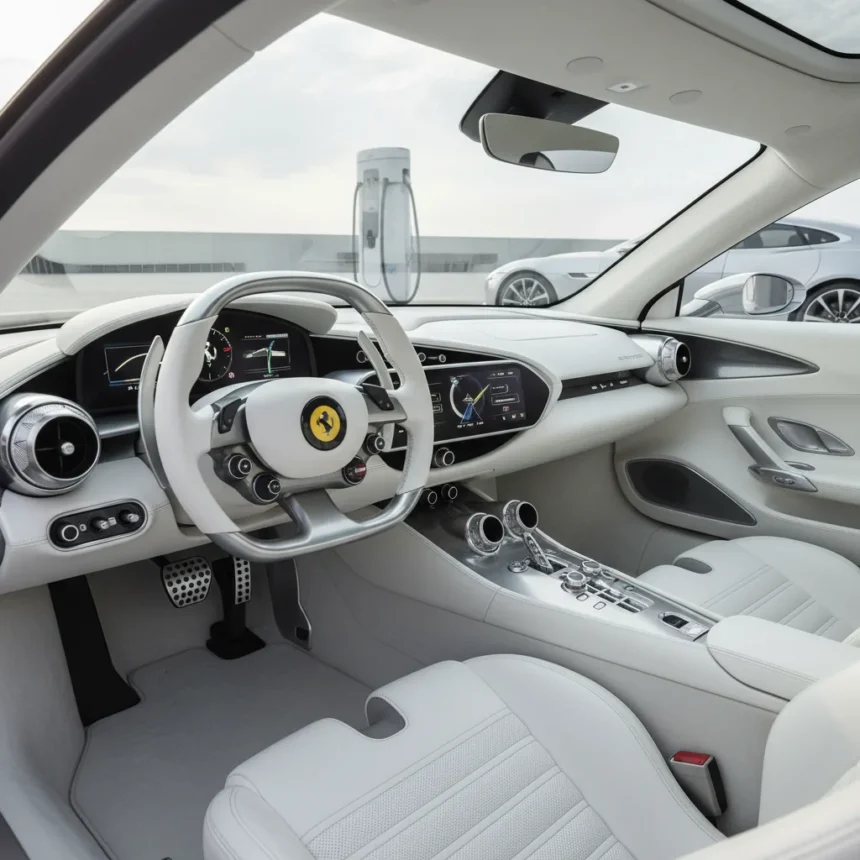
The Ferrari Luce interior design represents a bold rejection of the touchscreen-dominated automotive future that carmakers have chased for the past decade. Jony Ive, the design legend who shaped Apple’s minimalist aesthetic, has partnered with Ferrari and Marc Newson’s LoveFrom firm to reveal an interior that prioritizes physical controls, aluminum toggles, and precision-machined glass over the digital-first approach dominating the industry. The result is already drawing fire—and not the kind Ferrari typically celebrates.
Key Takeaways
- Ferrari Luce interior reintroduces physical switches, aluminum toggles, and glass controls instead of touchscreen-only design
- Jony Ive and Marc Newson’s LoveFrom firm designed the interior, bringing Apple’s minimalist philosophy to automotive UI
- The design features two screens with parallax glass effects and a motorized dial, combining analog and digital elements
- Critics compare the aesthetic to Apple products, drawing parallels to the controversial new Jaguar design
- The interior uses precision-machined components and multi-step glass manufacturing from Corning
The Ferrari Luce interior design is a concept interior reveal by Ferrari in collaboration with Jony Ive’s design studio LoveFrom, featuring physical controls, glass displays, and motorized mechanical elements instead of traditional touchscreen-heavy automotive interfaces. The controversy centers on whether this represents genuine innovation or an uncritical transplant of Apple’s design language into a machine that has always been about visceral, tactile performance.
Why Physical Controls Are Making a Comeback
After nearly two decades of automotive designers chasing the iPhone’s touchscreen revolution, Ferrari is walking backward—and it might actually be onto something. The Ferrari Luce interior design abandons the glass-only dashboard that has become industry standard, replacing it with physical switches, aluminum toggles, and glass controls that demand tactile interaction. This is not nostalgia. It is a direct challenge to the assumption that digital always beats mechanical.
The steering wheel, binnacle, control panel, and key all reflect this philosophy. The gauge area contains two screens with real glass pieces creating a parallax effect, paired with an actual dial that has a motor spinning inside it and illuminates on demand. These are not afterthoughts—they are precision-machined components built through a multi-step glass manufacturing process at Corning, suggesting Ferrari and Ive treated this interior with the same obsessive engineering that goes into the engine.

The timing matters. For years, carmakers copied Apple’s minimalism without understanding its purpose. They stripped away buttons to look modern, leaving drivers fumbling through nested menus to adjust climate control or radio volume. The Ferrari Luce interior design suggests Ive understands what Apple’s critics have always known: minimalism without function is just emptiness.
The Apple Design Controversy Nobody Asked For
Here is where things get messy. The Ferrari Luce interior design is already being compared to Apple’s most divisive aesthetic choices, with observers drawing parallels to what some call Apple’s biggest design crimes. The problem is not that the interior looks like an iPad—it is that it looks like an iPad in a car, where the expectations are fundamentally different.



Ferrari buyers do not want restraint. They want drama, aggression, and visual spectacle. An interior that whispers minimalist philosophy sits uncomfortably in a machine designed to roar. The new Jaguar faced similar backlash when its design language departed from what the brand’s audience expected, and the Ferrari Luce interior design is already inviting the same accusation: that designers have prioritized their own vision over the customer’s emotional connection to the brand.
The irony is sharp. Ive spent decades at Apple eliminating physical controls in pursuit of digital elegance. Now, working with Ferrari, he is reintroducing them. Is this a genuine shift in his design philosophy, or is it an acknowledgment that automotive interiors require different principles than consumer electronics? The answer matters less than the fact that the Ferrari Luce interior design is forcing the conversation.
Physical Controls vs. Touchscreen: The Broader Debate
The Ferrari Luce interior design sits at the center of a larger industry reckoning. For a decade, carmakers treated the iPhone as a blueprint for automotive UI, stripping away buttons in pursuit of a cleaner aesthetic. But drivers hated it. Adjusting temperature, changing radio stations, or controlling seat heat requires eyes off the road when everything lives behind a touchscreen menu.
Ferrari’s approach—combining motorized mechanical dials, physical switches, and precision glass displays—suggests a middle path. Not a return to 1990s dashboards, but a thoughtful integration of analog and digital elements designed for safety and usability. The two screens with parallax glass effects and the motorized dial represent a philosophy: some interactions should be tactile, some should be visual, and some should be both.



This is not revolutionary. It is competent design thinking. But in an industry that has spent years chasing minimalism as an end in itself, competent thinking feels radical.
Is the Ferrari Luce Interior Actually Controversial?
The real question is whether the Ferrari Luce interior design deserves its controversial reputation or if it is simply different. Controversy implies moral or aesthetic failure. What we are actually seeing is a departure from industry consensus—and departures always attract criticism from those invested in the status quo.
The comparison to the new Jaguar design is instructive. Jaguar’s rebrand sparked outrage because it abandoned visual cues that customers recognized and valued. The Ferrari Luce interior design does something different: it reintroduces cues—physical controls, mechanical dials—that the industry had abandoned but that customers never stopped wanting. That is not controversy. That is listening.
Whether the execution succeeds depends on details the available information does not fully reveal. How do the two screens integrate with the physical controls? Is the motorized dial a gimmick or genuinely useful? Does the glass manufacturing process justify the complexity? These questions matter more than whether the design looks like an iPad.
Can Ferrari Make This Work?
Ferrari has always positioned itself as the antithesis of rational automotive design. Performance, emotion, and drama come first. Engineering second. The Ferrari Luce interior design, with its precision-machined components and thoughtful integration of analog and digital elements, suggests a brand willing to challenge that hierarchy.
The risk is that Ive’s minimalist sensibility—refined through decades at Apple—may not translate to an audience that buys Ferraris for visceral, unapologetic excess. A dashboard that whispers feels wrong in a machine that screams. But if the Ferrari Luce interior design can prove that restraint and performance are not mutually exclusive, it could shift how the entire industry thinks about automotive interfaces.
Does the Ferrari Luce have a confirmed launch date?
No confirmed launch date or production timeline is available for the Ferrari Luce. The available information describes a design reveal and interior showcase rather than a finalized consumer model. Ferrari has not announced pricing, availability, or a specific release window.
How does the Ferrari Luce interior design compare to current luxury car interiors?
Most luxury carmakers have adopted touchscreen-heavy interfaces inspired by smartphone design. The Ferrari Luce interior design reverses this trend by reintroducing physical switches, aluminum toggles, and motorized mechanical elements alongside screens. This hybrid approach differs from competitors that have committed fully to digital-only interfaces.
Is the Ferrari Luce a production car or a concept?
The available information describes the Ferrari Luce as a design reveal and interior showcase developed by Ferrari in collaboration with Jony Ive’s LoveFrom studio. It is not confirmed as a production model, though the precision engineering and manufacturing details suggest serious development rather than a speculative concept.
The Ferrari Luce interior design matters because it challenges the assumption that automotive UI must follow smartphone logic. Whether Ive and Ferrari have found a genuinely better path or simply offered a more expensive version of the same problem remains to be seen. But at least someone is asking the question.
Edited by the All Things Geek team.
Source: Creativebloq




