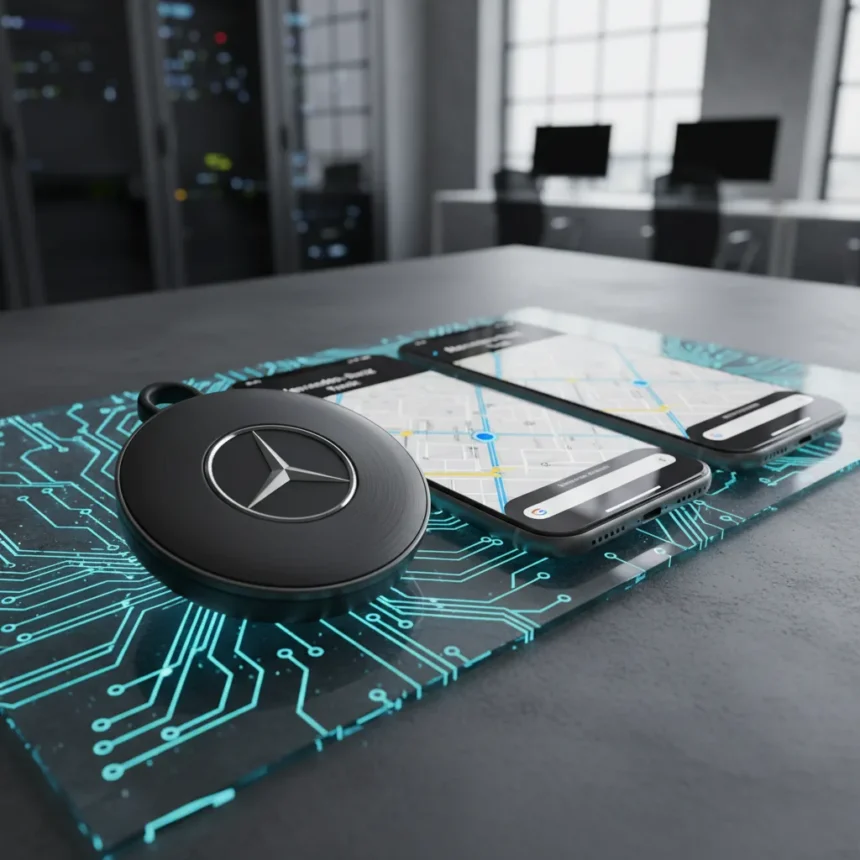
The Mercedes-branded Chipolo tracker represents a fundamental shift in how mixed-device households can approach item tracking. Unlike Apple AirTags, which lock users into Apple’s ecosystem, this cross-platform Bluetooth tracker works smoothly with both iPhone and Android devices through dual network support. For anyone juggling multiple device brands, this is the flexibility AirTag users have been waiting for.
Key Takeaways
- Mercedes-branded Chipolo tracker works with both Apple Find My and Google Find My Device networks
- Launched April 14, 2025, Chipolo Pop trackers use replaceable CR2032 batteries lasting up to one year
- IP55 dust and water resistance rating with built-in speaker and keyring hole for attachment
- Missing UWB support means no Precision Finding directional guidance like premium AirTag models
- Cross-platform compatibility solves AirTag’s core weakness for Android-iPhone households
Why Cross-Platform Bluetooth Tracker Design Matters Now
The core problem AirTags created is simple: they only work reliably within Apple’s ecosystem. Android users in mixed households either buy a separate tracker or settle for basic location pings without the premium features iPhone owners enjoy. The Mercedes-branded Chipolo tracker eliminates that split by functioning across both Apple’s Find My network and Google’s Find My Device network. This means a single device works whether you’re tracking keys from an iPhone or an Android phone, a genuine advantage that appeals to the growing number of households with multiple device brands.
Chipolo’s broader tracker lineup, including the Pop family that launched in April 2025, has been positioned specifically to bridge this gap. The Pop includes a built-in speaker for ringing the tracker and a replaceable CR2032 battery rated to last up to one year. With IP55 dust and water resistance, the tracker handles everyday wear without fragility concerns. These practical features address real user frustrations that pure ecosystem loyalty cannot solve.
The UWB Limitation That Still Matters
Here’s where the Mercedes-branded Chipolo tracker stumbles: it lacks ultra-wideband (UWB) support, which means it cannot deliver Precision Finding, the directional guidance feature that makes finding a lost AirTag feel almost magical on newer iPhones. When you activate Precision Finding on an iPhone 11 Pro or later, you get visual and haptic feedback pointing you toward the exact location. The Chipolo tracker cannot match this experience. For users who prize premium locating capabilities, this omission represents a meaningful trade-off against cross-platform flexibility.


The absence of UWB is not unique to the Mercedes version—it reflects Chipolo’s entire current product strategy. While the company has positioned its trackers as compatible with both Apple and Google networks, the engineering complexity of adding UWB support across both ecosystems apparently remains challenging. This leaves Chipolo trackers stronger on availability and weaker on precision, a calculation that works for mixed-device households but not for those prioritizing top-tier locating performance.
How the Mercedes Branding Changes the Tracker Market
Mercedes-Benz licensing Chipolo’s technology signals that automakers see item tracking as part of their broader connected ecosystem strategy. The Mercedes badge likely appeals to owners who value brand consistency and may already use Mercedes’ own connected services. However, the underlying technology remains Chipolo’s proven cross-platform approach—the branding is the premium positioning, not a fundamental feature upgrade.


Compared to AirTag’s ecosystem dominance, the Chipolo alternative represents a deliberate choice: sacrifice precision-finding convenience for multi-brand flexibility. For Android users tired of being locked out of Apple’s tracking ecosystem, or for households where family members use different phones, this trade-off makes sense. For users with exclusively Apple devices who want the best locating experience, AirTag’s UWB advantage remains compelling.
Is the Mercedes-Branded Chipolo Tracker Worth Your Money?
The Mercedes-branded Chipolo tracker solves a real problem that Apple has never addressed: cross-platform compatibility. If you own both an iPhone and an Android device, or if your household mixes Apple and Google users, this tracker gives you a single solution that actually works across both networks. The practical features—replaceable battery, water resistance, speaker, and keyring attachment—are solid. The missing UWB support is a legitimate drawback, but only if you prioritize directional precision finding over multi-device flexibility.
What makes the Chipolo Pop different from AirTag?
The Chipolo Pop works with both Apple Find My and Google Find My Device networks, while AirTag only works with Apple devices. However, AirTag includes Precision Finding with UWB support on newer iPhones, which Chipolo cannot match. The Pop uses a replaceable battery lasting up to one year, whereas AirTag has a non-replaceable battery.
Can you use a Chipolo tracker with Android phones?
Yes, Chipolo trackers work with Google Find My Device, which is crowdsourced from Android devices worldwide. This makes them the only viable option for Android users who want reliable item tracking comparable to what iPhone users get with AirTag.
How long does the Chipolo Pop battery last?
The Chipolo Pop uses a replaceable CR2032 battery rated to last up to one year on a single charge. Since the battery is replaceable rather than proprietary, you can swap in a fresh one without replacing the entire tracker.
The Mercedes-branded Chipolo tracker represents the most practical solution yet for households that refuse to choose between Apple and Android. It trades away the premium locating precision that AirTag owners enjoy for something arguably more valuable: the freedom to track items regardless of which phone brand you carry. For mixed-device households, that flexibility is worth the compromise.
Edited by the All Things Geek team.
Source: Android Central