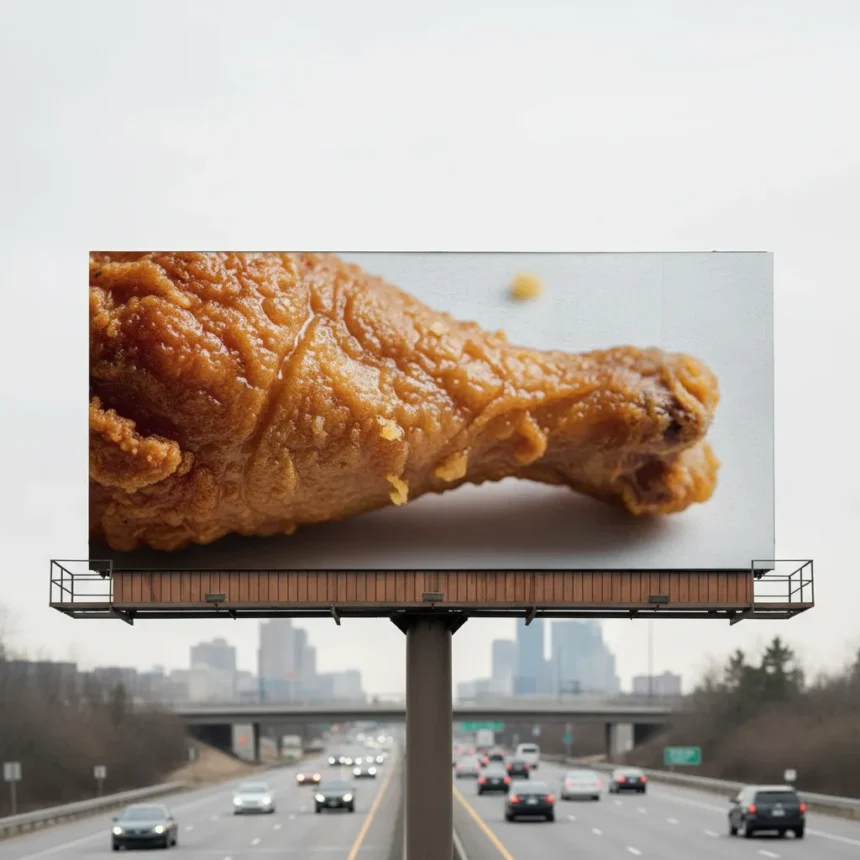
KFC’s billboard campaign represents a bold bet that making viewers uncomfortable is the fastest route to attention. The macro-style campaign, created by agency Uncommon, deliberately uses extreme close-up imagery designed to provoke visceral revulsion rather than appetite. But shock value alone is a fragile foundation for brand strategy—one that often collapses the moment the initial jolt wears off.
Key Takeaways
- KFC’s new macro billboard campaign relies on extreme close-up imagery to shock viewers into engagement.
- The campaign was created by Uncommon, a creative agency known for provocative work.
- Shock-based advertising creates short-term attention but risks alienating core audiences.
- The strategy prioritizes viral conversation over traditional brand affinity and loyalty.
- Intentionally disgusting creative can backfire when the shock value fades.
Why KFC Chose Shock Over Appetite Appeal
Traditional fast-food advertising operates on a simple formula: make food look delicious, trigger cravings, drive visits. KFC’s macro campaign inverts this entirely. By zooming so close that fried chicken becomes an abstract, viscerally unpleasant image, the brand abandons the visual language that typically sells food. This is deliberate. In a media environment where standard advertising blends into background noise, discomfort becomes a tool for breaking through. The strategy assumes that people will remember what disgusted them more readily than what merely appealed to them.
Yet this approach carries a fundamental risk: the people most likely to engage with disgusting content are not necessarily the people most likely to buy the product. Uncommon’s campaign prioritizes cultural conversation and shock value over the straightforward goal of making someone crave chicken. Whether that trade-off serves KFC’s business objectives—rather than simply its PR objectives—remains unclear.
Shock Tactics in Branding: A Short Shelf Life
Provocation has a history in advertising. Brands from Calvin Klein to Benetton have used discomfort to generate conversation and break through clutter. But shock value has an expiration date. The first time a viewer encounters extreme imagery, it registers as novel and memorable. The second time, less so. By the third or fourth exposure, the imagery becomes normalized, and the emotional impact collapses entirely. What remains is simply an ad that looks unpleasant—without the novelty that justified the approach in the first place.

KFC’s macro campaign faces this timeline compression. Social media accelerates both the spread and the fatigue of provocative content. A billboard that might have maintained shock value over weeks or months in a pre-digital era now risks becoming a meme, a reference point for jokes, or simply background noise within days. Once the shock fades, the campaign has no secondary appeal to fall back on—no emotional resonance, no brand affinity, no reason for someone to choose KFC over a competitor.
The Difference Between Attention and Loyalty
There is a crucial distinction between getting noticed and building brand preference. Shock content generates the former reliably. It triggers shares, comments, and conversation. But attention is not the same as desire. A viewer who finds an image disgusting may remember the image vividly while simultaneously developing negative associations with the brand itself. This is the hidden cost of visceral advertising: you may win the attention battle while losing the customer relationship.



Competitors who maintain more conventional, appetite-driven messaging may seem boring by comparison, but they are also building affinity with their audience rather than provoking revulsion. Over time, consistency and positive reinforcement typically outperform shock value in driving repeat purchases and customer loyalty. KFC’s campaign gambles that short-term cultural impact justifies the risk of alienating viewers who simply find the imagery off-putting rather than clever.
What the Campaign Says About Modern Advertising
KFC’s choice to partner with Uncommon on a macro-style billboard campaign reflects a broader shift in how brands think about attention. Traditional metrics—reach, frequency, brand recall—have become commoditized. The real scarcity is not exposure but genuine engagement in a world of infinite content. Shock, disgust, and provocation are reliable ways to earn that engagement because they trigger a visceral response that passive, pleasant advertising cannot match.
But this strategy also reveals a kind of desperation. It suggests that conventional brand appeal—making food look good, building emotional connections, creating positive associations—is no longer sufficient. Instead, brands must resort to discomfort to cut through. Whether this reflects a genuine shift in consumer psychology or simply a trend among agencies seeking award-winning work remains an open question. What is certain is that the approach is becoming more common, which means shock value itself is losing its power to shock.
Will the campaign drive sales or just controversy?
KFC’s macro billboard campaign will likely generate significant social media conversation and cultural commentary. Whether that translates to increased foot traffic or sales is a different question entirely. Shock-based campaigns excel at generating awareness and discussion but often fail to convert attention into purchase intent. The real measure of success will come weeks after the initial launch, when the novelty has worn off and KFC can assess whether the campaign moved the needle on actual business metrics rather than just viral metrics.



How does this compare to other provocative food advertising?
Food brands have experimented with provocative imagery before, but most eventually retreat to more conventional appeals because shock value does not sustain customer preference. KFC’s approach is more extreme than most competitors’ strategies, which typically balance edginess with some element of appetite appeal. The macro campaign abandons that balance entirely, betting everything on provocation. This makes it a riskier bet than advertising that maintains some connection to the product’s desirability.
Is disgusting advertising effective in the long term?
Research on shock advertising shows that while it captures attention initially, it often fails to build lasting brand preference or loyalty. Viewers may remember the advertisement vividly without developing positive feelings toward the brand. For fast food in particular, where impulse and appetite drive purchasing decisions, associating the product with disgust is counterintuitive. KFC’s campaign is a short-term attention play, not a long-term brand-building strategy.
KFC’s macro billboard campaign by Uncommon succeeds at one thing: making viewers uncomfortable enough to talk about it. Whether discomfort translates to sales depends on whether the shock value can sustain interest long enough to drive actual purchasing behavior. In a media landscape oversaturated with provocative content, shock value alone is rarely enough. The campaign will fade, the conversation will move on, and KFC will need to rely on the actual quality of its product to retain customers—the one thing the macro campaign deliberately avoids emphasizing.
Edited by the All Things Geek team.
Source: Creativebloq